I have been waiting all day for something big - good or bad - to happen. It's my dad's birthday, which is fairly big in and of itself, but this date has been a red-letter day for other reasons the last couple of years. Without going into any personal detail, July 22nd, 2006 was one of the more miserable in recent memory. On the other hand, on July 22nd, 2007 I and some of my classmates from the Analytical Paleobiology course took a whale-watching cruise out of Santa Barbara and saw several blue whales. Marine mammal viewing might not register as an epochal event for most people, but seeing the largest animal on Earth had long been on my list of things to do during my life; it was, however, one of those things (like receiving a knighthood) that I assumed would never actually happen. So, with the last two years still fresh in my memory, I have been waiting with a mixture of anticipation and trepidation for something to happen today. However, it's now 11:00 and the odds of anything taking place in the next hour are pretty small, so I guess that two year run was a flash in the pan. As relieved as I am that nothing bad happened, I'll admit that in a strange way I'm a bit disappointed; guess I'll just have to wait 'til next year.
22 July 2008


01 July 2008
Selection's Sesquisentennial
 "Evolution is only a theory" is a popular phrase with the "intelligent design" and creationism crowd. Far brighter and more articulate minds than mine have taken up pen and ink (or keyboard) to expose the glaring ignorance, both semantic and scientific, that underlie this motto. Evolution is, of course, a theory, but a theory is more than just an educated guess, as the Discovery Institute and their cronies would like us to believe, but a scientific fact, and it has been so since this date 150 years ago, when Charles Darwin and Alfred Russel Wallace jointly presented their theory of natural selection to the Linnaean Society of London. People often credit Darwin and Wallace with coming up with the concept of evolution out of the blue, but this is not the case; what they did accomplish was to take a somewhat amorphous idea and bring it solidly into the realm of science. In fact, prior to 1858, the creationists might have had a point: evolution was not a theory, but an as-yet unproven hypothesis. It has been suggested by some that the earliest glimmerings of the idea occurred to Linnaeus himself who, after a life of categorizing organisms, may have realized that some natural force was responsible for the nested patterns he observed. This is all conjecture, but, whatever its beginnings, the concept had, well, evolved into nearly its present form by the early 19th Century. The most famous proto-evolutionist was Jean-Baptiste Lamarck, who looked a the same patterns and correctly identified them as evidence of biological change over time. Lamarck's only major failing, and the reason he is often scoffed at by scholars today, is that he was unable to establish the mechanism underlying evolution. Darwin and Wallace, then, were not starting from scratch, but this in no way diminishes their accomplishment. It is one thing to come up with a hypothesis, quite another to move that hypothesis into the realm of theory (which is to say, again, fact). To do so requires a mechanism (in this case natural selection) and mountains of supporting evidence. Darwin, of course, collected much of his evidence on his voyage around the world in the Beagle, and then spent the next several years studying organisms closer to home, most notably pigeons and barnacles. Wallace spent many years in the jungles of Malaysia and the Amazon, often low on both money and luck (his entire Amazonian collection was lost at sea on the return to England). Both men independently came to realize that variation and differential survival were the driving force behind the diversity of life on Earth. Darwin was the first to recognize this fact, but held off on publishing it because he realized the ramifications it would have. When he realized that his younger colleague had come to the same conclusions, he was finally spurred into publishing, and on July 1, 1858, the two men presented natural selection to the world by way of the Linnaean Society (some have suggested that this apparent act of camaraderie masks the fact that Darwin's behavior upon learning he was about to be scooped was less than honorable; the historical record is murky upon this point).
The social shock waves were soon to hit, just as Darwin predicted. It is a testament to the soundness of natural selection, though, that its main detractors were social entities (the most vociferous of these being the Church of England) rather than scientists. The evidence compiled over the years by Darwin and Wallace was so substantial and well-presented that the scientific community flocked to it remarkably rapidly (a few well-known and outspoken opponents such as Richard Owen notwithstanding). Any scientific critique of the theory was ultimately shown to be flawed, and several well-timed fossil discoveries (Archaeopteryx and Java Man chief among them) helped cement natural selection as fact beyond any reasonable doubt. Social criticism continued, and is still very much in force today, but even the most vehement creationists must admit that the theory of Darwin and Wallace is a milestone in world history. July 1st has the misfortune of falling within a week of the anniversary of another epochal date and for that reason (among others) it is often overlooked. However, as this year marks the sesquicentennial of what may be thought of as science's watershed moment, I encourage everyone out there to take just a moment to give a tip of the hat (literally or figuratively) to Charles Darwin, Alfred Russell Wallace, and their theory of natural selection - still standing tall and proud after 150 years!
14 June 2008
The Wide World of Paleontology: Spring 2008
At the end of last quarter, I summed up the high points of our department's paleo discussion group. While the group didn't meet this spring, I thought that it might be fun to sum up the major developments in paleontology during the last few months for the sake of whoever out there still reads this blog. Enjoy!
 The term "missing link" is generally frowned upon, and with good reason, but it can't be denied that discoveries of transitional fossils are always exciting. It may not have the glamor of Lucy or Archaeopteryx, but paleontologists from the University of Calgary described an animal very near the common ancestor of salamanders and frogs this May. Dubbed Gerobatrachus, it lived in the Permian and looked very much like what a salamander/frog would be expected to.
- South America and Australia are both island continents (or at least South America was until Panama appeared on the scene in the Pliocene), and as such have been of interest to paleontologists as long as there has been a science of paleontology. This spring, two papers showed that the continents have more in common than many people may realize. A Cretaceous dinosaur from Victoria and an Eocene mammal from Queensland both show affinities with South American animals; this is no shock, as the two continents were connected until relatively recently, but the results are nonetheless biogeographically interesting. Other extinct Australian organisms to make the news this spring were the giant marsupial Diprotodon, which may be represented by only one species rather than several as had previously been thought, the placoderm fish Gogonasus, a specimen of which was found with an unhatched embryo preserved within it, and the so-called Tasmanian tiger, from which genes were isolated and inserted into a mouse embryo.
 Northwest fossils also found their ways into the headlines in the last few months. Dinosaur bones found in British Columbia several years ago have been revisited by a University of Alberta student, and they may represent a new species. The paleoecology of BC's most famous fossil site has also been revisited, and the result is a food web for the Cambrian Burgess Shale fauna. While not entirely paleontological, coprolites from eastern Oregon have yielded the oldest human DNA from the New World and show - not surprisingly - that the earliest Americans were genetically similar to Siberians.
- The seemingly inexhaustible quarries of Liaoning, China just keep on producing exquisitely-preserved fossil birds and feathered dinosaurs. The early bird Eoconfuciusornis was described by researchers at the University of Bristol, including my former master's supervisor. A former Bristolian made further paleornithological waves by describing a fossil parrot from the Eocene of Denmark, which he nicknamed "Danish Blue" after Monty Python's famous 'Dead Parrot Sketch.'
 My favorite paper this spring was the one that suggested the giant pterosaur Quetzalcoatlus and its relatives did not, in fact, spend much time in the air, but were likely terrestrial predators. This is an interesting hypothesis, as the diet of giant pterosaurs has long been a matter of some debate. It is not unheard of for flying animals to become predominately land-living hunters; the most spectacular example are the flightless, extinct phorusrhacids, but modern storks, secretary birds, and seriemas live similar lifestyles, making the image of Quetzalcoatlus as a predator is at least plausible.
12 June 2008
I'm back and you're all brilliant!

Incidentally, if any of you are reading this post, it means you are not only very bright (apparently), but very patient as well. I have been terrible about posting lately, and in the off-chance that any of you look to The Oregon Trail for part of your day's entertainment or edification, I will try to be much better about updating things. Welcome back to my weird little world!
10 May 2008
Rhododendrons
The Northwest certainly isn't the only part of the world in which rhododendrons grow (the middle stretch of the Appalachians, I understand, has some particularly nice groves), but they do seem to disproportionately common in gardens here. Presumably this is because our climate mirrors that of the Himalayan foothills where the greatest diversity of wild species occurs; whatever the reason, rhododendron blooms are perhaps the most spectacular symbol of spring in this part of the world (a fact that Washington has recognized by declaring a native species, Rhododendron macrophyllum, the state flower). On the premise that there are few better subjects out there on which to test my "new" camera's macro function, I spent an hour or so today in the gardens at Eugene's Hendricks Park photographing rhododendrons. The result is the slideshow below (which also includes shots from my trip to Seattle a couple of weeks ago); I'm no Ansel Adams, but if you've had a hard time believing that spring has actually arrived, I hope these photos do their part to get you in the spirit.
07 May 2008
Happy Music Day!
Today marks the 184th anniversary of music's acme. On May 7th, 1824, Beethoven's Ninth Symphony was premiered in Vienna. The Ninth and it's signature Ode to Joy (based on a work by poet Friedrich Schiller) has routinely been recognized as the greatest piece of music ever written, and I'm not about to second guess received wisdom in this case (especially when you consider that Beethoven was stone deaf when he wrote it). The same concert also saw the premier of Die Weihe des Hauses and Missa Solemnis, both brilliant works in their own right. If that weren't enough, today is also the birthday of two musical giants, Johannes Brahms (whose eponymous lullaby you've heard many times even if you don't listen to classical music) and Peter Illych Tchakovsky (long a personal favorite of mine). So if you, like me, regard music as something near a religion, I hope you had a chance to enjoy what would undoubtedly be one of the faith's high holidays.
22 April 2008
Beer Here
I'm well aware that I'm prone to hyperbole, especially when writing about the Pacific Northwest, but it looks like there is at least one category in which an unbiased third party also believes we belong among the elite. The results of the World Beer Cup were announced recently, and the region did disproportionately well. The Oregonian has a nice blog entry on Oregon beers, but several entries from Northern California, Idaho, B.C., Alaska, and Washington placed very high as well. I very much doubt we will ever surpass England, Germany, or Belgium in terms of beer quality, but it's nice to know that we at least belong in the same league.
31 March 2008
The Voice of Summer
The Northwest has seen some bizarrely unseasonal weather over the course of the last couple of weeks, but the gray pall of winter gets thrown off today. It is, of course, Opening Day for my beloved Seattle Mariners, signaling the onset of Spring for all of us fans. This opener is sweeter than most, not only because the M's expectations are higher than they've been for years, not only because of the optimism and anticipation of warmer weather that are always engendered by the return of baseball, but because the heart and soul of the franchise will, at long last, be going into the season as a hall of famer. For many of us growing up in the Northwest the voice of Dave Niehaus has been as integral a part of summer as blue skies, idyllic temperatures, and hours upon hours of daylight. He has been a finalist for the Ford C. Frick Award (the broadcaster's equivalent of a Hall of Fame induction) for several years now, and this winter he was finally recognized as belonging among the game's great orators (he'll be inducted alongside Goose Gossage, meaning that for the first time two Mariners will be recognized in one year...sort of). I have listened to enough broadcasters to be able to state with conviction that Dave truly deserves this honor. For my entire life - indeed, for the entire life of the Mariners franchise - he has been synonymous with Northwest baseball and, for that matter, with summer. His approach to calling a game is a very narrative one, approaching each game as an unfolding story. Because of this, people sometimes complain that his style is rambling and unfocused, but to those of us that grew up listening to him, his voice is as familiar and his stories are as welcome as those of a grandfather. There is no Mariners fan out there that ever gets tired of listening to his calls from the 1995 postseason, in particular "The Double," a seminal moment in Northwest sports history. Here's hoping Dave gets a chance for an encore performance this Fall.
18 March 2008
Obama on Race
I have waxed poetic about Barack Obama several times on this blog, but I think in this case it's best just to let him speak for himself. All I'll say is that this is probably the best speech any US politician has given in my lifetime. They'll be talking about this one for a long, long time.
The Wide World of Paleontology: Winter 2008
This quarter saw the return of our department's paleontology discussion group, and over the course of the last few months we've gone over several papers of note. Here are some of the paleontological highlights from the first quarter of 2008:
- Two of my former MSc supervisors, Sarda Sahney and Mike Benton, published a paper on faunal recovery after the Permian-Triassic extinction. Their research yielded two particularly interesting results. First, extinction at the P-T boundary was the last of three extinctions that occurred during the late Permian. Second, ecological recovery took much longer than had previously been thought. Though some organisms - in particular the pig-like reptile Lystrosaurus - survived the extinction and thrived afterwards, ecosystem complexity remained low until 30 million years into the Triassic. You can read Sarda's much more detailed explanation of the paper's findings on her blog.
 My current advisor, Samantha Hopkins, has also published a paper this year. It deals with the issue of rodent body size estimation. In particular, it emphasizes that previous estimates likely overestimate the size of the giant South American rodent Phoberomys, which had been described as "buffalo-sized." Just before this paper came to press, an even larger South American rodent was reported: the cumbersomely-named Josephoartigasia, which was estimated by the authors to weigh 10,000 kg (11 English tons). Unfortunately for fans of giant rodents, this reckoning is likely also too high, though it still would have been a massive animal, far larger than any rodent alive today (as is made abundantly clear in the picture at right at which the skull of Josephoartigasia is compared to a living rat).
- On the paleoclimate front, Wolfram Kürschner and his colleagues published a study of Miocene plant stomata, orifices in leaves that allow carbon dioxide to enter the cells. The density of these openings varies with atmospheric CO2 content, and as such they provide a proxy for climatic conditions. This line of evidence is significant because marine and terrestrial isotopic studies show different climate signals. Stomatal data confirm the pattern observed in the terrestrial isotopic record, showing a period of global warming (the mid-Miocene climatic optimum) between 17 and 15 million years ago, followed by a prolonged period of global cooling.
- Perhaps my favorite paper of the quarter was a description of the Eocene fossil bat Onychonycterus. Before the discovery of this specimen, all fossil bats looked for all intents and purposes like modern forms. This was frustrating, as these fossils told us nothing about the early evolution of bats. Onychonycterus effectively settles one major debate that had been raging in the paleochiropteral community; its ear showed none of the features associated with echolocation in modern species, demonstrating that bats took to the air before evolving "sonar." Even more interesting are the implications for the evolution of bat flight. Onychonycterus has wings similar to those seen in modern bats that fly by intermittent fluttering and gliding. What's more, it had relatively long legs and large claws on its wings, both of which would have made it an adept climber. Taken together, these lines of evidence suggest that the first flying bats were climbing trees and gliding rather than evolving wings from the "ground up" to help them catch insect prey. Another glimpse of early bat evolution was provided by fossil from the Fayum of Egypt, where - among others - a giant species was recently described.
 There were several other stories in paleontology that we didn't discuss in our group that deserve mention anyway. Fellow Bristol and Chicago alumnus Steve Brusatte has described two new carnivorous dinosaurs from Africa. Dinosaurs weren't the only big things around in the Mesozoic, though, a point underscored by the discovery of a giant, dinosaur-eating frog (shown at right). Our Primate ancestors seem to have been part of the dinosaurs' world for longer than expected as well, and our own species seems to have evolved into more diverse niches than we had previously realized. One thing our species is not, according to a U of O anthropologist, is a duck-killer. The debate over how old ducks and their relatives really are rages on, but at least one contentious issue seems to have been solved: if a modern lion and an extinct marsupial "lion" got in a fight, who would win?
17 March 2008
04 March 2008
Seattle
 The big news in the Seattle area yesterday was the arson of a group of suburban houses, apparently by the Earth Liberation Front. This is not the first time ELF has gone and done something stupid (their torching of the Urban Horticulture Center a few years back still baffles and angers me), but this time it really stings. For all their zealotry, ELF was apparently protesting the unchecked sprawl that has gobbled up most of the rural landscape of the Puget Sound lowlands, which is a matter of genuine concern. By resorting to criminality and terrorism, though, they have done more harm than good, marginalizing those of us who think that sprawl is just one symptom of a much bigger problem that needs to be addressed. This is a topic I've been mulling over quite a lot since I was up in Seattle over Christmas, and this seemed a good opportunity to put it into writing, awkward as the segue may be.
I should preface everything by saying that, though I currently live in Oregon, I was born and raised in Seattle, and there is a lot I really love about the city. First off, it has one of the most fortunate geographic settings in the world, on an isthmus between Puget Sound and Lake Washington, with sunrises over the Cascades' most spectacular peaks and sunsets that silhouette the Olympics. It also has a much richer cultural heritage than it gives itself credit for, especially in regards to music (which goes back a lot further than the grunge bands of the '90s). It has an enormous Vietnamese population, salmon runs through the Ballard Locks, a beautiful baseball stadium, a series of Olmsted parks that rival New York's for scenery, and is - for some inexplicable reason - the best place in the country to get a hamburger. It's a city built on boats, both those of Scandinavian fishermen and of the so-called "Mosquito Fleet" that kept the city in business after its upstart neighbor Tacoma was named the rail terminus for the region. Seattle succeeded against all odds, cementing its role on the national stage during the Klondike gold rush and on the world stage during the dot-com revolution. It has, however, become a victim of its own success after a quarter-century of unchecked growth. The most obvious - and ugliest - change has been in the suburbs. Farms have been plowed under, forests have been leveled, and once-rural towns have become soulless bedroom communities for the big city. This is the trend that was apparently being "protested" by ELF in the most ineffectual and destructive way possible, but things have been changing for the worse in Seattle itself as well.
An article that I read in the Seattle P-I over Christmas is what really got me thinking about all this in the first place. The story was about a jury from the American Institute of Architects giving the city a failing grade on its new architecture. The main argument of the author was that Seattle's greatest failing was its lack of vision. A sudden influx of money led to myriad new construction projects that were not necessarily ugly or useless, but that lacked any distinctly local style, leading to what the author referred to as "a watery Dallas." Ouch. This may sound trivial, but a lack of foresight or desire to retain the city's original character has cropped up many times over the past few decades. Voters have several times rejected measures to fund transportation that the city now desperately needs (the new South Lake Union Streetcar is a nice idea, but
the route is almost comically short and no more effective than a bus line), as well as an initiative to create what would have been one of the world's great urban parks in a former warehouse district. Several urban neighborhoods are thriving, which is nice, but almost everything that made those neighborhoods interesting to begin with has disappeared. I am thinking in particular of Ballard, which almost overnight went from a Scandinavian community to a hipster enclave; it's still a perfectly nice place, but with barely a hint of Nordic heritage.
All this may seem ludicrously petty to someone who didn't grow up in Seattle. The region's economy was in the tank during the '70s, only to be rescued by Microsoft and the high-tech industry of the '90s and it may seem as though I have a lot of gall to complain about the city's near-miraculous turnaround just because it made things change from the way they used to be. That, however, is not the point I'm trying to make. Cities should try to grow their economies, of course, and development in and of itself is not a bad thing, nor is the change that is necessarily attendant on that development. However, I know the reason I loved growing up in Seattle was that it was not just a nice place to live, but it was genuinely unique. I also know I'm not alone in this, and that one of the major reasons the city's economy exploded in the '90s was that people wanted to work somewhere that was not a carbon copy of so many other urban centers across the country. The irony, of course, is that so many people wanted to live somewhere different that they wound up building over many of the things that made Seattle stand apart. For years, Seattleites have put the blame on new arrivals to the city, in particular those from California. Scapegoating is easy, but I think it's time we recognized the problem lies squarely on our shoulders. The people and the government of Seattle had plenty of chances to allow development within a framework that preserved the city's heritage, but we failed to do so. We need only look to Portland, which has managed to balance economic success and local identity spectacularly well, to see how effective such a framework can be. It is my fervent hope that someday Seattle will follow the lead of its southern neighbor and finally make itself a city worthy of its setting and of its own history. The miles of suburbs aren't going anywhere, and places like Ballard and Fremont will likely never return to the way they were, but there's still a lot of Seattle worth saving.
01 March 2008
Polls
The trial run of my blog poll is over, and the people have spoken (all sixteen of you; is that really the extent of my audience?). Apparently there's no consensus on which southern continent would be most fun to visit, with four votes each for Australia, Antarctica, and South America. Poor Africa didn't get a single vote, though for my part it's an easy second choice. I've decided to try again, this time with only two options. The question is simple: what is the greatest comic strip of all time? What this really comes down to, of course (and with apologies to fans of Peanuts), is a debate between the often arcane nerd-humor of The Far Side and its cartoonist, Northwest native Gary Larson, and the often cynical philosophy-humor of Bill Watterson's Calvin & Hobbes. Frankly, this is an argument in which I'm not sure I can take sides: both were an integral part of my childhood, and I still find myself laughing just as hard as ever when I read them today. I'm curious to know what the rest of the world (or at least the infinitesimal portion of it that reads this blog regularly) thinks. So please, chime in on this hugely important issue. I can't think of any other big voting-related events going on right now that might distract you...
18 February 2008
It's Easy Being Green...
...if you live in the Pacific Northwest. This news is a few days old now, but I couldn't help but brag about the region's strong showing in Popular Science's list of greenest cities. Congratulations are due to Portland in particular, which edged out San Francisco for the #1 spot (further proof that Portland is the best city in the world). Eugene shows up at #5, and is rated as having the most environmentally-friendly electricity in the country. The third top-ten finisher from the Northwest is Seattle in the #8 spot. Surprisingly, Seattle's strength was its transportation, which has to be one of the most woefully underfunded and underdeveloped systems in the nation (though it must be admitted that Metro does a very good job with what little they're given). Northwesterners - especially Portlanders, Eugenians, and Seattleites - should give themselves a pat on the back for showing that, despite all the changes we've seen in the past several years, we still deserve our reputation as leaders of the pack on environmental issues.
15 February 2008
Heinrich Harder & the Art of the Prehistoric Landscape
 While I was in Germany a couple of years ago I took the train from Berlin to Hamburg. I had a few hours to kill in the morning, and since the Berlin station is directly across the street from the world's largest zoo, I decided I'd pay it a visit. Without a doubt, my favorite part of the zoo was its aquarium/reptile house, not just because of the animals within it, but because of the building itself. It was built in 1913 and is covered in a series of colorful murals of prehistoric animals. I remember thinking at the time that the reconstructions were nicely done, if more than a little dated, and wondering who had painted them. Fast forward to earlier this week; I was looking for paintings of fossil horses that I could use in a presentation, and serendipitously stumbled across those same murals on the Internet. It turns out that the artist's name is Heinrich Harder (who, if nothing else, gets points for being alliterative) and he was quite a prolific painter of prehistoric life. "Paleoartitsry" is a term that has been coined to describe visual depictions of past life, and it is a field as old as paleontology itself. Working in the opening years of the 20th Century, Harder would have been one of the earliest paleoartists; he would, in fact, have been a contemporary of Charles R. Knight, widely recognized as the old master of scientific illustration. Where Knight was known for his detailed knowledge of anatomy and his ability to paint animals in active, lifelike poses, Harder's strength appears to lie in placing his subjects in interesting landscapes. According to what little biographical information I was able to track down, Harder was particularly inspired by the countryside of northern Germany and Scandinavia, as is apparent in his painting of a cave lion, though more exotic landscapes were well within his abilities as well; I particularly like his Hyaenodon in an Everglades-like swamp. I am sure this all seems very arcane and possibly uninteresting to most of my audience (such as it is), but I confess I have always had a soft spot for prehistoric landscapes. It was, in fact, the gloomy, expansive landscapes of Czech paleoartist Zdenek Burian that really cemented my interest in paleontology as a child; I always felt a mixture of excitement, wonder, and a tinge of melancholy when looking over his re-creations of an Ice Age taiga or a wind-blown Carboniferous swamp, and I knew then - as I still do now - that nothing could be as fascinating as reconstructing the world as it once was. Harder's images have a similar effect on me, and I thought I'd do my small part to share his work with the world by way of gratitude for reminding me that, even now, when you can barely turn on the TV without coming across some new series featuring computer-animated dinosaurs, a much simpler work inspired by genuine imagination can be more evocative by far.


13 February 2008
Bluelisting
For some time, I have harbored the delusion that if this whole paleontology thing doesn't work out, I could make it as a travel writer. In many ways it seems as though it would be an ideal life: wandering around the world and telling people about what you saw. Of course, there's much more to travel writing than just describing a trip, and if I ever actually tried my hand at it, I would certainly be a miserable failure. That said, I was thrilled to learn the other day that Lonely Planet has introduced a feature called Bluelists that lets the general public take a crack at travel writing. I couldn't help myself, and wrote a couple of lists about Oregon (describing the state's "seven wonders," both natural and cultural). There's nothing particularly remarkable about them, but the ratings I've gotten so far suggest that people seem to like them, which is gratifying. If you take the time to go read them, let me know what you think; while I enjoy rambling on about places I've visited, it'd be interesting to know how helpful or interesting that rambling is to other people.
12 February 2008
It's Darwin Day!
 Happy 199th, Charles R. Darwin! If you have a subscription to Nature (or work somewhere that does, in the case of you academics out there), check out this article by Kevin Padian summing up Darwin's achievements and looking forward to next year's bicentennial (and On the Origin of Species sesquicentennial) celebrations.
07 February 2008
Vote, then vote again!
No, I'm not advocating that anyone double-dip our electoral system; I just have two topics I want to address in today's post that both happen to be related to voting. First, I want to draw everyone's attention to The Oregon Trail's newest features: the snazzy photo of Heceta Head at the top of the page that replaces the lackluster witticisms I'd previously posted there, a whole bunch of new links to sites that I think are worthwhile, and most importantly the new poll. Blogger introduced a new feature that lets you post questions that your visitors can answer, and I thought that sounded like a good time. So, each month you'll get a brand new, off-the-cuff question from the random-most reaches of my brain. This month's question, as you can see, is about which southern continent you'd most like to visit. With only six votes in, it's quite a tight race, so please do chime in on this frivolous and entirely meaningless debate!
My second topic today is addressed to my audience in Washington (though the rest of you are welcome to read it as well, I suppose). What with Super Tuesday turning out to be entirely indecisive on the Democratic side (though the Republican race seems to be over; congratulations to John McCain, the first GOP candidate in years that I genuinely respect), the Great State of Washington is all of a sudden hugely important on the national scene. The state's caucuses are on Saturday, and I urge - even beg - everyone who's able to go to do so. I urge this regardless of which candidate you support, because as I've previously remarked, caucuses are democracy as democracy should be. That said, I am partisan, and at the risk of proselytizing, I encourage everyone out there to consider Barack Obama. I've already stated why I think he's the best choice out there, and I won't be repeat myself except to say that he's the only candidate we have that truly understands how our system of government is supposed to work and who has any shot at turning the tide away from political dogmatism and special interests. On a more practical level, McCain's apparent victory on the Republican side means that the GOP will be fielding a candidate with significant appeal to independents. Of the two Democratic candidates, only Obama has shown that he has strong support outside of the traditional Democratic base, and as such has a much better shot in the general election. For those of you that are going to the caucuses this weekend, regardless of who you support, it's always good to go in with more than empty rhetoric to back up your candidate; to that end - and, again, because I'm biased - here's a link to Obama's stances on major issues. Of course, if you're a supporter of Clinton, McCain, or any of the other candidates, they all have similar sites that you can look up. Just remember: this is a big deal. It's the first time in a while that Northwest voters will play a major role in determining the course of national politics, and we (by 'we,' of course, I mean 'you;' Oregon doesn't get to vote until May) should make sure we take the responsibility seriously by using the caucuses as a forum for informed debate and rational decision-making. That said, enjoy them as well; the 2004 caucuses were lots of fun because I got to argue politics with complete strangers. As I recall I even changed a few peoples' minds and that, of course, is one of the greatest feelings in the world...
My second topic today is addressed to my audience in Washington (though the rest of you are welcome to read it as well, I suppose). What with Super Tuesday turning out to be entirely indecisive on the Democratic side (though the Republican race seems to be over; congratulations to John McCain, the first GOP candidate in years that I genuinely respect), the Great State of Washington is all of a sudden hugely important on the national scene. The state's caucuses are on Saturday, and I urge - even beg - everyone who's able to go to do so. I urge this regardless of which candidate you support, because as I've previously remarked, caucuses are democracy as democracy should be. That said, I am partisan, and at the risk of proselytizing, I encourage everyone out there to consider Barack Obama. I've already stated why I think he's the best choice out there, and I won't be repeat myself except to say that he's the only candidate we have that truly understands how our system of government is supposed to work and who has any shot at turning the tide away from political dogmatism and special interests. On a more practical level, McCain's apparent victory on the Republican side means that the GOP will be fielding a candidate with significant appeal to independents. Of the two Democratic candidates, only Obama has shown that he has strong support outside of the traditional Democratic base, and as such has a much better shot in the general election. For those of you that are going to the caucuses this weekend, regardless of who you support, it's always good to go in with more than empty rhetoric to back up your candidate; to that end - and, again, because I'm biased - here's a link to Obama's stances on major issues. Of course, if you're a supporter of Clinton, McCain, or any of the other candidates, they all have similar sites that you can look up. Just remember: this is a big deal. It's the first time in a while that Northwest voters will play a major role in determining the course of national politics, and we (by 'we,' of course, I mean 'you;' Oregon doesn't get to vote until May) should make sure we take the responsibility seriously by using the caucuses as a forum for informed debate and rational decision-making. That said, enjoy them as well; the 2004 caucuses were lots of fun because I got to argue politics with complete strangers. As I recall I even changed a few peoples' minds and that, of course, is one of the greatest feelings in the world...
05 February 2008
Welcome to Orcuttopolis!
 A year or two ago, before the realities of life as a grad student set in, I was considering putting together an honest-to-goodness web page rather than just this blog. Because I'm creatively challenged, I discussed my idea with Michael, creator of The Planet Mike and one of the most creative people I know. He recommended an urban motif, suggesting the name Orcuttopolis. I loved the idea, particularly because the theme lent itself to clever ways of naming sub-pages (my "About Me" section could have been the Chamber of Commerce, and my photos could be displayed in the Art Institute of Orcuttopolis). I even went so far as to download several drawings of buildings from cities in which I've lived and put them together in a cityscape. The web page will likely never see the light of day, but I thought it was a shame to deprive the world of a glimpse of Orcuttopolis' skyline. I'm especially proud of the somewhat cryptic city motto on the road sign.
27 January 2008
16 January 2008
Wild, Wild West
One of the more entertaining things about working on paleontology of the American West is that you come across a lot of colorful names, in large part a legacy of work done in the region when it was still a frontier. Sometimes quarries or formations are named after something found there (Shark Tooth Hill), sometimes they bear an Indian (Minnechaduza) or Spanish (Caliente) name, sometimes they're ludicrous hyperboles (Mount Eden), and sometimes they're a simple description of the area (Dry Canyon). They are strangely - if unintentionally - poetic, reflecting either the hope (Drinkwater) or despair (Massacre Lake) of whichever settler first stumbled across it. I've come across several in the last few days while doing background research for my project; here are some of my favorites:
Etchegoin
Pinole
Lava Mountain
Black Hawk
Siesta
Nettle Springs
Coal Valley
Fish Lake
Comanche Point
Iron Canyon
Virgin Valley
Skull Springs
Sucker Creek
Hidden Treasure Spring
Boron
Hackberry
Woody
Pyramid Hill
Uptegrove
ZX Bar
Bear Tooth
Snake Creek
Sand Canyon
High Rock Lake
Railroad Canyon
Flint Creek
Deep River
Sheep Creek
Split Rock
Agate Springs
Rosebud
Mollie Gulch
Boulder Valley
Ash Hollow
Six Mile Creek
Horned Toad
Bedrock Springs
Chanac
Esmeralda
Vaqueros
08 January 2008
The goose is on the loose!
 Congratulations to Goose Gossage for his election to the baseball hall of fame, doubling the size of the Mariners contingent there. He may have only played for Seattle at the very end of his career, but I remember seeing him pitch in a few games in the Kingdome back in 1994 (I especially remember the ridiculous "goose is on the loose" animation they played on the scoreboard when he would come into games), and it's always a thrill to see a player from your hometown team receive the highest honor in baseball. Incidentally, I'm afraid I've disgraced my blog (not that it had much prestige to lose, granted) by allowing the Yankees' logo to appear on it, but that picture was the only one I could find that also showed Gossage in a Seattle uniform. Go Mariners!
03 January 2008
The Caucus Race
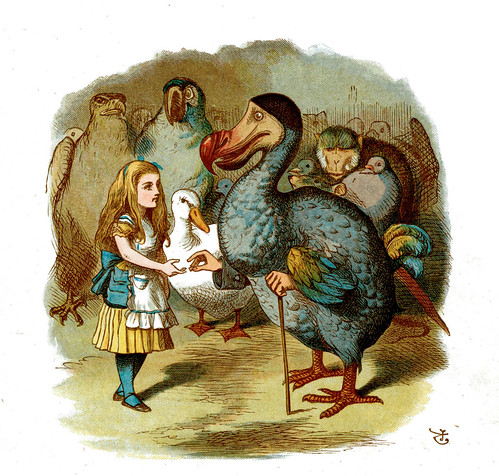 As no doubt everyone out there is aware, Barack Obama just won big in the Iowa caucuses (the right decision, I think, and a very exciting development, as pundits everywhere are observing). There's been quite the media frenzy in the weeks leading up to the vote, and as always no two news outlets ever seem to agree on things. One topic on which I have heard general consensus is the condemnation of the caucus system. There seems to be a widespread opinion that at worst a caucus is the chaotic, raucous spectacle parodied by Lewis Carroll in Alice in Wonderland, and that at best it is just plain boring. I think that attitude is a shame. In 2004, I participated in the Washington caucus (I was a Howard Dean delegate, I'm proud to say) and loved it. A caucus is politics the way politics should be: a community gathering together to discuss what's important to them and argue about which candidate best represents those interests (I should note that when I say 'community,' I mean it in the sense of a neighborhood, not as the trite platitude it seems to have become). It's true that some particularly vociferous people can drone on about their personal agenda longer than would be ideal (and yes, I realize the fundamental hypocrisy of a blogger criticizing people for long-winded oratories about their opinions) and that the whole process is a much more drawn-out affair than a simple primary. That said, politics is not meant to be some intangible entity of interest only to a few old white men in D.C.; it is a dynamic system that affects each of our lives daily, and it is meant to be discussed not just by congressmen, but by all of us. The beauty of a caucus is that it encourages people not just to pick a candidate blindly because they appear to share many of your values, but to form a coherent argument for why your choice makes more sense than your neighbor's. It's a sad fact that intelligent thought has become less and less prevalent in American politics, and that may account for why the public opinion of caucuses has been on a downturn. It's encouraging to see that turnout for and, by all accounts, excitement during the Iowa caucuses has been unexpectedly high among both republicans and democrats, and it would be nice to believe that rationality is making at least a modest comeback in government (though Mike Huckabee's victory on the republican side tempers my enthusiasm somewhat). Time will tell, but at the very least, the next few months are shaping up to be very interesting. Obama '08!
31 December 2007
2007
It's New Years Eve, and like many people, I enjoy looking back on the old year before ringing in the new. Because I like dealing in superlatives, here's my recap of 2007 in a "best of" format.
Personal
Best Accomplishment: Getting my MSc. Despite doing all the work for it in 2005 and 2006, I officially got my masters degree this February. Not only was it nice to see the fulfillment of my work in Bristol, but I got to return to England for the graduation, a trip that in and of itself was one of the year's highlights. Honorary mention: SVP poster, acceptance into Analytical Paleobiology course, winning Thomas Condon award.
 Best Trip: England. This one's a no-brainer. Not only was it nice to be reunited with the Bristol palaeontology cohort, but I spent an excellent few days in Wiltshire and Oxfordshire. Museums in Oxford, ruins in Avebury, scenery in the Cotswolds, and jaw-dropping architecture at Blenheim Palace; all told, it was one of the most worthwhile weeks of my life. Honorable mention: Southern Oregon, Austin.
Best Port of Call During my Nomadic Summer: Santa Barbara. I could never afford to live there full-time (half a summer there pretty effectively bankrupted me), but there are few cities on Earth more lovely and better-located than Santa Barbara. Good wine, too. Honorable mention: Bay Area, John Day Country.
 Best Wildlife Sighting: Blue whales in Santa Barbara Channel. It's hard to beat seeing the largest animal on Earth, and we had rare Risso's dolphins and a school of ocean sunfish thrown into the bargain. Honorable mention: California condor over the Big Sur, rattlesnakes and scorpions in eastern Oregon.
Biggest News Stories in...
 Oregon: Passage of Measure 49. Oregon voters proved that they still have at least some foresight by re-establishing land use controls that had been largely repealed by an earlier initiative. It sounds boring enough, but it helps preserve the state's incomparable scenery from wholesale development. Honorable mention: Winter storm.
Science: Public perception of science. The good news: the Bush administration finally (and apparently unwillingly) recognized that anthropogenic climate change is real and public opinion on the matter seems to have shifted in favor of action. The bad news: public understanding of science in the US remains abysmal, exemplified by the success of Kentucky's new (and very well funded) Creation Museum. Honorable mention: reprogramming of cells to behave as stem cells.
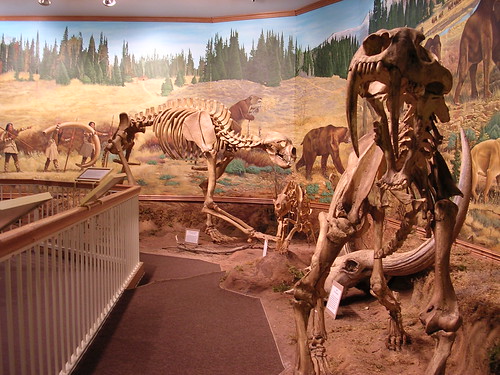 Paleontology: Ice age meteorite. I may be biased because a researcher from the U of O was in on this study, but the notion of an extraterrestrial impact triggering the most recent ice age is an interesting one, and the evidence at hand seems to support it fairly well. Honorable mention: sequencing of DNA from Tyrannosaurus and a mastodon.
Sports: Fiesta Bowl. It happened all of one day into 2007, but people are still calling it the best football game ever played. I always enjoy a good David-over-Goliath type victory, and the game was made all the sweeter by the underdog (Boise State) being relatively local and the favorite (Oklahoma) being one of the most universally despised teams in college sports. Honorable mention: the Colorado Rockies' improbable World Series run.
In Memoriam
No recap of 2007 would be complete without acknowledging the loss of two of the greatest teachers I have ever had: Paul Raymond and Floyd Standifer. Paul was an advocate of social responsibility and civil disobedience who practiced what he preached, and he is the reason that I and several of my classmates traveled to El Salvador in 1999 to observe that country's national elections (an experience that taught me a great deal more about democracy than any US election ever could). Floyd was a Seattle jazz legend and will rightly be remembered as such, but he was also the leader of the Northwest School jazz ensemble, in which I played for seven years. I will forever be indebted to him for taking a chance on a scrawny young trombonist and subsequently teaching me most of what I know about music. It may be a little late now, but thanks to both of you.
It's had its ups and it's had its downs, but on the whole, my '007 was both productive and enjoyable. I hope yours were as well, and may your '008s be even better! Happy New Year!
Personal
Best Accomplishment: Getting my MSc. Despite doing all the work for it in 2005 and 2006, I officially got my masters degree this February. Not only was it nice to see the fulfillment of my work in Bristol, but I got to return to England for the graduation, a trip that in and of itself was one of the year's highlights. Honorary mention: SVP poster, acceptance into Analytical Paleobiology course, winning Thomas Condon award.
Best Trip: England. This one's a no-brainer. Not only was it nice to be reunited with the Bristol palaeontology cohort, but I spent an excellent few days in Wiltshire and Oxfordshire. Museums in Oxford, ruins in Avebury, scenery in the Cotswolds, and jaw-dropping architecture at Blenheim Palace; all told, it was one of the most worthwhile weeks of my life. Honorable mention: Southern Oregon, Austin.Best Port of Call During my Nomadic Summer: Santa Barbara. I could never afford to live there full-time (half a summer there pretty effectively bankrupted me), but there are few cities on Earth more lovely and better-located than Santa Barbara. Good wine, too. Honorable mention: Bay Area, John Day Country.
Best Wildlife Sighting: Blue whales in Santa Barbara Channel. It's hard to beat seeing the largest animal on Earth, and we had rare Risso's dolphins and a school of ocean sunfish thrown into the bargain. Honorable mention: California condor over the Big Sur, rattlesnakes and scorpions in eastern Oregon.Biggest News Stories in...
Oregon: Passage of Measure 49. Oregon voters proved that they still have at least some foresight by re-establishing land use controls that had been largely repealed by an earlier initiative. It sounds boring enough, but it helps preserve the state's incomparable scenery from wholesale development. Honorable mention: Winter storm.Science: Public perception of science. The good news: the Bush administration finally (and apparently unwillingly) recognized that anthropogenic climate change is real and public opinion on the matter seems to have shifted in favor of action. The bad news: public understanding of science in the US remains abysmal, exemplified by the success of Kentucky's new (and very well funded) Creation Museum. Honorable mention: reprogramming of cells to behave as stem cells.
Paleontology: Ice age meteorite. I may be biased because a researcher from the U of O was in on this study, but the notion of an extraterrestrial impact triggering the most recent ice age is an interesting one, and the evidence at hand seems to support it fairly well. Honorable mention: sequencing of DNA from Tyrannosaurus and a mastodon.Sports: Fiesta Bowl. It happened all of one day into 2007, but people are still calling it the best football game ever played. I always enjoy a good David-over-Goliath type victory, and the game was made all the sweeter by the underdog (Boise State) being relatively local and the favorite (Oklahoma) being one of the most universally despised teams in college sports. Honorable mention: the Colorado Rockies' improbable World Series run.
In Memoriam
No recap of 2007 would be complete without acknowledging the loss of two of the greatest teachers I have ever had: Paul Raymond and Floyd Standifer. Paul was an advocate of social responsibility and civil disobedience who practiced what he preached, and he is the reason that I and several of my classmates traveled to El Salvador in 1999 to observe that country's national elections (an experience that taught me a great deal more about democracy than any US election ever could). Floyd was a Seattle jazz legend and will rightly be remembered as such, but he was also the leader of the Northwest School jazz ensemble, in which I played for seven years. I will forever be indebted to him for taking a chance on a scrawny young trombonist and subsequently teaching me most of what I know about music. It may be a little late now, but thanks to both of you.
It's had its ups and it's had its downs, but on the whole, my '007 was both productive and enjoyable. I hope yours were as well, and may your '008s be even better! Happy New Year!
25 December 2007
Merry Christmas!
 "It was always said of him, that he knew how to keep Christmas well, if any man possessed the knowledge. May that be truly said of us, and all of us!"
-Charles Dickens, A Christmas Carol
05 December 2007
Dreaming of a Gray, Soggy Christmas
One of my favorite about-faces in history occurred just over two hundred years ago and is revealed in the journals of Lewis and Clark. After two years of slogging their way across some of the most inhospitable terrain in North America, they had finally reached the Pacific Ocean, a feat that many had thought impossible. On November 7th, 1805, Clark expressed the elation felt by the entire expedition in the most famous phrase he ever penned: "Ocian in view! O! the joy!" A few days later, the realities of a Northwest winter (and a particularly wet one, at that) had set in, prompting a drenched Clark to exclaim, "O how horrible is the day!" Lewis and Clark were among the first to record their complaints about Northwest rain for posterity, but they have certainly not been the last. I have always argued that gray skies and steady rain are vastly preferable to snow as winter weather, with of my central points being that water is generally much more disruptive to daily life in solid form than as a liquid; I can understand how people might get depressed by the lack of sunshine and might want to dry out, but rain (with the obvious exception of hurricanes) usually doesn't shut down cities the way a snowstorm does. The key word in that last sentence is 'usually.' Last weekend, nature chalked up another big victory in its ongoing struggle against mankind by drenching the Northwest with a truly impressive rainstorm. Here in Eugene, the rain began to fall in earnest at exactly the moment Oregon State beat Oregon in double overtime (Coincidence? I think not...) and continued unabated until some time Monday night. This wasn't your typical Northwest drizzle, either. These were torrential, Noachian rains made all the worse by 100+ mile per hour winds on the coast. The results have been spectacular. Highways and railroads across the region are flooded, including Interstate 5, the region's main artery. The logging town of Vernonia was first cut off from the outside world by landslides and then had to be evacuated by National Guardsmen in inflatable rafts. The world's tallest Sitka spruce is now a great deal shorter, and I think I speak for most people here when I say I'm skeptical that my house and yard will ever be dry again. For anyone who thinks I'm exaggerating, I suggest you check out The Oregonian's excellent photo gallery of the storm. After all this, though, I'm still sticking to my guns: give me a rainstorm over a blizzard any day!
13 November 2007
Happy Fantasia Day!
 The greatest animated movie of all time (sorry Pixar, but you've got nothing on Walt Disney, Leopold Stokowski, and the Philadelphia Orchestra) turned 67 today. Everyone knows it because of The Sorcerer's Apprentice, but the real reason to watch it is for the 30s-style dinosaurs plodding across the screen during The Rite of Spring. Good, if outdated, fun for the whole family.
12 November 2007
Obama '08!
Though I imagine I'm mostly preaching to the choir with this post, I just want to do my own small part to try and sell people on Barack Obama. It's very rare for me to actually get excited about a politician: as a rule, I find them disingenuous and more interested in toeing the party line or garnering campaign contributions than in actually doing the job to which they were elected. American government was devised by some of the greatest minds of the Enlightenment, and it is a triumph of rationalism. However, a rational government only works when the politicians that compose it and the people that are represented by it are also willing to be rational (I would argue that voter ignorance - both on the right and the left - is one of the main reasons the country is in its currently lamentable state, but I'll save that rant for another day; suffice it to say that every American really should read - and understand - the Constitution, as elegant a doctrine on government as has ever been written). As we will all hear in the months between now and next November, the country is at a hugely significant crossroads, and what we need more than anything else is politicians who actually understand the precepts on which this country was founded. I can honestly say that of all the current presidential candidates in both major parties, Barack Obama seems to be the only one who does. His opponents like to claim he lacks experience. The Obama camp often counters that this makes him less beholden to special interests. I think this is true, but I also think that experience is used as an excuse by people who fear the change that Obama represents away from politicians who pander to their base and hedge their bets on difficult issues. There are a number of very thorny, but also very important, issues facing the country, both foreign and domestic, and to approach these with the same dogmatic, divisive attitude that politicians have adopted for the last few decades will almost certainly lead to disaster. I would support Hilary Clinton (her husband, after all, was far and away the best president we've had in my lifetime) or John Edwards (though I am distrustful of populism, which too easily devolves into demagoguery), but the one quality I admire most in a politician is rationality, and Obama has the ability to be a truly great rationalist president in the mold of FDR or Kennedy. That's my two cents, and I hope I've convinced at least a few people out there that Barack Obama is worth taking seriously.
Incidentally, whether or not you support Obama, everyone should check out the video I've appended below of the speech he gave yesterday to Iowa democrats. It is, admittedly, largely devoid of concrete plans, but it is the most stirring political speech I've heard in a very long time.
Incidentally, whether or not you support Obama, everyone should check out the video I've appended below of the speech he gave yesterday to Iowa democrats. It is, admittedly, largely devoid of concrete plans, but it is the most stirring political speech I've heard in a very long time.
06 November 2007
Democracy Stumbles On
Today was Election Day, and the local media are all very excited that Oregon voter turnout has reached 50%; only Oregon Public Broadcasting has had the wherewithal to point out how laughably low that is. Fortunately, those few voters that did go to the polls today made a good decision by resoundingly supporting a measure to reinstate land use rules (in all fairness, they made a bad one as well by voting down an initiative to fund children's health care by taxing cigarettes; can't win them all, I guess). Now, I realize that land use sounds like an appallingly boring topic when first mentioned, but effectively what this amounts to is the rescinding of a blank check that had been given to developers to ruin some of the most beautiful scenery on earth. I happen to appreciate beauty, and seeing it preserved is, to my mind, something worth celebrating. Score one for the greatest landscape on the face of the earth!
02 November 2007
Change of Pace
I've been awfully remiss lately in keeping the Oregon Trail updated, and I intend to change that. Since this summer, I've been mostly using it as a means of recounting stories about trips I've taken; effectively, it's been an online diary. That's all well and good, I'm sure, but it's not all that exciting just to recap what I've done, and I'm sure it's even less thrilling to read. My original purpose in creating this blog was partly to share stories about what I've been up to, it's true, but I also wanted a place where I could post whatever random thoughts came into my head. While I realize that many of you may care even less about my opinions on life than you do about my experiences in it, I enjoy blogging much more when I spend time trying to follow the careening, random line that is my train of thought, so I'm going to try to get back to more of that in the coming weeks.
In the mean time, I'm curious. Who out there (aside from my family) is reading this? Frankly, even if the answer is no one, I won't care: blogging is as much a chance for me to break the monotony of everyday life as it is to share my thoughts and experiences with the world, and there's a pretty good chance I would continue to post even if I knew I was effectively talking to myself (and yes, I realize how that could be construed as creepy). Still, it'd be nice to have some inkling of how many readers I have and who they are; after all, the #1 rule of writing is to know your audience.
In the mean time, I'm curious. Who out there (aside from my family) is reading this? Frankly, even if the answer is no one, I won't care: blogging is as much a chance for me to break the monotony of everyday life as it is to share my thoughts and experiences with the world, and there's a pretty good chance I would continue to post even if I knew I was effectively talking to myself (and yes, I realize how that could be construed as creepy). Still, it'd be nice to have some inkling of how many readers I have and who they are; after all, the #1 rule of writing is to know your audience.
22 October 2007
Deep in the Heart of Texas
 Last week was Society of Vertebrate Paleontology's annual meeting, the highlight of the academic year for those of us that study mammals, reptiles, fish, and the like. I presented my first-ever academic poster ('Tetrapod extinction across the Jurassic-Cretaceous boundary,' a summation of the work I did for my MSc), got to spend some quality time with friends from Bristol, Chicago, and Seattle, was introduced to several people that will likely be playing significant roles in my PhD project, and of course got to spend time in Texas' paradox of a capitol city, Austin. It's not the first time I've ever been to Austin, and it remains one of my favorite cities to visit in the country. It's famous for being a liberal bastion in the heart of American conservatism, and thus the prevailing view of visitors from elsewhere is that it doesn't represent the "real" Texas. After this trip, I'm not so sure that's true. There are several things I admire about Texas that become apparent immediately on setting foot in Austin. First and foremost, the people are polite and genuinely friendly, even if it's abundantly clear that you stand diametrically opposed to them culturally and politically. Texas has long been a cultural melange of Indian, Spanish, French, Mexican, German, and American cultures, which has helped weave an historical tapestry that is much richer than most non-Texans realize. What's more, Texans generally seem to be not just proud of their history, but knowledgeable about it as well, traits that are lacking in most other regions of the US (sadly, I include the Northwest in that category). Of course, on the more practical level, the mix of cultures that comprise Texas mean that the food there is fantastic; Mexican, barbecue, and steak are the holy trinity of Texan cuisine, and deservedly so, but I will also mention that the best Indian food I have ever had was in Austin. Finally, the thing I most admire about Texas is its independent spirit. It used to annoy me that the capitol in Austin was six feet taller than the one in DC, that the Texas flag is flown more prominently than the Stars and Stripes, and that the people there consider themselves members of the Republic of Texas first and the United States second. However, on further reflection, I don't think there's anything wrong with that. The US is, after all, organized as a federal system, with each state operating as a separate entity, and there's no crime in being proud of where you're from if it's for the right reasons and not at the expense of other regions. In fact, I often found myself feeling jealous of the Texans for having such a clear regional identity; why can't we Northwesterners have that same sense of pride? That's a rant for another day, but that was a direction in which I frequently found my thoughts wandering.
Of course, some things are rotten in the state of Texas, as is made abundantly clear by a trip to the capitol building. The capitol itself is a magnificent work of architecture, but a walk around the grounds leads one to some disturbing reminders of what Texas can be at its worst. The first is a monument to confederate soldiers that occupies pride of place next to the main gate on Congress Avenue, the second is a granite tablet displaying the Ten Commandments near the supreme court. Memorializing confederate soldiers is a thorny issue: certainly anyone who believes in any cause strongly enough to die for it deserves at least to be remembered, but the cause these soldiers died for was to retain an outmoded aristocratic society that had no place in the emerging modern world. It can be difficult to separate the men from the cause, and for a state government to officially celebrate the confederacy seems hypocritical. My feelings about the biblical monument are much less ambivalent. While politicians are, like any citizen of the US, free to believe whatever they would like, one of the central tenets of the Constitution is that religion should never under any circumstances play a role in government. My goal is not to single out these two monuments, but to use them to point out that Texas has become the seat of the fanatical, irrational, and xenophobic movement that has hijacked conservatism in America. This is especially tragic because Texas has a long history of down-to-earth, pragmatic, and even witty politicians on both sides of the aisle (before you scoff at the notion of Texan democrats, let me just invoke the names of Lyndon Johnson, Ann Richards, and Molly Ivins). In fact, one of the founding fathers of Texas, Sam Houston, was a progressive well ahead of his time, advocating both Indian rights and allegiance to the North during the Civil War. Now, of course, Texas' most prominent politician is also the world's: George W. Bush, an exemplar of nearly every negative quality a politician can possess. So fast has Texas' swing to the extreme right fringe of politics occurred that even the current president's father and namesake has distanced himself from his son's policies. It's certainly a bleak outlook, but this trip left me feeling oddly hopeful. Many of us are often tempted to pass off all Texans as rednecks and zealots, but Austin remains a steadfastly liberal and cosmopolitan city, Texans remain genuinely decent people, and the Lone Star State has a lot more going for it than most of us from outside its borders are willing to give it credit for.
Also, you can see my few photos from the trip here.
10 October 2007
Snakes in the Grass
 For obvious reasons, you don't see a lot of reptiles on the west side of the Cascades, particularly once summer is over; grey skies and constant rain hardly are hardly ideal for an animal that can't regulate its own body temperature. Yet, as I learned this weekend, reptiles can do pretty well for themselves even during a Northwest autumn. I have had ridiculous luck this summer as far as seeing wildlife, having figuratively stumbled across blue whales, condors, and ocean sunfish (among other animals) while in California; this weekend while hiking up Spencer's Butte, the rocky monolith that looms over Eugene, I literally stumbled across not one, but two species of snake. The first was a gopher snake, a species I've never seen before, and the second was a garter snake which, while far from rare, is one of the most brightly-colored reptiles you'll ever encounter in a temperate climate. If you ever get a chance to just sit back and watch a snake go about its business, I certainly recommend it. No animal gets from place to place quite like a snake, and it never ceases to amaze me how versatile a legless animal can be. I've seen snakes climb trees, wend their way through dense leaf litter, and swim down streams, all with the same fluid motion and apparent ease. I'm sure we've all heard people wax poetic about galloping horses or soaring eagles, but for my money, nothing quite matches the fluid sinuosity of a snake's slither.
30 September 2007
Fall Has Fell
Several things have happened in the last few days that have driven home the fact that summer is well and truly over and that autumn is here. First, Halloween decorations are beginning to crop up on doorsteps across Eugene. Those of you that know me are probably expecting a rant about decorating too early, but in fact seeing all a bunch of paper ghosts and plastic pumpkins has galvanized me into thinking about what my costume for the annual Halloween party should be. I've been jotting down ideas as they came to me over the course of the year, but they're generally uninspired (my favorites so far are an evil version of Jimmy Stewart or one of two old Saturday Night Live characters - The Continental and Dieter from Sprockets). Of course, October doesn't just mean dressing up like an idiot and - in my case - listening to soundtracks from old horror movies: it also means that the baseball playoffs are here. Like all Mariners fans, I'm disappointed that the season ended in mediocrity rather than in celebration as seemed likely a month or two ago. Still, that's almost made up for by the fantastic last week of the regular season, particularly in the National League. Regardless of the result of tomorrow's San Diego/Colorado tiebreaker, a full half of the teams in the playoffs will be small-market, low-payroll teams built from the ground up. That is to say, for once the playoffs will showcase baseball the way it's meant to be played. Needless to say, I'm very excited.
Of course, nothing really announces the coming of autumn like a change in the weather. In much of the world, this is the time of year when people head to the countryside to see botanical fireworks. However, this is the Northwest, so instead of a change in foliage, late September is marked by the onset of the rainy(er) season. Like anyone born and raised here, there's little I love more than the look on newcomers' faces when you tell them it will be gray and rainy pretty much every day between now and March (serves them right for moving here; we told then not to, after all). Even if that is a bit of an exaggeration, after a summer split between Southern California and the Eastern Oregon desert, falling asleep to the rhythm of raindrops on the roof and waking up to see the hills around town shrouded in mist feels very much like being reunited with an old friend. While many people I know fall into a grim depression at the first sight of gray skies, I find it marvelously exhilarating. It's good to be home, and it's great to be welcoming in another Northwest fall.
Of course, nothing really announces the coming of autumn like a change in the weather. In much of the world, this is the time of year when people head to the countryside to see botanical fireworks. However, this is the Northwest, so instead of a change in foliage, late September is marked by the onset of the rainy(er) season. Like anyone born and raised here, there's little I love more than the look on newcomers' faces when you tell them it will be gray and rainy pretty much every day between now and March (serves them right for moving here; we told then not to, after all). Even if that is a bit of an exaggeration, after a summer split between Southern California and the Eastern Oregon desert, falling asleep to the rhythm of raindrops on the roof and waking up to see the hills around town shrouded in mist feels very much like being reunited with an old friend. While many people I know fall into a grim depression at the first sight of gray skies, I find it marvelously exhilarating. It's good to be home, and it's great to be welcoming in another Northwest fall.
23 September 2007
What I Did on my Summer Vacation
 Today is the first day of Fall, which means my summer as a nomad is over. As near as I can figure, I've driven somewhere in the vicinity of 3000 miles. I've stayed in Seattle, Lopez Island, Dunsmuir, Oakland, Santa Barbara, Monterey, San Francisco, Sacramento, and Dayville (some more than once), with day trips to Marin County, Pinnacles National Monument, Santa Barbara wine country, Los Angeles, John Day, and the Central Cascades on the side. I've seen blue whales off the Channel Islands, condors over the Big Sur, rattlesnakes on desert highways, and scorpions right outside my office. I've wandered through museums in L.A., strolled the hills of San Francisco, attended a wedding in the East Bay, and dodged lightning outside of Prineville. Along the way I crossed paths with family members, old friends, new friends, and paleontologists of every description. It's been exhilarating at times and exhausting at others, and while I'm extremely happy to be back in Eugene, it's been one of the best summers I've ever spent; it's certainly been the busiest. Now back to school and - for the moment - calm.
18 September 2007
"Art is the dream of a life of knowledge"
I saw that quote on the wall of the Henry Art Gallery at the University of Washington today. It seemed especially apropos, as I've been thinking a lot about art lately, largely because after my time in Dayville I found myself wanting to go to an art museum as soon as returning to city life. That should come as a bit of a surprise to any of you that know me because, despite an education that's been heavy on art history, I've never really been what you might call a connoisseur. So, why is it that when on his own for a month and a half in the middle of nowhere, a left-brained paleontologist finds himself missing art museums before any of the other luxuries of urban life? That's the question I've been mulling over lately, and I think I've come up with an answer. That said, I'm not about to go about telling people why they should appreciate art, so I'm going to keep that answer to myself. I'll give you all a hint, though: it has something to do with the quote I saw on the museum wall. Also, existentially enough, it has something to do with me leaving it for you all to figure out rather than just saying it. Hope that's cryptic enough!
16 September 2007
Summer Photos
After a stirring sendoff from the John Day Country (a desert thunderstorm at sunset - one of nature's greatest visual treats, so long as you're not caught caught out in it), I'm back in Seattle for a few days enjoying the luxuries of civilization. One of those luxuries, of course, is high-speed Internet, which has finally given me a chance to upload both from Oregon and from California. Check them out in the slideshows below, and enjoy!
13 September 2007
The Blue Bucket
Tomorrow is my last day working out here at John Day, after which I will be heading back to the greener, rainier side of the Cascades. It's been a whirlwind six weeks here, and very worthwhile. I accomplished what I came for, nailing down a PhD topic, on top of which I also got to get acquainted with the excellent fossil collection of the park, to spend several (reasonably productive) days in the field, to see all sorts of desert wildlife (scorpions and rattlesnakes and coyotes, oh my!), and in general to soak up the lifestyle of John Day Country. I do, however, have one regret: I never did find the Blue Bucket Mine. In all fairness, this may be because a) it never existed as a mine per se, and b) I only just learned about it yesterday. At any rate, the Blue Bucket is a legend in these parts and has driven many a local to distraction. In 1842, an emigrant party passed through the region in hopes of finding a southern alternative to the Oregon Trail. Unfortunately, they were led by an inept guide who they followed right into one of the most desolate deserts anywhere in North America. Eventually they decided to rejoin the main trail, and as they made their way north they passed through the John Day Country. Somewhere near here a group of children found several colorful rocks in a stream, which were passed off as copper at the time. Though the children claimed there were at least enough of them to fill a blue bucket they had with them, all but one rock was left behind. After finally reaching the Willamette Valley and later learning of the discovery of gold in California in 1849, the settlers went back and looked at the colorful rock once more, which turned out to be a good deal more valuable than just a lump of copper. Ever since, people have been trying to find the stream from which the nugget was taken, to no success. Given that I'll be leaving soon, it doesn't look as though I will be, either. I'm not giving up just yet, though, because I think my discovering the Blue Bucket might still be in the cards: while in California, I got two fortune cookies, the first telling me that I would "discover unexpected treasure" and the second that "the start of riches" was shining on me. As far as I'm concerned, that's money in the bank...
11 September 2007
The Big Picture
I like the big picture. After all, being able to piece together scattered bits of information to discern some sort of higher-order pattern (whether that pattern is actually there or not) is what makes us human. I especially like looking at the big picture in science. In paleontology, one could make a distinguished career of describing new species of dinosaur or of debating exactly how many species comprise a certain genus of plant. While I don't want to imply that such research is unimportant (far from it, in fact), it's not for me. To my mind, the most interesting issues to address are ones that are almost impossible to resolve. The classic "big picture" questions in paleontology are those relating to the nature and rate of evolutionary change and to mass extinctions, though several other topics have received a good deal of attention as well (the effects of climate change have been an area of increasing interest lately, for obvious reasons). Because of both the staggering complexity of the systems being studied and the extremely fragmentary nature of the fossil record, many of these questions will never be fully answered. A certain degree of speculation will always be inherent in such research, and as such many paleontologists avoid it like the plague (and understandably so). However, even if the conclusions drawn from such studies must be taken with a grain of salt, their implications are potentially very important (again, the utility of climate change research should be readily apparent). On top of that, at least to my mind, studying great, overarching problems is just more fun than focusing on the minutiae.
This is all a long, rambling preamble to me saying that, to that end, I've decided to radically increase the scope of my PhD project. If there's anyone out there that reads this regularly, you may recall that I'd decided to focus on the effects of the Columbia River Basalts on Oregon mammal communities. However, there were several other events going on at the same time that were just too significant to ignore. In the Middle Miocene, from about 20-13 million years ago, there was a significant shift in climate (to almost exactly the conditions predicted by most models of modern day global warming, interestingly enough), a major migration of mammals from Asia to North America, large-scale volcanism in the form of the Columbia River Basalts, regional volcanism in Oregon and Washington, and a major shift from forest to grassland habitats. Because I like setting myself impossible goals, I want to tease apart the effects these factors had on mammal ecology. Rather than trying to do so across the globe (I like impossible goals, but not that impossible), my plan is to focus on the far west of North America, effectively Washington, Oregon, California, Mexico. I'm still piecing together the methods I'll use (and I wouldn't want to bore you all any more than I already have even if I had a clearer plan); suffice it to say it'll require trips to museums in Berkeley, Los Angeles, and Mexico City (as well as - time and funding allowing - further afield to compare sites in the Great Plains, Europe, Africa, and South America). I may very well have bitten off a great deal more than I can chew, especially as projects tend to balloon in complexity the further they progress. Still, I'm thrilled with the prospect, and I know that, as hectic as it may get, I'll be having a blast each step of the way.
This is all a long, rambling preamble to me saying that, to that end, I've decided to radically increase the scope of my PhD project. If there's anyone out there that reads this regularly, you may recall that I'd decided to focus on the effects of the Columbia River Basalts on Oregon mammal communities. However, there were several other events going on at the same time that were just too significant to ignore. In the Middle Miocene, from about 20-13 million years ago, there was a significant shift in climate (to almost exactly the conditions predicted by most models of modern day global warming, interestingly enough), a major migration of mammals from Asia to North America, large-scale volcanism in the form of the Columbia River Basalts, regional volcanism in Oregon and Washington, and a major shift from forest to grassland habitats. Because I like setting myself impossible goals, I want to tease apart the effects these factors had on mammal ecology. Rather than trying to do so across the globe (I like impossible goals, but not that impossible), my plan is to focus on the far west of North America, effectively Washington, Oregon, California, Mexico. I'm still piecing together the methods I'll use (and I wouldn't want to bore you all any more than I already have even if I had a clearer plan); suffice it to say it'll require trips to museums in Berkeley, Los Angeles, and Mexico City (as well as - time and funding allowing - further afield to compare sites in the Great Plains, Europe, Africa, and South America). I may very well have bitten off a great deal more than I can chew, especially as projects tend to balloon in complexity the further they progress. Still, I'm thrilled with the prospect, and I know that, as hectic as it may get, I'll be having a blast each step of the way.
08 September 2007
The Time Machine
 I've done my share of complaining about my time spent here in Dayville, and it's true that I've had to come to terms with being something of an urban snob who doesn't deal well with rural life. Still, for all my whining, this region is really not as remote as all that, nor is it a cultural wasteland. In fact, I spent this afternoon perusing one of the more unique and fascinating museums I've ever seen: the Kam Wah Chung store in John Day, which one served the region's Chinese community as a general store/apothecary/doctor's office/letter-writing service/post office/temple/restaurant/social club/bunkhouse/opium den. It's run by the state park service now, and to step through its door (made of reinforced metal to protect the patrons and inhabitants from the bullets - stray or otherwise - of drunken cowboys) is to take a trip to a different era. The time machine effect is a happy accident of fate: the family that ran the store deeded the building to the town, which literally did not bother to look inside. Because of this, the original contents of the store were preserved intact for the better part of three decades. These contents run the gamut from the personal possessions and furniture of the owners to boxes of products from China (as well as from closer to home, such as "extra standard" canned steelhead from Portland) to medicinal herbs and animal parts. My favorite item was the dried body of a flying gecko; not sure it's something I'd want to take as medicine, but it looked really cool. The walls are covered in sheets of Chinese characters, both ads and devotional texts. Years of smoke from candles, the kitchen, and opium pipes have left their mark as well, coloring all the permanent fixtures in the building black. All of this really does make it feel like you've stepped into an exotic corner of the Wild West. Perhaps because I plan to make a career of studying things that have been dead for millions of years, I have a predilection for any experience that makes you feel as though you've travelled to the past. All too often, though, such experiences are over-marketed and artificial. It's always refreshing to come across a more authentic "time machine" such as Kam Wah Chung. If nothing else, it proves that I underestimated the cultural bounty of the John Day Country...
Subscribe to:
Posts (Atom)