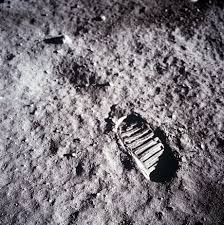
 Forty years ago today, the astronauts of the Apollo 11 mission became the first people to set foot on an extraterrestrial body. It was - and still is - a monumental technological triumph and inspired a generation of scientists and engineers. That inspiration has proven to be, in fact, the most lasting legacy of Apollo 11; sending humans into space instead of unmanned spacecraft is both highly risky and highly expensive (so much so that the recurring discussions about a manned mission to Mars always strike me as lunacy), but no single image has done as much to galvanize public support for science as that of Neil Armstrong taking a giant leap for mankind. This was, of course, by design: John F. Kennedy was one of the smartest presidents we've had, and he knew full well that a moon mission would give Americans a huge morale boost out of what had been a particularly grim period of the Cold War. His plans succeeded spectacularly, and ushered in an era in which it would have been great to be a scientist. It's no exaggeration to say that since the days when Huxley lectured to London workers on a piece of chalk and Marsh and Cope's fossil discoveries were front-page stories in New York newspapers, science has never been as popular as it was immediately following the moon landing. It is in honor of that, then, that I'm writing this post and reminding every scientist out there that they really should like the moon.
20 July 2009
One Giant Leap for Mankind (and Science!)
Forty years ago today, the astronauts of the Apollo 11 mission became the first people to set foot on an extraterrestrial body. It was - and still is - a monumental technological triumph and inspired a generation of scientists and engineers. That inspiration has proven to be, in fact, the most lasting legacy of Apollo 11; sending humans into space instead of unmanned spacecraft is both highly risky and highly expensive (so much so that the recurring discussions about a manned mission to Mars always strike me as lunacy), but no single image has done as much to galvanize public support for science as that of Neil Armstrong taking a giant leap for mankind. This was, of course, by design: John F. Kennedy was one of the smartest presidents we've had, and he knew full well that a moon mission would give Americans a huge morale boost out of what had been a particularly grim period of the Cold War. His plans succeeded spectacularly, and ushered in an era in which it would have been great to be a scientist. It's no exaggeration to say that since the days when Huxley lectured to London workers on a piece of chalk and Marsh and Cope's fossil discoveries were front-page stories in New York newspapers, science has never been as popular as it was immediately following the moon landing. It is in honor of that, then, that I'm writing this post and reminding every scientist out there that they really should like the moon.


07 July 2009
Paleo Road Trip '09: Seattle
After a long, sometimes weary, trip across the country, it was very nice to spend a few days at home in Seattle. I always enjoy showing people around Seattle because, like any Northwest native, I'm proud of where I come from, but also because it serves to remind me that there really is a lot about the city that remains unique. I have made the argument that uncontrolled growth in the last couple of decades has done much to homogenize the place, and I stand by that argument, but it is encouraging to note that even after all that has happened, there are still a great many things you can see and do in Seattle that you simply can't anywhere else. A few cases in point:
- The Ballard Locks: Ballard itself is one of the most sadly altered neighborhoods in the city (though kudos to the Nordic Heritage Museum, Olsen's Foods, and Larsen's Bakery for keeping the community's Scandinavian heart beating), but the locks remain a proud reminder of the city's nautical heritage. Not only that, but the fish ladder is the only place in any major city that I know of in which you can get an underwater view of migrating salmon.
- The Seattle Center: It's something of a failure as a public space (not because it's unpopular, but for a site that plays host to so many major events, you'd expect a little more open space) and some recent additions (well, really just the EMP) were extremely ill-advised, but if you think about it, there are few - if any - places in the world where you can see a comparable collection of legitimately good '60s architecture. The Space Needle, Pacific Science Center, and Key Arena are the cornerstones, of course, but what I've always liked about the Center are its less-visited areas, like the courtyards and fountains outside the Northwest Rooms and the Bagley Wright Theater.
- Archie McPhee: Other cities have novelty stores, yes, but nothing I have ever seen comes close to Archie's (now newly returned to its home in Wallingford).
- Ye Olde Curiosity Shop: If you can ignore all the tourist schlock, the likes of which you could find in any store in any coastal town in the world, and focus on the mummies, shrunken heads, and freak animals, I would argue that a trip to Ye Olde Curiosity Shop qualifies as a unique experience.
- Downtown Library: Most of Seattle's downtown is composed of buildings that, while not ugly, are also not particularly inspiring. The new library, though, really is something different, and I'm generally inclined to agree with the architectural critics who gave it a thumbs-up. The views through the glass shell - a nice nod to the Northwest's often overlooked endemic architectural style - are especially nice.
- Burgers: I have never understood exactly why Seattle is such a hotbed for really good burger places, but I'm glad it is. Growing up here, I thought that having easy access to places like Dick's and Red Mill Burgers was the norm, but nowhere else I've ever lived has ever had anything comparable (not even Chicago, though in its defense it does have the world's best hot dogs).
- Pike Place Market: There's a reason all the tourists flock here. A working farmers'/fishermen's/whatever market right in the middle of downtown - especially one that's been running uninterrupted for over a century - is something you just don't see in many cities.
This is obviously not an exhaustive list, and I'm sure that many of my readers have already thought of additions they would make. If I wanted to be a downer, I could mention that there are plenty of negative unique things about Seattle (the way it's geography is perfectly shaped to funnel drivers into hellish traffic jams and how civic leaders have ignored that fact for decades, for example) or that several formerly unique things have lost much of their luster (like Fremont, where older works of public art such as the troll or 'Waiting for the Interurban' stand as monuments to a time when artists could actually afford to live in this alleged artists' colony). However, I'm sure I'll have enough time to dwell on the city's future in later posts, so I'll end this one with an upbeat reminder for all you Seattleites out there: yes, your city has seen significant change, but at its core it's still something special. That's probably something all of us - even the more jaded among us, such as yours truly - should remember from time to time.
04 July 2009
Paleo Road Trip '09: The Journey Home
It's always hard to sum up a road trip, especially one of the magnitude of Cincinnati-Seattle, without falling into the trap of just recounting everything you did in excruciating detail. In the interest of saving everyone's time, then, I present to you this cop-out: a series of bulleted lists inspired by the sights our trio of paleontologists saw en route.
Best Road Signs
- "Prepare to Meet Thy God/Maker;" we saw one of each version, and both were equally inexplicable.
- The multiple series of rhyming pro-gun-rights signs across Illinois.
- "Spelunk This!" and "Get Lost;" from billboards advertising a cave and maze, respectively, in the Black Hills. You could tell both from the wittiness of the slogans and the quality of the signs that these two were real winners
- The countless signs - especially in the Northern Rockies - peppered by bullet holes from recreational gunfire
Best National/State Parks
 Yellowstone; don't really know how it could be otherwise. It's always jammed with gawking tourists for a reason.
- Ashfall Fossil Beds, Nebraska; according to the signs advertising it, it's "America's Pompeii." Not really sure that's accurate, but anyone passing through Nebraska should make time to see it. Think the Dinosaur National Monument quarry, but with rhinos and horses (which of course makes it even cooler).
- Badlands; if you like pictures of craggy rocks in low-angle afternoon sun, this is the place for you. If you want to see genuine fossils in situ...not so much.
- Ginkgo, Washington; the reason that Washington's state gemstone is petrified wood, but the real reason to go is for the views of the Columbia. Also, there's wineries nearby!
- Mount Rushmore; it still strikes me as odd that anyone would look at a mountain - especially one in South Dakota, of all places - and say to themselves, "Hey, you know how I could improve this stunning natural vista? By adding the faces of three incontrovertibly great presidents and Teddy Roosevelt for some reason!"
- Missouri Headwaters, Montana; given that we were loosely tracing Lewis & Clark's trail most of the way back, there was just no way we could have missed this one, and it's a good thing we didn't, since we saw some migrating pelicans there.
Best Attractions
 Museum of the Rockies, Bozeman, Montana; it's ridiculously dinosaur-heavy and far too prone to presenting Jack Horner's word as gospel, but it's one of the best paleo museums in the West and has only gotten better with time.
- Dinosaur Park, Rapid City; it's pretty much the best one out there, provided you're not looking for accuracy (or imaginative color schemes) in your dinosaur models. The panoramic views of Rapid City and the Black Hills are a big plus.
- Berkeley Pit, Butte, Montana; it's an old pit mine! It's home to the most polluted body of water in North America, with a pH slightly lower than that of Coke! It kills migrating waterfowl (though not immediately, as the tourist literature points out)! Someday it will reach the water table, at which point being a citizen of Butte will become even more miserable! If nothing else, it provides plenty of conversation fodder for road-trippers.
- Snoqualmie Falls; they're very close to home and easy to overlook, but there's a reason David Lynch put them front-and-center in the Twin Peaks credits.
Best Quotes
- "Daddy, I hate this place." -Remarkably perceptive kid at the Berkeley Pit
- "Can I join you?" -Extremely drunk southern gentleman who entered our hotel elevator in the lobby, pushed the button for said lobby, waited a few seconds, realized he actually needed to go to the 9th floor, and talked to us the rest of the way about how much his sister had to pay for a room there.
- "Arrive at Wendy's, on right." -My GPS; imagine, say, Richard Attenborough pronouncing 'Wendy's' to see why this was so funny.
- "Turn right." -My GPS, directing me to turn into the middle of a prairie dog town, which was occupied by several ground squirrels but by nothing resembling a road.
Best Scenic Drives
 Bighorn Mountains, Wyoming; the literal high point of our trip was also one of the figurative high points
- Yellowstone; again, kind of a no-brainer, though the most scenic highways in the area tend to be the ones running through the canyons and valleys just outside the park.
- Lake Couer d'Alene, Idaho; The lake really is gorgeous, but between the houses clustered along the shore and the fairly thick forests that cover the area, there are disappointingly few good vistas.
- Mountains-to-Sound, Washington; I-90's path over the Cascades has always been a sentimental favorite of mine, and it certainly is one of the more impressive routes into Seattle.
- Pintler Scenic Byway, Montana; a nice enough alternative to I-90, though the interstate's course through the mountains north of Missoula is in many ways more impressive.
26 June 2009
Paleo Road Trip '09: NAPC & Cincinnati
 If I were more on the ball - or had an audience that I didn't think would be bored to tears by it - I would give a blow-by-blow overview of some of the research presented at the North American Paleontology Conference at the University of Cincinnati. There were several noteworthy talks, including a few session related to the public dissemination of paleontology, one of the most neglected and essential topics in any field of science. There were also several talks by friends of mine from Bristol and elsewhere in the world of paleontology, but rather than go into excruciating detail, if you really want to know about the talks at the meeting, I'll refer you to the abstract volume here. In general, it was a good conference, and certainly a change of pace from what I'm used to at the somewhat more formal annual meeting of the Society of Vertebrate Paleontology. It was also nice (and cheap!) to be put up in university which, while a bit on the institutional side, at least had an excellent view.Cincinnati was an interesting choice for a host city. I'd only ever been once before and remembered it being fairly unremarkable; that impression was borne out on this trip, but given that most people I know seem to actively dislike Cincinnati, I feel the need to stand up for it. It's true that the city has segregation issues, an apparent total lack of civic planning, and that Skyline Chili is not quite as great as it's made out to be. On the other hand, it has several things going for it. It has some really nice old neighborhoods, some gorgeous parks, a great zoo, and a baseball stadium right on the banks of the Ohio River.
The University of Cincinnati, where I spent most of my time, is one of the odder campuses out there, and like the city itself it inspires ambivalence. Much of the architecture on campus is very recent, and in some cases the results are very nice. However, in many cases the new building were constructed around the shells of older halls, which does nothing to dispel the university's odd vibe. Add to this some of the other unusual landscaping and architectural choices made by UC planners - the location of the football stadium directly in the middle of campus and the presence of dorms in the athletic center, for example - and you can see what I mean when I say it's a somewhat weird place. That said, I thought it was a pretty nice campus all in all; they've got a great music department, and I generally heard students practicing en route to the conference each day. There were lots of restaurants and shops around, as well as a couple of really good bars (one an outdoor beer garden, one an archetypal college pub, complete with shuffleboard). If campus itself got boring, there were some nice old neighborhoods and parks immediately to the north. The point of all this is that Cincinnati and its university probably don't deserve the negative reputation that seems to dog them. Neither may be the most exciting of its kind out there, but there are far worse places to find yourself on a sunny June day.
19 June 2009
Paleo Road Trip '09: Lincoln
 I've stopped in Lincoln several times on my road trips across the country, and on my very first trip I realized that it makes an excellent home-away-from-home for two reasons. First, it is the only place in the Northern Plains where you can reliably get dinner after 8:00. In fact, you can get some really good food there, particularly around the Haymarket district. This is a product, of course, of Lincoln being the college town to end all college towns, giving it a cosmopolitan air of a city several times its size. Case in point: Omaha is a much larger city less than an hour down the road, and it is certainly more of an economic powerhouse, but while it's not a bad place, it is something of a cultural wasteland. It is, to be fair, home of the College World Series and one of the nation's best zoos, but force me to choose between the two and I'll choose Lincoln 10 times out of 10. It was, in fact, Lincoln that taught me the valuable lesson that road trips are best broken up as legs between college towns, which has made my many cross-country excursions over the years much more enjoyable.
The other reason I have always had a fondness for Lincoln is what brought me to town this summer: it's home to one of the best - if most overlooked - paleontology museums in the US. As I noted in my last post, Nebraska is probably the best part of the world in which to find Miocene mammals, and the University of Nebraska State Museum reflects this rich fossil record spectacularly. It has case upon case of horse, rhino, and camel skeletons, but somewhat counterintuitively, the real reason paleontologists should take the time to visit Lincoln is their collection of fossil elephants and elephant relatives, which is the largest in the world and includes the largest mammoth I've ever seen (which is, not coincidentally, the state fossil of Nebraska).
Of course, nowhere is perfect, and I happened to arrive in Lincoln at the same time as a fairly formidable storm front with some equally formidable tornadoes in tow. As noted before, I'm not a big fan of thunderstorms, and that goes double when those storms blot out the sun between the Missouri and the Wabash. Still, there are only so many ways of getting to Cincinnati from Lincoln, and the end of the first stage of my trip was destined to be made in the company of lightning, thunder, and blindingly heavy rain.
16 June 2009
Paleo Road Trip '09: The Oregon Trail
 This blog didn't get its title because 'The Oregon Trail' was the first name to spring to mind. Or rather, it was the first name to spring to mind for a good reason. When you grow up in the South, I'm told, your history classes revolve around the Civil War. In the Northeast, you get a heavy helping of the American Revolution. Presumably, Californian children are all conversant about the Camino Real and the Gold Rush. In the Northwest, we learn about trails. Two trails, to be precise: the one blazed by Lewis and Clark and the route followed by overland immigrants to the promised land of the Willamette Valley. It's quite a testament to the Northwest that people wanted to get there so badly they were willing to risk life and limb (from bears and Indians in the case of Lewis and Clark, from snakes and dysentery on the part of the settlers) to get there. Of course, both trails were blazed across landscapes far different from the lush river valleys and dense forests of Oregon and Washington. One of the most storied parts of the Oregon Trail lay nearly 2000 miles to the east, in the western half of Nebraska. This is where the emigrants first saw significant topography along the trail. They were still out of sight of the Rocky Mountains, but over millions of years the Platte River has carved the sandstones along its banks into convoluted hills and bluffs that would become among the trail's most recognizable landmarks. The two most famous of these (intimately familiar to anyone who played the Oregon Trail computer game as kids) were Chimney Rock and Scott's Bluff. Given that I had a full day to get between Laramie and Lincoln, I couldn't pass up the chance to swing a little bit out of my way and acquaint myself with these monoliths in person. Chimney Rock is a state symbol of Nebraska and certainly the more bizarrely shaped of the two, but if you find yourself in the area and only have time to see one, by all means go to Scott's Bluff. You can drive or hike to the top, and it's well worth the trip, because the views are expansive and absolutely gorgeous. On top of that, the area has some really interesting plant life, with flora that would look more at home somewhere in the Southwest than in the Great Plains.
Of course, there's another reason to make the trip to the Nebraska panhandle, provided at least you have an interest in fossils. I waxed ecstatic in earlier posts about the Eocene fossils of Wyoming, but if you, like me, are more interested in the fauna of the Oligocene and Miocene, there's no place like Nebraska. Every town you pass through seems to have some formation, fauna, age, or at least species named after it: Gering, Scottsbluff, Bridgeport, and so on ad nauseum. People don't tend to think of Nebraska as a paleontological mecca, but it really is. I only regret that time didn't allow for me to visit Agate Fossil Beds up the road, source of copious numbers of fossils of the bizarre perissodactyl Moropus and the gigantic, piglike entelodont Dinohyus. As it was, I had to get back on the road to get to Lincoln, one of my favorite homes-away-from-home.
15 June 2009
Paleo Road Trip '09: Laramie
The state quarter for Wyoming is one of the simpler coins in the series: a bronco-riding cowboy and the motto 'The Equality State.' The slogan is a tip of the hat to Wyoming's status as the first state to allow women the vote, and while that's certainly something to be proud of, the cowboy is really the more accurate symbol of the state. Other states may lay a louder claim to the cowboy mythos, but nowhere in the country is the Wild West still as palpably alive as in Wyoming. It's one of my favorite things about the state; while I may disagree politically with your average Wyomingite (don't forget that this is the state that gave us Dick Cheney), but I appreciate genuineness, and there can be no doubt that the genuine frontier spirit is alive and well here. As one of Wyoming's more prominent cities, you might expect Laramie to be a microcosm of the still-Wild West. However, it's also the site of the state university and as such has a more cosmopolitan atmosphere than even Cheyenne, its much larger neighbor to the east. If I had any doubts that I would enjoy my brief visit to Laramie, they dissipated when I drove into town to find that the university hosts public radio stations playing both jazz and classical music (this puts it one solid step ahead of Eugene which, despite its somewhat pompous claims to cultural prominence, is a wasteland when it comes to jazz on the radio). Besides just having impeccable taste in music, Laramites enjoy one of the nicest and most architecturally unified campuses around, views of some of the more spectacular peaks of the Rockies, and a downtown full of old buildings and good restaurants. One of those restaurants is even vegetarian, but one really has to pity anyone who would voluntarily deprive themselves of some of the world's best beef straight from the source. Say what you will about cowboys, but they certainly know how to do steak right.
Save the UW Geology Museum
 It is, of course, stating the obvious to point out that these are economically difficult times. Everyone is feeling the pinch, and universities are no exception. Sadly, I have found myself in Laramie not long after the University of Wyoming has announced several budget cuts and that prominent among them is the closure of the Museum of Geology. This has, not surprisingly, created an uproar in the paleontological community, as the primary focus of the museum is the state's fossil record. Many people have pointed out that the museum's operating costs are small relative to the university's overall budget. They have pointed out that Brent Breithaupt (one of paleontology's true characters, as anyone who has attended an SVP auction can attest) will be out of a job. They have pointed out that the museum is one of the largest and most important in the Mountain West, that it is home of one of only five Apatosaurus skeletons anywhere in the world and of "Big Al," the only Allosaurus ever to get its own program on BBC and one of the most well-known and remarkable dinosaur fossils anywhere. All of these are excellent points, but I'd like to approach the issue from a slightly different angle.
The American West in general is justifiably famous for its paleontological resources, but even by the standards of this mother lode of fossils Wyoming stands alone. It is most famous for its dinosaurs. Ask anyone what their favorite dinosaur was as a child, and it will almost certainly be from Wyoming: Apatosaurus, Allosaurus, Stegosaurus, Triceratops, and Tyrannosaurus are all local products. The Wyoming record of Cenozoic vertebrates is equally rich. The database I've been compiling as part of my dissertation research is full of specimens from the eastern part of the state, where some of the world's finest Miocene mammal faunas have been uncovered. Spectacular as these faunas are, they pale in comparison to those from a few million years earlier and a few hundred miles to the east in the Bridger Basin, home of what is probably the best sequence of Paleoecene and Eocene beds on the planet. Fossils here are not just plentiful, they are gorgeous. Herring-like fish from the Green River Formation are preserved in the millions and in exquisite detail, along with crocodiles, stingrays, birds, gars, bats, and other Eocene lake dwellers. Go to any of the great museums out east, and you will see fossils from Wyoming. You will see lots of them, because there are few - if any - places on Earth with as rich a paleontological heritage.
By deciding to close down the UW Geology Museum, the university has turned its back on this heritage. Knowing that their state has produced a fossil bestiary more spectacular and more diverse than those of most countries should be a point of pride for Wyomingites. The museum has, until now, done an admirable job inspiring interest in and teaching about the state's fossil record. It has shown generations of visitors that the land on which they live is not only gorgeous and unique now, but has been for millions of years, and that Wyoming's celebrated wildlife is heir to a long and spectacular tradition. If the museum closes, it won't just be the university that feels its loss; a truly important public institution and point of state pride will have disappeared.
The museum has put together a petition, if you're interested in doing something to try to counteract the university's mistake. I particularly urge paleontologists to make their voices heard; even if you have no connection to the UW museum, I know we all care too much about the future of our field to see a precedent like this set.
Paleo Road Trip '09: The Road to Laramie
As many of you know, I left Eugene on Saturday on a 3-week trip to Cincinnati and points between. The main purpose of my trip is to attend (and present at) the North American Paleontological Convention, but I'll be doing dissertation research at points along the way. This old blog has run fallow of late, so I thought that posting about my various stops along the way would be a good way of clearing out the cobwebs (you see, I'm so out of shape writing-wise that I'm using mixed metaphors; dear me...). I'll also be posting photos here. So, stay tuned: it should be an interesting ride.
I'm writing this from my first waypoint, Laramie, Wyoming (more about it in a later post), home of the University of Wyoming's vertebrate fossil collection (more about that later on, too). The drive here was one of the longest I'll be doing this entire trip, and it's a real shame I only had two days to do it. It's also a shame that the Mountain West has been experiencing one of its more protracted periods of thunderstorms in some time. Of course, I'm sure many of you are probably pretty jealous of this, but I was never much of a storm-chaser. To be sure, there is something breathtaking about seeing an impossibly dark cloud looming above the Rocky Mountains and to see the flashes of thunderbolts crashing all around you. Usually, I'm all for experiencing nature at its most sublime (a word that, as always, I use in its original sense, not the watered down version that's bandied about so much these days), and I think it's healthy to be reminded of just how small and insignificant you are from time to time. Thunderstorms, though, tend to impress me more with terror than with awe (other members of the Hopkins Lab will vouch for just how nervous I got when storm clouds hove into view during field work last summer). To me there is just something fundamentally wrong about a weather system that can simultaneously start flash floods and fire. Give me good, old-fashioned grey skies and a persistent drizzle any day.

That whining aside, there is one more thing worth mentioning briefly about my drive to Laramie. On several previous road trips, I've passed near Promontory, Utah, but had never stopped (part of the reason for this is that no one in my family has ever been too keen on spending money in the Beehive State for fear that a good chunk of any taxes you pay here will find their way to the Mormons). Still, as one of those kids who grew up loving all things train-related, Promontory has always had a strong attraction. As I'm sure everyone remembers from their history books, that was where Leland Stanford drove in the "Golden Spike" in 1869, joining his Southern Pacific Railroad to the Union Pacific and creating the first transcontinental railroad line. It's hard to overstate the importance of this event in the history of Westward Expansion: it pretty effectively marks the end of the age of mountain men and emigrant trails and the beginning what people tend to think of as the Wild West. As both a train and Western history buff, the allure proved just too much to ignore this time. I was a little disappointed to learn that the spike itself is back in California, and I also happened to arrive at a time of day during which there were no programs going on, so I'll confess the overall effect was a little underwhelming. Still, if you like your old steam locomotives, the park has two spectacularly restored examples (which I'm told they run a few times each day, sadly none of which was anywhere near the time I was around) and it's always worth seeing the spot where such an epochal event took place. It also gives you a chance to see some of the bird life that shows up this time of year at the north end of the Great Salt Lake (which, incidentally, manages to break several laws of physics by somehow being flatter than other bodies of water).
The thunderstorm-ridden drive across southern was unremarkable, but by way of a segue to my next post, I'd just like to briefly mention that it crosses the Bridger Basin. That name most likely doesn't ring a bell, but it would if you were a paleontologist. One of the great joys of traveling through this part of the country as a paleontologist is that you are continually encountering place names that are very familiar to you and your colleagues, to locals, and to absolutely no one else anywhere in the world. I imagine that if you study the Eocene, going to southeast Wyoming - and in particular, passing through Fort Bridger and Green River - must feel like coming home. Given that I've rambled on longer than I intended too already, I won't go into much detail on the historical and scientific significance of the Eocene beds of the Bridger Basin, but suffice it to say that they account for much of what we know about life on Earth between about 75 and 40 million years ago, and that many of the biggest names in paleontology have worked there. The same could be said for the Jurassic beds to the east or the Miocene beds near the Nebraska border. In short, there are few places on Earth as fossiliferous as Wyoming, a fact that you would think would make anyone proud. Turns out, though, that now is not a great time to be a paleontologist in the Equality State.

11 May 2009
Destino
Today is the birthday of Salvador Dalí, one of the most famous artists to have ever lived. It has been argued that this fame has as more to do with Dalí's self-aggrandizement than it does with his actual art, and it can't be denied that he was one of the most narcissistic people ever to have lived (case in point: the object in the right foreground of The Persistence of Memory is, in fact, a sideways profile of the artist). There are plenty of other reasons to dislike Dalí, chief among them his tacit support of the fascists in the Spanish Civil War. All that aside, though, it also can't be denied that he had considerable talent and that more people are drawn to his paintings than to those of any other surrealist. I include myself in this group; there's something about the empty landscapes, nightmarish figures, and optical illusions of Dali's paintings that I find fascinating. You can imagine, then, how excited I was when I learned that he had teamed up with Walt Disney in the '40s to make a short animated film entitled Destino. It would seem that this pairing really was too good to be true, and for whatever reason the project never took off. Destino was forgotten until very recently, when it was completed based on Dalí's original storyboard. As far as I'm concerned, it's one of the great achievements in animation, right up there with The Rite of Spring in Fantasia. I've attached a couple of clips below; if you like your cartoons creepy, then you'll absolutely love these.

06 April 2009
The Prodigal Kid
It's the first week of April, which means that once again the baseball season is upon us. Last year at this time I was rhapsodizing over Dave Niehaus' induction into the Hall of Fame and was voicing cautious optimism about the upcoming Mariners season. Well, as any of you who are Northwest sports fans know, that optimism was dashed quickly and mercilessly, ushering in the worst year in history not just for the Mariners but for Seattle sports in general (capped off, of course, by the Sonics' treacherous defection to Oklahoma City). In light of all that, you might expect me to be pretty downbeat about the advent of a new season, but once again I am cautiously optimistic. I'm not predicting that the Mariners will be making the playoffs, mind you, but things are looking up: it's a beautiful spring day, the team is under new and wiser management, and Ken Griffey, Jr. has come home.
This offseason was supposed to be all about stockpiling young talent, and for the most part it was. However, no move the Mariners made this winter created a bigger splash than the signing of Junior. There were several legitimate concerns about the team signing a veteran who will likely retire after the season, but I'll admit I was as thrilled as anyone when the news came down the wire that the greatest player in team history was returning to Seattle. Every team out there has had great players, of course, but in his first tour with the Mariners, Griffey transcended greatness. It's not that he was always the best player in the league - though there were years when that was the case - but no player has ever meant as much to a team as Junior did to Seattle. He shared the clubhouse with other greats who deserve all the praise they get and then some - Edgar Martinez, Jay Buhner, Randy Johnson - but in the '90s, Ken Griffey, Jr. was the Seattle Mariners. He was unique, bursting with almost unbelievable potential (which he sadly never lived up to after leaving for Cincinnati), and always a pleasure to watch. Some of the best memories from my childhood involve sitting in the Kingdome watching his majestic home runs soar along the right field line and into the upper deck. It's not a stretch to say that the Seattle Mariners wouldn't exist without Junior: without his drawing power, it's all but certain that the team would have moved to Tampa Bay or some other city with cash and a stadium to spare. It was a dismal day when he left for a nearly decade-long sojourn in the Midwest, but now he's come home. He may not - in point of fact will not - treat us to a repeat performance of his glory days, but just seeing him playing in Safeco Field (a stadium designed around him) is going to be a wonderful experience, and one that Seattle has never needed more desperately.
11 March 2009
Ik houd dan honkbal!
That, as near as my computer's translation software can figure, is how to say 'I love baseball' in Dutch. Why did I bother to learn that phrase? Because I do love baseball, and I also love underdog stories, and the Netherlands have provided me with both during the early stages of this year's World Baseball Classic. Those of you out there who are baseball fans but have been ignoring the WBC should be ashamed of yourselves: not only is it a good thing for the game on the international level, but it's been immensely entertaining so far. Coming into the tournament, the Dominican Republic was thought by many to be one of the top contenders to win it all. I certainly shared that opinion, and with good reason: their lineup is made up not just of Major League players but of Major League stars. And yet, here we are reaching the end of the first round and the Dominicans have been eliminated already. Had you told me prior to the WBC that this would be the case, I would have presumed that they had lost two games at the hands of second-tier Caribbean powers Puerto Rico and Panama, but no: both losses came at the hands of the Dutch, a team with two or maybe three recognizable players, none of which could ever be considered a star by any stretch of the imagination. Just how big is this upset? This chart of the odds of winning the tournament should give you some idea:
For those of you that prefer to think in more strictly mathematical terms, the a priori probability of the Dominican Republic winning the WBC was 100 times greater than that for the Netherlands. Of course, the Dutch are a long way from being able to claim the championship, but those numbers do nicely underscore the magnitude of this upset, which is easily one of the greatest ever in any sport (especially considering that they beat the Dominicans twice. TWICE!!!). The Dutch and what they've accomplished so far are exactly the reason I will always proudly say that 'Ik houd dan honkbal.'
Oh, and we shouldn't forget about another lovable underdog that, as I write this, is still alive. Advance, Australia fair...
11 January 2009
Happy Swan Day
A month ago, I proposed that today, James G. Swan's birthday, would make an admirable regional holiday for the Northwest. I don't know about you all, but it's a lovely (for January) day here in Eugene, and I intend to celebrate accordingly. The best way to do so, at least as far as I see it? Go do something today that you couldn't do if you lived elsewhere. I plan to walk up Spencer's Butte or around Hendricks Park; if you're in Seattle, a trip to the Pike Place Market or Ballard Locks might be in order, and Portlanders have easy access to the Gorge and the northern Oregon Coast (to say nothing of Powell's). If you're up for something more low-key, or are a Northwesterner exiled to some other part of the world, might I recommend sitting down with a book by Jonathan Raban, Ken Kesey, or any number of other local authors (which would go well with some local music, anything from George Frederick McKay to Pearl Jam). Whatever you do, if you - like me - love the Northwest, try to take a moment at some point to reflect on just how lucky you are to be a resident of one of the most beautiful corners of the world. Happy Swan Day!
12 December 2008
What I Learned in 2008
- Heinrich Harder is wicked awesome.
- Even Mariners baseball can get boring if the team is inept enough.
- Never volatilize cat urine. Not even your worst enemy deserves to smell that.
- Day trips from Eugene to the John Day Fossil Beds are feasible, provided you're willing to get up at 4:00.
- There's never a dull moment on the Mariners blogosphere.
- The Rock & Roll Hall of Fame is everything the Experience Music Project wishes it were but will never be.
- Going to a game at Autzen is much more fun when the Ducks win.
- Getting funding is hard, at least under the Bush Administration.
- Preparing for - and worrying about - comps is far, far worse than actually taking them.
- There is no free lunch as far as camping in the Juntura area is concerned. Unless you're a mosquito.
- Lucy is well worth the trip to see in person.
- American democracy is still alive and kicking.
- Barack Obama is an exceptionally good speaker, especially in person.
- Caucuses are more fun than primaries.
- Horses > dogs >> squirrels, at least as far as their fossil records go.
- Genghis Khan invented pants.
- I still refer to Seattleites and Washingtonians as 'we' (and I probably always will).
- Dave Niehaus really is a hall of fame-caliber broadcaster.
- Pasadena is cool. San Bernardino is not.
- The Big Time Brewery has a long-lost twin in Berkeley.
- Giving a talk at SVP is much better than presenting a poster.
- I'm not the only one who thinks making a year-in-review bulleted list is a good idea.
Happy 2009, everyone!
10 December 2008
Swan Day: A Modest Proposal
One of the best things about living in the US is that you can travel between radically different cultures without ever leaving the country. You could visit, for example, the Deep South and the Southwest and be forgiven for thinking you had just been to opposite sides of the globe. While having such differences can sometimes lead to friction (see the last eight years for an illustration of this point), each region is unique, fascinating, and well worth celebrating. In some areas, this admittedly well-worn axiom is taken at face value, leading to the development of regional holidays. Sometimes these holidays were created to honor a person or event unique to a region (as with Kamehameha Day in Hawai'i or Patriots' Day in New England), and sometimes they evolve from ostensibly nationwide holidays that for one reason or another have strong local appeal (as with Leif Erikson Day in the Upper Midwest and New Orleans' Mardi Gras). Any long-term readers of this blog can probably see where I'm going with this, so I'll cut right to the chase: the Northwest is conspicuous in its lack of a regional holiday, and I think I know just the day we should have one.
A month from today is the birthday of James G. Swan, one of the greatest - albeit least known - figures in Northwest history. I could drone on for paragraphs about why Swan was an interesting person, but I'll leave that in the much more eloquent hands of novelist Ivan Doig, who's Winter Brothers is a book I would recommend to anyone with an interest in Swan or, indeed, in the Northwest as a whole. I'll just briefly outline why I think Swan embodies the best of this region. First, he wasn't born here, but in Massachusetts. This may sound counterintuitive, but when you consider that the region's history has been driven by exploration (e.g. Lewis and Clark) and immigration (e.g. The Oregon Trail) it's really very appropriate. Second, unlike many of his contemporaries, his relationship with the many Native Americans he encountered was, it appears, mutually positive. He saw the region's tribes not just as savages or anthropological curiosities, but as the complex, living cultures they were (and still are). Third, and most importantly, he loved the Northwest and made this abundantly clear in his writing. He lived On Willapa Bay, among the Makah on the Olympic Peninsula, and in Port Townsend on Puget Sound. He travelled to Astoria in Oregon and the Haida Gwaii in British Columbia, and he wrote glowingly of his experiences in all these places. Few people have ever taken to an adopted home more enthusiastically and more wholeheartedly, and at least to my mind there is no date more appropriate for a Northwestern regional holiday.
Many of you may think this is some elaborate and long-winded - though not particularly funny - joke. It's not. I'd estimate that at least half of the posts on this blog are paeans to the cultural and physical landscape of the Northwest (which is why, incidentally, I'm not bothering to defend my assertion that the region deserves to be celebrated; there's plenty of that elsewhere on this site). Many of you out there, of course, are from elsewhere and don't feel any particular connection to Oregon, Washington, or BC, in which case there's no reason this should affect you. However, for those of you who consider yourself Northwesterners, be you native or adopted, I suggest you mark January 11th on your calendars, and if you have friends who you think are likely to be enthusiastic about this hare-brained idea, mention it to them as well. I'm not advocating anything extravagant here, mind you. The last thing the world need is another made-up holiday when people are expected to throw money at cards, gifts, or fancy meals. For many of us who call the Northwest home, though, I think there's a great deal to be said for recognizing what it is that we appreciate about it.
07 December 2008
Going Bowling
I usually try to stay away from opining about sports on this blog, since I know much of my audience (if I still have one) are more interested in other things. However, due to current events, you all will have to put up with me writing about college football (fortunately, I can't force any of you to read my blog...yet). The matchups for the 2008-2009 bowl season were announced today, which means that sportwriters across the country are indulging in their annual bout of whining about how a playoff system is necessary for the future of NCAA football. As you may have guessed by my use of the word 'whining,' I am a staunch supporter of the bowl system (though not necessarily the BCS). There are several reasons for this; these reasons are idealistic (Why should college sports, which are ostensibly played by amateurs, be so concerned about crowning a champion?), financial (bowls can be extremely lucrative for almost everyone involved), or traditionalist (a sport as steeped in pageantry as college football should maintain the system is has had for a century now) in nature, and admittedly some are much more convincing than others. However, the best argument against a playoff system is, I would argue, purely practical in nature.
The main complaint leveled against the bowl system is that rankings are somehow intrinsically less fair than playoffs. A few simple stats show that, in football at least, this is simply untrue. For the sake of argument, let's assume that a really top-notch NCAA football team wins 60% of its football games against teams of the caliber it would meet in a playoff (this is awfully generous, I should point out, as the real underdog winning percentage in bowl games is roughly 50%). Let's assume as well that in order to win the championship, a team would have to win three playoff games, just as a conference champion with a first round bye in the NFL would. As we all learned as far back as high school, the chances of a team winning all three games to claim the championship are 60% x 60% x 60%, or 21.6%. If we up the odds of winning a game to 70%, the odds of winning out rise to just 34.3%. The reason odds like these are so problematic in football is that the sample size of one game is laughably small. In baseball, basketball, or hockey, where playoffs consist of multi-game series, the odds of the better team prevailing are much greater (though even in these sports it can be hard to predict; does anyone really think the Colorado Rockies and Philadelphia Phillies were the best teams in baseball the last two years?).
Opponents of the bowl system would interject at this point to argument that playoffs allow teams to control their own destiny. This also is patently untrue. The most compelling argument against this notion is that one team alone cannot control the outcome of a game; if that were the case, there would be no point in playing the games in the first place. Besides, in any close football game (as the latter games of a playoff generally would be), it is generally factors well outside a team's influence that give one side an edge. Weather, field conditions, fan presence (even in a "neutral" stadium, one team will have more fans than another, which really can make a difference in football), and, most importantly of all, human error on the part of the referees routinely affect game scores, as anyone who watched the Oregon/Oklahoma game in 2006 could tell you.
So, to return to my original point, college football has two choices for how it could run its postseason. The supposedly "fair" playoff system is in fact governed by chance and the team that is crowned as champion at the end will almost certainly not be the best from the regular season. The BCS, to be sure, has some flaws as well. Most glaringly, there are too many bowls, and the computer rankings determining which teams get to go to the best games are, in a word, terrible. However, the coaches' and sportswriters' polls that are compiled at the end of the bowl season tend to do a good job of reflecting which teams are the best, not based on a handful of single-elimination games at the end of the year, but over the course of the entire season. Which system, then, is really more "unfair" and less likely to crown a "legitimate" champion? It's worth thinking about. If you care about this sort of thing.
N.B. For those of you who don't follow football, I apologize for pretty much everything about this post, and especially for not explaining what exactly I mean by the BCS and the bowl system. The simple truth of the matter is that, love it or hate it, the selection process for college football's postseason is extraordinarily complex, and explaining it would have just about doubled the size of an already-overlong post. Hopefully Wikipedia will suffice on this one.
28 November 2008
Lucy's Legacy
I'd like to put in a plug for my old stomping grounds, the Pacific Science Center. This is old news to most of you, I imagine, but PSC is currently hosting 'Lucy's Legacy.' Lucy is, of course, the best-preserved skeleton known of the early hominid Australopithecus and is the most famous fossil in the world. This fame is well-deserved; while Lucy is physically not particularly large, she is a titanic figure in the story of human evolution; without her, much of what we know about our early ancestors could never have been learned. What the Rosetta Stone, the Declaration of Independence, or the Dead Sea Scrolls are to our history, Lucy is to our prehistory. In fact, in being quite literally unique, she may eclipse any man-made artifact in significance. I'm posting this little soliloquy not just because I'm still a bit giddy from having had the privilege to see a fossil of such stature, but to encourage any of you who have the means to get to Seattle before March 8th to do so. Unless you plan to make a habit of visiting Ethiopia (a plan that is sadly impractical for most of us), this is most likely a once-in-a-lifetime opportunity. No doubt many of you will think I am blowing this out of proportion because I am myself a paleontologist that is easily excited by this sort of thing. This may be somewhat true, but regardless of your opinions on fossils, it is not everyday a key figure in humankind's heritage is deposited for a few months right in our own backyard, and it would be a shame for anyone to pass up the chance to see Lucy in person.
04 November 2008
USA! USA! USA!
As established in an earlier post, the readers of my blog may be small in number but rich in brains, so I'm sure you were all aware that today is Election Day, and I imagine that most - if not all - of you have voted already. Just in the off-chance that any of you had forgotten, though, consider this a public service announcement reminding you that you if you don't vote in an election of this magnitude (there may never be bigger in most of our lifetimes) you're ruining democracy for the rest of us. Also, don't forget that there is more than just the presidency at stake; I know that all the west coast states have hugely important issues and races lower on the ballot, and I have no doubt the same could be said of states across the country. Remember, regardless of what you think of our country's behavior in recent years and over the course of its history, it was founded on unimpeachably noble ideals, and today is your chance to celebrate the very best of what the US stands for.
20 October 2008
Lobbying for Paleontology
 Last week was the Society of Vertebrate Paleontology's annual meeting in Cleveland. It was a great conference all around: Cleveland is a much better city than it's made out to be (the Rock & Roll Hall of Fame is especially excellent, despite the exorbitant entry fees), there were lots of good presentations, and as always it was great to meet up with old friends and make new ones. I should mention that every member of our lab group presented a talk or poster, and I think (and certainly hope) that we succeeded in our goal of announcing Oregon's return to the world of vertebrate paleontology. My favorite thing about the trip, though? The hotel lobby. Honestly. The conference was held in the Renaissance Hotel, which was built, and the lobby in particular is a throwback to the Gilded Age (an era that was, it must be noted, gilded for paleontologists as well as industrialists; when the Renaissance was built, Henry Fairfield Osborn was presiding over Barnum Brown and Charles R. Knight, and the "Bone Wars" of Marsh and Cope were a recent and palpable memory). One of the points of scientific conferences is to give researchers a chance to discuss their current work with their colleagues, and there is no better atmosphere in which to do so than in marvelously soft couches with the sound of a fountain in the background and vaulted arches overhead (arches with spandrels, appropriately enough for a meeting of evolutionary biologists). It helped that there was an excellent - if expensive - bar built in, complete with Great Lakes microbrews, which provide an exception to the rule that there is no good beer between the coasts (the Oktoberfest and Eliot Ness amber ales are especially nice). Sitting around talking with your friends and colleagues in the Renaissance lobby makes you feel like one of the railroad tycoons or captains of industry the hotel once hosted. Could there be a better place to hold a meeting for people who make a living of living in the past?
25 September 2008
My Name is Chin Trout
Say what you will about the journalistic quality of the Eugene Weekly; it introduced me to this fantastic application of modern technology, so it can't be all bad.
Subscribe to:
Posts (Atom)