Showing posts with label Wildlife. Show all posts

06 December 2018

6. American Museum of Natural History

Location: New York City, New York
Website: https://www.amnh.org/
The Collections: The American Museum of Natural History is the first museum in which I did collections work (in high school, due to the efforts of a truly outstanding biology teacher) and I've spend many hours in it since. I'm especially familiar with the floor housing carnivores and rodents. And yes, I did mean floor: the ten-story building in which the AMNH houses its mammal fossils is bigger than the entirety of most museums.
The Exhibits: Pass beneath the towering Barosaurus or the Haida canoe in the AMNH's entrance halls and you've truly entered an enchanted world. The big draws are the incomparable vertebrate fossil halls on the top floor and the many halls of wildlife dioramas that act as windows on the world for nature-starved New Yorkers, but one could spend days exploring the wonders on display throughout the museum (which, of course, make up only a tiny fraction of its collections). I am especially fond of the many anthropology halls that tend to get overlooked by locals and tourists alike and make for an excellent day of museum-going.
Gift Ideas: The museum has several excellent in-house authors and a press that has released some really stunning collections of scientific illustration. Its library is also one of the best resources natural history resources out there, with all its its scholarly publications freely available.

08 July 2016

Fossil Vertebrate of the Month: Miracinonyx

Natural Trap Cave
Photo by the author
This year being the centennial of the US National Park Service, the ecosystems and animals of Yellowstone have been on lots of peoples' minds (and itineraries).  Certainly, the Greater Yellowstone Ecosystem remains the best place in the continental United States to see what remains of North America's megafauna, but a site roughly a hundred miles to the east attests to how much more diverse that fauna used to be.  On the hills above Bighorn Canyon on the Wyoming-Montana border sits Natural Trap Cave, one of the most important Pleistocene vertebrate localities in the world.  Then as now, the cave is a huge hole in the ground, and while a grate keeps anything too big from falling in anymore, during the Pleistocene it was a death trap for tens of thousands of animals.  I was fortunate enough to be able to spend some time working at the site this month, and while my contributions consisted mainly of rodent bones and teeth, the cave has yielded fossils of a wide range of animals.  Some of these - bison, wolves, wolverines, to name a few - would be familiar to Yellowstone visitors today.  Some - mammoths, horses, and camels, for example - are now extinct but are nevertheless fairly familiar.  Others are more obscure, and perhaps the weirdest of these often overlooked animals is the American cheetah Miracinonyx.  Really, I should have quotes around the word "cheetah," as the evolutionary history of Miracinonyx has long been a bone of contention.  It was first described on the basis of fossils from Pennsylvania by the great paleontologist E.D. Cope in the 1890s, who placed it in Uncia, the same genus as modern snow leopards.  Other finds from the east led 20th Century researchers to conclude that it was closely related to modern Puma, the genus that includes modern jaguarundis and cougars.  It was specimens from Natural Trap Cave described in the 1970s that first demonstrated that Miracinonyx had extremely elongated legs similar to those of cheetahs, indicating that it too hunted its prey by chasing it down.  This was something of a bombshell, as most cats are ambush predators specialized for sneaking up on prey and pouncing; modern cheetahs are the only modern big cat that is a really effective pursuit predator.  It was widely suggested that this similarity in morphology meant that North American and African cheetahs not only hunted in a comparable and unusual way, but that they were very closely related.  Consequently, during the 1980s most authors referred Miracinonyx specimens to the Acinonyx, the genus of modern cheetahs.  All this taxonomy may seem very dry and dull, but it has an important implication: that despite their geographic distance, cheetahs in North America and Africa were similar because they were close relatives descended from a recent common ancestor, an evolutionary phenomenon known as parallelism.  However, since 1990 our understanding of the evolutionary history of Miracinonyx has changed substantially.  That was the year that Blaire Van Valkenburgh and colleagues performed an analysis of the morphology of a specimen from a West Virginia cave and showed that, in fact, the animal that paleontologists had been referring to for years as a cheetah was actually a very close relative of cougars.  This finding was later backed up by an analysis of ancient felid DNA, which likewise showed a close relationship between Miracinonyx and Puma.  The North American cheetah's evolution switched from being an example of parallelism to one of convergence, in which two unrelated species evolve similar traits due to similar environmental pressures.  It has been further argued, though with considerably less direct evidence, that the evolution of pursuit predation in Miracinonyx may have had a major impact that can still be observed today.  As "cheetahs" got faster, it would likely have put pressure on their prey to evolve traits that would allow them to run faster as well, which would in turn lead to further pressure towards speed-related traits in Miracinonyx in a process known as coevolution (or, more colorfully, an evolutionary arms race).  This could explain the blazing speed of the still-extant pronghorn Antilocapra, which has been clocked at over 60 miles per hour.  This is far faster than any living mammalian predator in North America, but well below the top speed of modern cheetahs.  So if you do make it to one of the western national parks this centennial year and you're fortunate enough to see a herd of pronghorn running at full tilt, spare a thought for the bizarre cat that may have made such velocity necessary.
Miracinonyx and Antilocapra
Reconstruction by Mauricio Antón

15 June 2014

An Exhibit for the Ages: 100 Years of the Laysan Cyclorama

Laysan Cyclorama
Courtesy International Panorama Council
Exactly 100 year sago, on June 15th, 1914, the University of Iowa opened a new exhibit: a cyclorama of the wildlife of Laysan, an atoll at the tail end of the Hawaiian Islands and, at that time, a major seabird rookery.  Many other displays have come and gone at the UI Museum of Natural History, some of which - most notably Rusty the Giant Sloth - have replaced the Laysan albatrosses and frigatebirds as the public "faces" of the museum, but the centenarian exhibit remains the most remarkable of the bunch.  There are probably as many ideas about what makes a great natural history exhibit out there as there are natural historians and museologists, but in my estimation there are five criteria for a really outstanding display, and the Laysan Cyclorama meets each and every one.


  • Historically interesting - The Laysan Cyclorama really got its start in 1902, when UIMNH director Charles Nutting visited the island.  He was enchanted by the nesting birds he saw there and in 1911 he sent taxidermist Homer Dill on an expedition to Laysan (an expedition that was, delightfully, funded in part by proceeds from a skit put on by the football team).  When the specimens collected in 1911 were put on display three years later, the cyclorama became the first exhibit in the museum to depict an entire ecosystem.  This may not sound terribly remarkable, but given that Carl Akeley had only just introduced the concept of creating dioramas that represented ecological snapshots rather than simply displaying individual animals in glass cases, the Laysan Cyclorama was, in fact, part of the leading edge of a major change in the way natural history exhibits were designed.
  • Scientifically important - When the UIMNH expedition visited Laysan in 1911, it was already a dying ecosystem.  The introduction of rabbits to the island in 1903 wreaked havoc on the native plant, insect, and bird life.  Most severely affected were the endemic species that had depended on the vegetation that was decimated by the rabbits.  Three species - the Laysan rail, millerbird, and honeycreeper - went extinct and two - the Laysan finch and duck - survived but remain endangered to the present day.  Specimens of these species on display in the cyclorama and preserved in the collections of the UIMNH and a handful of other museums are the last remaining evidence of the extinct birds and a source of valuable information about the surviving taxa.
  • Educationally effective - The gorgeous, narrow, wood-panelled passageway that leads into the cyclorama leaves little doubt as to the vintage of the exhibit, but the display was ahead of its time in its efforts to teach visitors about the effects of human activity on island ecosystems.  Perhaps the most remarkable thing about about the Laysan Cyclorama is that age has made it an even more valuable educational tool.  Over the course of the intervening century, the last remaining rabbits have been extirpated from Laysan, some native species have begun to recover, and the island has become a natural laboratory for studying the ecology of island ecosystems.  Instead of a window into a lost world, then, the cyclorama represents a look at the beginning of an ecological epic that continues to unfold today.  The modern signage in the exhibit does a nice job showing how this story has developed since 1914 and very effectively demonstrates that ecosystems are not static and that time is an important variable in biology (a lesson near and dear to my heart as a paleontologist).
  • Aesthetically pleasing - A trend in modern biodiversity exhibits is to develop large, walk-through environments rather than classic "window on the world" dioramas (and lest you all think I'm being characteristically curmudgeonly, I think this is generally a trend for the better).  The cyclorama format of the Laysan exhibit anticipates the immersive exhibits of today, but it also retains the artistry and almost obsessive attention to detail that characterize the great dioramas of the early 20th Century.  Dill didn't just bring back bird specimens from his expedition: he brought back sand from Laysan's beaches and rocks, which would literally form the groundwork of the exhibit.  The authenticity of the cyclorama is augmented by the background mural by Charles Corwin, who was not only a talented painter but also a member of the 1911 expedition.  The end product is not only very authentic, but extremely detailed (if you ever have a chance to visit, see if you can pick out the nesting sea turtle) and beautiful to look at.  The intent of the exhibit was to make visitors to feel as though they'd been transported to Laysan, and the fact that it conveys that feeling even today is a testament to how well the designers succeeded.
  • Unique - Other museums have dioramas depicting Pacific island rookeries (the Denver Museum of Nature & Science has a particularly impressive example), but both the cyclorama format and Laysan setting of the UIMNH exhibit make it unique.  Many natural history exhibits are repeated between museums, the best example being the "African watering hole" diorama pioneered by the aforementioned Carl Akeley in Chicago and New York and then repeated ad nauseum by museums across the globe; each iteration is impressive, but the sheer number of them makes each less remarkable than it would otherwise be.  The uniqueness of the Laysan Cyclorama makes it truly stand out.  Not only is the exhibit groundbreaking, important, and educational, but it's something that can only be seen in Iowa, and if you're ever in the area you should do yourself a favor and pay it a visit.
As mentioned above, everyone with an opinion on such things probably has a slightly different idea of what constitutes a great natural history exhibit, and I welcome peoples' comments on favorite displays and criteria for evaluating them.  However, regardless of how you judge exhibits, it's hard to imagine that anyone would find the Laysan Cyclorama to be anything less than remarkable.  So, join me in wishing a Happy 100th Birthday to an exhibit that was ahead of its time, that has told generations of Iowans an important ecological parable, and that looks as good today as it did a century ago!

08 May 2014

Fossil (Gondwanan) Vertebrate of the Month: Thylacosmilus atrox

Thylacosmilus atrox
By Mauricio Antón
Some animals are not as weird as we often think they are (zebras, for example, are really just horses with stripes, a not-uncommon color pattern among mammals).  Some animals are far stranger than people tend to realize (elephant trunks are like no other structure that has ever evolved).  Among my favorite animals, though, are those that people tend to recognize as being strange but that are, in fact, even more bizarre than they might appear at first glance.  The prime example among living animals is the platypus, which is aberrant in almost every single way possible.  This month's featured fossil vertebrate provides a nice paleontological example of an animal who's outer coating of weirdness just hides more profound weirdness underneath.  Thylacosmilus atrox lived in the savannas of South America in the Mio-Pliocene of South America.  A reasonably well-known fossil mammal, it is often referred to as the marsupial sabertooth, a name that highlights the two superficially strange things about it.  Thylacosmilus had among the largest sabers of any predator ever to have lived, and this trait has drawn comparisons to saber-toothed cats and to the cat-like Barbourofelis.  Unlike cats and barbourofelids, though, Thylacosmilus was not a carnivoran.  In fact, it wasn't even a placental mammal, but rather a metatherian more closely related to kangaroos and opossums than to cats.  So, was Thylacosmilus a marsupial that evolved convergently with cats on a continent without carnivorans?  This is certainly how it is often described and depicted (perhaps most notably by the great Czech paleoartist Zdenek Burian), but this view of Thylacosmilus does not do its weirdness justice.  To begin with, it wasn't actually a marsupial, but a member of the Order Sparassodonta a group of stem metatherians endemic to South America.  This means that, while Thylacosmilus was more closely related to marsupials than to placentals, it and its sparassodont kin were only distantly related to both groups.  Secondly, while Thylacosmilus certainly had its share of cat-like features, it was not a perfect felid analog.  As Julie Meachen has shown, there is more than one way to be a sabertooth: some carnivorans have sturdy sabers and gracile arms, while some have long, delicate sabers and robust arms, and some (such as Xenosmilus) don't fall neatly into either category.  With its long, thin sabers, it is tempting to think of Thylacosmilus as the South American version of Smilodon or Barbourofelis, but does the rest of the body follow suit?  As mentioned in a previous post, my student Laurel Perper has been looking into this question by visiting the type specimen of T. atrox at the Field Museum.  Her results show that some aspects of the forelimbs of Thylacosmilus are similar to those of saber-toothed cats, but the robustness of its humerus turned out to be literally off the charts, meaning that Thylacosmilus had arms so beefy that they compare better to those of bears than to even the burliest of cats.  So why is Thylacosmilus so similar to cats in some ways but so different in others?  Is it because it was descended from a very different group of mammals, from which it would have inherited a very different "evolutionary toolkit" than did cats?  Were differences in the environment and climate between North and South America responsible for the weirdness of Thylacosmilus?  Were its robust arms an adaptation to preying upon the unique megafauna of the Pampas, which would have included armored glyptodonts, enormous toxodonts, and sloths and rodents orders of magnitude larger than their living relatives?  Perhaps Thylacosmilus evolved as it did because of competition with other South American predators, most notably the giant "terror birds."  Between the measurements Laurel has made at the Field Museum and those that I intend to make in my upcoming trip to South America, my students and I are hoping to have sufficient data to be able to start answering these questions soon, so if they piqued your curiosity as much as they did mine, stay tuned!

12 September 2008

Just Deserts

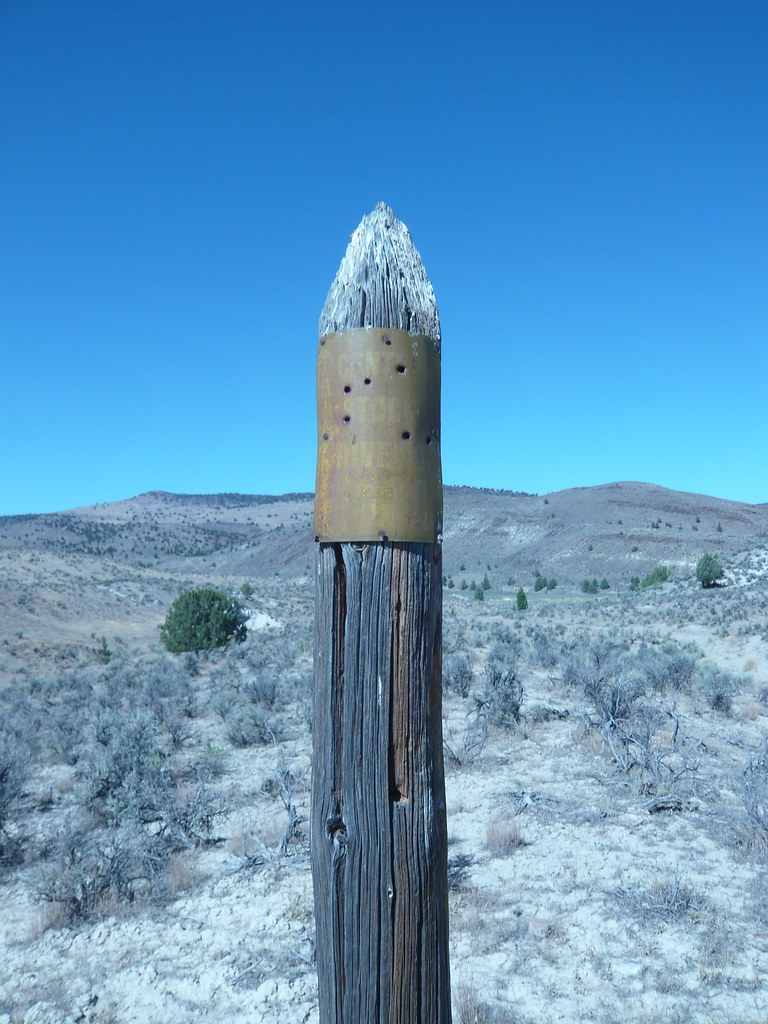
People often refer to most of the American West as 'desert,' but strictly speaking much of it is not true desert, but scrubland.  It's a minor difference both ecologically and semantically, but much of Oregon falls into the latter category.  However, the southeast corner of the state is true desert by anyone's standards (it's the northern reaches of the Great Basin Desert, for those of you who are sticklers for this sort of thing), and that's where I spent the last week.  I was there with the rest of the U of O vertebrate paleontology program (all 5 of us); our main goal was to re-locate several sites collected in the 1950s and '60s that have since fallen into neglect.  I'll confess that at first I was not too thrilled with the idea, partly because I'm never too happy about leaving my cat behind, partly because I much prefer lab work to field work (the lab is where real science is done, after all), but also because I find deserts oddly unsettling.  This is probably because the desert is so radically different then the wet, temperate climates in which I've spent most of my life.  To give just one example, rain west of the Cascades is at worst an annoyance, at best something to be welcomed because it keeps everything so green.  Head east of the Cascades, though, and rain can kill you if it comes down hard enough to trigger flash floods (to say nothing of the lightning that often accompanies it).
There are plenty of other differences as well, of course, and it is by that same token that deserts also hold a strange fascination for me (the list of things that simultaneously creep me out and appeal to me is a long one).  As a kid, my favorite nature programs were those set in Arizona or the Sahara, largely because the wildlife was so radically different than anything we saw in western Washington.  The animals (and to a lesser extent the plants) of the North American desert are still the main attraction for me; there's something to be said for living in a state in which you can drive only a couple of hundred miles and find yourself in a completely different ecosystem filled with exotic organisms.  I especially like the bestiary of biting, stinging, and prickly animals (though I also realize that these are the main complaint about the desert for most people).  It's always a bit of a thrill to come across a rattlesnake, scorpion, or black widow (none of which are a particularly great threat to a healthy adult, especially if viewed from a prudent distance; the only desert animals I would just as soon avoid completely are the giant Pepsis wasps which lay their eggs in living tarantulas and can inflict the second most painful injury - and most painful sting - of any insect).
I'm happy to say, that on balance, this trip fell more towards the interesting rather than the nerve-wracking end of the spectrum.  The weather was perfect (though there was one afternoon of looming rain clouds that had me a bit nervous), the wildlife was present but unthreatening (with the exception of the clouds of mosquitoes that descended upon us nightly; that's what we got for camping in the wettest spot in the area, I guess), and the paleontology was, on the whole, successful.  While our main goal was to locate old sites and get a sense of the regional geology, we also spent a fair amount of time prospecting for fossils.  We came back with a respectable haul of camels, horses, mastodonts, and lots of catfish; one of our crew even found a dog jaw that I'll be able to use in my dissertation research.  In the end, then, it was well worth it, but it may be some time before I'm ever truly comfortable in the desert.

26 August 2008

Corvid Appreciation

In pretty much any part of the world, crows, jays, or magpies - the group of birds known as corvids - are a daily fact of life, animals so common that most people don't even notice them.  This is especially true in Seattle, which is rumored to harbor the world's largest population of crows (either the American crow, Corvus brachyrhynchos, or the Northwestern crow, Corvus caurinus, depending on who you believe).  Whether or not this has ever been reliably demonstrated, it is a fact that Seattle is home to a remarkably large number of the animals, most of which roost directly above the house of one of my best friends from middle school.  At my family's house, our backyard was frequented by a more colorful relative, the electric-blue, crested Steller's jay.  When we went camping in the mountains, we were invariably plagued by gray jays ("camp-robbers," as they're aptly known to many people) and Clark's nutcrackers, and if we headed east of the Cascades we saw more than our share of black-billed magpies and Northern ravens.  I've always had a certain fondness for corvids, not only because I saw so much of them while growing up, but because they are among the smartest animals on the face of the planet (there are, of course, lots of angsty people out there who identify with crows because they are seen as dark and misunderstood; the irony of this Gothic fascination is that corvids in general - and crows in particular - are intensely social animals). Corvids maintain extremely complex social structures, have been observed using tools, are inveterate problem-solvers, have remarkable memories, and are apparently capable of quite sophisticated communication.  Further proof of the intellectual capabilities of crows and their relatives was provided this week by John Marzluff at the University of Washington, who suggests that not only are Seattle's crows capable of remembering people's appearance, they are able to communicate the appearance of individuals perceived as dangerous to other crows.  I'm more convinced of the first point than the second, but read the article and decide for yourself; regardless of the extent of their skills of recognition, the study is another testament to the complexity of the corvid mind.  Most of us will never have the opportunity of seeing chimps or gorillas in the wild, and while dolphins are nothing new to many of us, few people ever get to see them up close an in their element.  Fortunately, we all (unless we live in Antarctica) have the opportunity of observing animals on nearly a daily basis that belong in the same brainy category as primates and cetaceans.  Bear that in mind next time you see a jay foraging in your yard, a murder of crows in a tree, or even a magpie raiding a trash can; each and every corvid out there is a remarkable animal, as will become quickly apparent if you spend even a little time observing their behavior.