 |
| Diceratherium John Day Fossil Beds National Monument |
04 July 2013
Fossil Vertebrate of the Month: Diceratherium


01 June 2013
Fossil Vertebrate of the Month: Tylosaurus ivoensis
 |
| Tylosaurus. ivoensis and other marine vertebrates from the Karlstad Basin (Sørensen et al 2013) |
31 May 2013
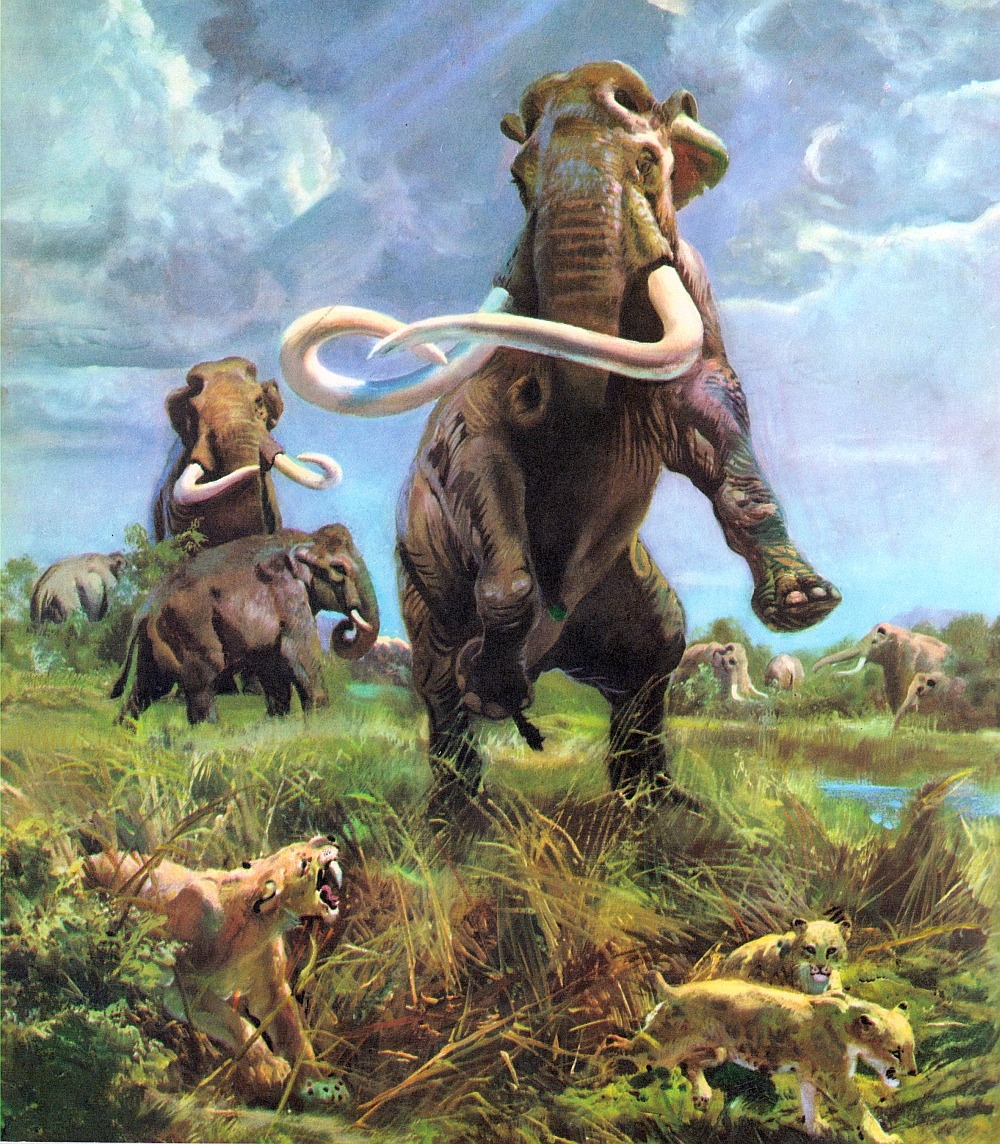
The Mammoth Prairie
 |
| Mammoths & Sabertooth Cats (Zdenek Burian) |
24 May 2013
Bellingham's Big Bird
 |
| DiatrymaUniversity of Wyoming Geological Museum |
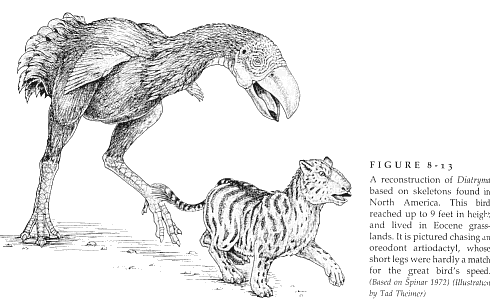
The western half of the Northwest is, for the most part, a geologically young landscape, shaped by the still-growing Cascades and by sediments deposited during the Pleistocene. The fossils found here are, for the most part, correspondingly young. In the Puget Sound Lowlands and the Willamette Valley in particular the vertebrate fossil record is dominated by Ice Age mammals (including the Manis Mastodon). However, there are pockets of older rocks in the region, including the Oligo-Miocene formations of the outer coast that have yielded some of the world's most important specimens of marine mammals and the marine reptile-bearing Cretaceous rocks along the Strait of Georgia. Among the most unusual vertebrate fossils in the region are those from the Chuckanut Formation near Bellingham. In the Eocene, the area was a low-lying floodplain in a warm climate (as indicated by the palm fronds that have been found there). Bones of fossil vertebrates are rare in the formation, but many animals left their footprints in the then-soft sediments of the floodplain, several of which have been preserved as fossil trackways. Trackways and other trace fossils are invaluable paleoecological tools, as they preserve direct evidence of interactions between organisms and their environment. A recent publication out of Western Washington University describing a pair of giant bird tracks from the Chuckanut Formation is a nice case study of the use of fossil footprints in making inferences about the behavior of extinct animals. One of the Eocene's most charismatic animals was the giant flightless bird Diatryma (possibly the same animal as the European Gastornis of BBC fame). Diatryma bones are well-known from the Eocene beds of Wyoming, and when it was first discovered by Edward Drinker Cope in the late 19th Century, it was thought to be a carnivore and was frequently depicted as preying upon the small horses that were common in the area. However, it has subsequently been hypothesized that Diatryma was herbivorous, possibly using its large beak to crack nuts or fruit rinds. The Washington tracks have been tentatively assigned to Diatryma or a close relative; while assigning trace fossils to a taxon previously known from body fossils always entails some risk, but since no other large birds are known from the Eocene of North America, in this case the authors are not going out on too much of a limb. If the tracks were indeed made by Diatryma, they provide some hints as to the animal's behavior, as they don't seem to show any evidence of the sharp talons that characterize modern predatory birds (including, significantly, the terrestrial secretary bird). This is not, of course, the final word in the debate; it's entirely possible that if Diatryma were a predator, it relied more on its beak than its feet for hunting, and it's not outside of the realm of possibility that evidence of talons simply wasn't preserved in these tracks. However, the footprints do provide a novel viewpoint, and it is certainly to be hoped that the Chuckanut Formation will continue to produce fossils that will help elucidate the ecology of Eocene ecosystems.

05 July 2012
Fossil Vertebrate of the Month: Rutiodon carolinensis

12 March 2012
Fossil Vertebrate of the Month: Panthera atrox
 |
| P. atrox in the Natural History Museum of L.A. County John Orcutt, 2010 |
01 February 2012
Fossil Vertebrate of the Month: Nothrotheriops
 |
| Nothrotheriops in the Nevada State Museum, Las Vegas John Orcutt, 2011 |


09 January 2012
Fossil Vertebrate of the Month - Lystrosaurus
10 November 2011
Fossil Vertebrate of the Month: Shonisaurus popularis

22 October 2011
The Manis Mastodon

Addendum: Adding to the Manis Mastodon's Northwest cred, Knute Berger, my favorite Seattle journalist has supplied a brief article on the subject.
13 October 2011
Fossil Vertebrate of the Month - Terror Bird


07 September 2011
Fossil Vertebrate of the Month: Megalonyx jeffersoni

09 May 2011
Orcutt & Hopkins, 2011

02 May 2011
Fossil Vertebrate of the Month: Archaeotherium

19 April 2011
Fun With Body Mass Estimates
02 April 2011
Fossil Vertebrate of the Month: Baryonyx walkeri

06 March 2011
José María Velasco
Serendipity can be a wonderful thing. While doing research in Mexico City last September, I spent a day in the historic center of the city, and one of the places I visited was the Antiguo Colegio de San Ildefonso; tourists like me flock there because it was the birthplace of the Mexican muralist movement, but while I was there it was also hosting an exhibit celebrating the centennial of the Universidad Nacional Autónoma de México. You can imagine how pleasantly surprised I was to round a corner in the geology section of the exhibit to see these:

The paintings above, as well as a third of cave bears that I couldn't find an imagine for online, are by the artist José María Velasco, who I have to admit I'd never heard of before my trip. He lived and worked in the late 19th and early 20th Centuries and is best remembered for his landscapes of the Valley of Mexico, which have served as a touchstone of Mexican national identity. He was also a scientist, with a particular interest in natural history (a running theme in his profession, it so transpires, as Mexico's greatest landscape artist, Dr. Atl, was also an amateur volcanologist and advocate for science); he even described a species of salamander, that has since been renamed in his honor. This may explain why he was commissioned to decorate UNAM's Instituto de Geologia. Velasco's paintings have adorned the palatial building (itself as glorious an example of early 20th Century museum architecture and design as you'll find anywhere in the world) near central Mexico City since the 1910s, and had been brought over to the UNAM exhibit during some renovations (you can get a sense of how they look in situ in this picture). Information on the paintings is scarce, but it appears that Velasco painted two series: one tracing the history of marine life and one depicting terrestrial animals and landscapes through time. These would have been painted at roughly the same time as some of the greatest works of Charles R. Knight and his European counterpart, Heinrich Harder, and I would argue that not only are Velasco's reconstructions in the same league as those of his more famous contemporaries (though it must be said that no one before or since can compete with the vibrancy of Knight's animals), but he in fact surpasses them in many ways; his paleo-landscapes are especially impressive (though sadly underrepresented online). This should come as no surprise, as Velasco was, after all, a classically trained painter and one of his country's greatest artists of the pre-modern era. It seems a shame that his contributions to scientific illustration and paleoart should have lapsed into obscurity, and I thought I'd do my humble best to try to share some of those contributions with the world.
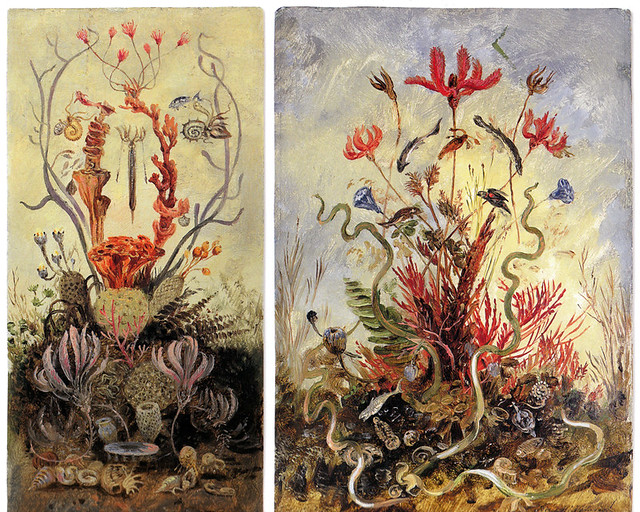
The paintings above, as well as a third of cave bears that I couldn't find an imagine for online, are by the artist José María Velasco, who I have to admit I'd never heard of before my trip. He lived and worked in the late 19th and early 20th Centuries and is best remembered for his landscapes of the Valley of Mexico, which have served as a touchstone of Mexican national identity. He was also a scientist, with a particular interest in natural history (a running theme in his profession, it so transpires, as Mexico's greatest landscape artist, Dr. Atl, was also an amateur volcanologist and advocate for science); he even described a species of salamander, that has since been renamed in his honor. This may explain why he was commissioned to decorate UNAM's Instituto de Geologia. Velasco's paintings have adorned the palatial building (itself as glorious an example of early 20th Century museum architecture and design as you'll find anywhere in the world) near central Mexico City since the 1910s, and had been brought over to the UNAM exhibit during some renovations (you can get a sense of how they look in situ in this picture). Information on the paintings is scarce, but it appears that Velasco painted two series: one tracing the history of marine life and one depicting terrestrial animals and landscapes through time. These would have been painted at roughly the same time as some of the greatest works of Charles R. Knight and his European counterpart, Heinrich Harder, and I would argue that not only are Velasco's reconstructions in the same league as those of his more famous contemporaries (though it must be said that no one before or since can compete with the vibrancy of Knight's animals), but he in fact surpasses them in many ways; his paleo-landscapes are especially impressive (though sadly underrepresented online). This should come as no surprise, as Velasco was, after all, a classically trained painter and one of his country's greatest artists of the pre-modern era. It seems a shame that his contributions to scientific illustration and paleoart should have lapsed into obscurity, and I thought I'd do my humble best to try to share some of those contributions with the world.


02 March 2011
Brontomerus, Hell Creek, and Mesozoic Ecology

01 March 2011
Fossil Vertebrate of the Month: Megaloceros giganteus

21 February 2011
Oregon Trail Word Cloud
What's this blog all about? This word cloud from Wordle pretty succinctly sums up my major themes from the last several months. Apparently I like ecology a lot, but not as much as the number one.
01 February 2011
Humboldt, Bergmann, and Haeckel: The German Roots of Ecology
One of the axioms of science is that any report on your research should include a thorough overview of the topic it addresses. This often means that introductions to scientific papers include some very old citations (for some authors, trying to find the oldest publication you can legitimately cite has become a game, and a pretty fun one at that). I'm in the process of writing the first chapter of my dissertation on the influence - or lack thereof - of climate on body size evolution in mammals, which turns out to be a very long-standing area of study. In working back to the roots of the debate, I've found myself returning to three papers from the early to middle 19th Century, one of which has a direct bearing on my research, another that is a little more tenuously connected, and a third that is only indirectly related but has a profound impact on everything I study. These papers were written by three very different scientists who were studying very different groups of organisms, but all three papers share one major commonality and, as I hope to convince you, several smaller ones as well.
The most recent of these publications is Haeckel (1866): Generelle Morphologie der Organismen by Ernst Heinrich Philipp August Haeckel. Haeckel is remembered today for many things; some of these are positive (he was continental Europe's most eloquent and effective supporter of Darwin and one of the most accomplished scientific illustrators of all time) and some of them very, very negative (he used evolution and his studies on development to justify scientific racism), but he makes an appearance here because it was in his 1866 book that he introduced the word 'ecology' to the world. Haeckel defined his newly-minted word (which roughly translates as 'house study' in Greek) as the study of the environments of organisms. In modern popular culture, environment is often taken to mean the group of abiotic factors - variables such as climate, geography, and geology - that influence an organism, but to ecologists, this is only half the story; organisms also interact with a biotic environment shaped by factors such as predation, competition, and productivity. Ecology, then, is the study of how biotic and abiotic variables influence organisms or, more simply put, the study of why organisms evolve (as opposed to how life has evolved and is evolving, the province of evolutionary biology, though of course there is a huge overlap between the two fields). Because he coined the term, Haeckel is often thought of as the father of ecology, but in fact he would have had no field to provide a name for had it not been for the work of earlier scientists studying the influence of environment on evolution.
One of the most influential of these proto-ecologists was Karl Georg Lucas Christian Bergmann, whose work forms the backbone of my dissertation and of countless other research projects over the course of the last century and a half. Very little biographical information is available for Bergmann: the salient points are that he was born in 1814, attended the University of Göttingen, taught at both his alma mater and at Rostock, and died in 1865, one year before Haeckel wrote his landmark book. While at Göttingen in 1847, Bergmann published the paper for which he is best remembered today: Über die Verhältnisse der Wärmeökomie der Thiere zu ihrer Grösse. The title is a bit of a tongue twister for non-German speakers, but the concept is straightforward enough. Bergmann observed that species of mammals (not individuals within species, as is commonly thought) that lived near the poles tended to be larger than those living towards the equator. Bergmann's explanation for this was that large mammals have small surface area to volume ratios and can therefore retain heat more easily while, conversely, small mammals can shed heat more effectively. Naturally, the poles are colder than temperate regions which are in turn colder than the tropics, and therefore as you head from the former to the latter, you should expect to see a decrease in body size. Bergmann's rule, as this hypothesis has come to be known, has been put to the test several times; his relatively simple explanation has been both supported and attacked by ecologists through the years, but regardless of what you think of his rule, it can't be denied that Bergmann was a pioneering ecologist. By assigning a physical cause to a biotic pattern - and eleven years before Darwin and Wallace introduced the world to natural selection, no less - Bergmann set the tone for generation of ecologists to follow, and as such he deserves to be remembered as a father of the field.
If Bergmann is one of the fathers of ecology, then surely its grandfather was Friedrich Wilhelm Heinrich Alexander Freiherr von Humboldt (1769-1859). As opposed to the relatively obscure Bergmann and the politically distasteful Haeckel, Humboldt is one of the best-known and most beloved figures in the history of science; his Latin American travels and research garnered praise from such luminaries as Edgar Allen Poe, Simon Bolivar, and Thomas Jefferson (himself a scientist of no little reputation) and would inspire Darwin's voyage on the Beagle. While it was his travel narrative that would establish his fame, Humboldt also laid the cornerstone of ecology when, along with his traveling companion Aimee Bonpland, he published Essai sur la géographie des plantes in 1805. During his sojourn in South America, Humboldt had climbed the volcanic peak of Chimborazo in the Ecuadorian Andes (though he failed to reach the summit) and was struck by the distinct zones of vegetation he encountered during his ascent. His notes, coupled with observations of similar patterns on European mountains, gave Humboldt the data necessary for his 1805 paper as well as the large-scale figure that accompanied it (itself a milestone of scientific illustration). By tying vegetation to factors such as temperature, air pressure, and soil type Humboldt became the first scientist to seriously study the influence of the environment on organisms, earning his reputation as a pioneering ecologist as well as countless citations in manuscripts (including mine) over the course of the subsequent two centuries.
The authors of these three papers no doubt had many things in common, but perhaps the most striking is that they shared a country of origin. At first glance, it seems illogical that ecology should have been born in Germany (which, after all, was only a collection of smaller kingdoms and principalities until 1871). Germany has always produced great scientists, from Leibniz to Einstein, but in Humboldt's time Paris was the center of the scientific world, and many of the most celebrated accomplishments of 19th Century science took place not on the Continent but across the English Channel. Even within biology, France and Britain played a dominant role, producing some of the greatest anatomists and, later, evolutionary biologists that have ever lived. Nonetheless, ecology was, at its root, a uniquely German phenomenon. This begs a rather obvious question: why? While I'm a far better paleontologist than historian, I think think I have the glimmer of an answer, but in the interest of keeping unassailable historical facts apart from more baseless arm-waving, I'll save my thoughts for a later post. Stay tuned...

The authors of these three papers no doubt had many things in common, but perhaps the most striking is that they shared a country of origin. At first glance, it seems illogical that ecology should have been born in Germany (which, after all, was only a collection of smaller kingdoms and principalities until 1871). Germany has always produced great scientists, from Leibniz to Einstein, but in Humboldt's time Paris was the center of the scientific world, and many of the most celebrated accomplishments of 19th Century science took place not on the Continent but across the English Channel. Even within biology, France and Britain played a dominant role, producing some of the greatest anatomists and, later, evolutionary biologists that have ever lived. Nonetheless, ecology was, at its root, a uniquely German phenomenon. This begs a rather obvious question: why? While I'm a far better paleontologist than historian, I think think I have the glimmer of an answer, but in the interest of keeping unassailable historical facts apart from more baseless arm-waving, I'll save my thoughts for a later post. Stay tuned...
Fossil Vertebrate of the Month: Megatherium americanum

10 November 2010
Fossil Vertebrate of the Month: Diplodocus carnegii
 Last month's Society of Vertebrate Paleontology meeting was held in Pittsburgh and while animal chosen for the conference logo was the awkwardly-named tetrapod Fedexia, there is another animal that will forever be associated with vertebrate paleontology in that city's Carnegie Museum of Natural History. The museum has existed since 1895, but it was in 1898 that its namesake would spur the discovery of its most famous specimen. It's unclear whether Andrew Carnegie was alerted to the publicity value of sauropod skeletons by a visit to the American Museum of Natural History or by a sensational newspaper headline trumpeting the discovery of "The Most Colossal Animal Ever On Earth." Regardless of the cause, he hired away some of the AMNH's paleontologists and sent them to the badlands of Wyoming to find a giant dinosaur for his museum. His team succeeded spectacularly, and in 1901 the fruits of their labor were described as Diplodocus carnegii. The skeleton, which for decades was the longest - though far from largest - dinosaur known, was a huge hit in Pittsburgh and around the world, as Carnegie presented casts of the skeleton (known affectionately as Dippy) as gifts to museums in capitals across the globe. Dippy even has a couple of connections to paleontology in Oregon: D. carnegii was one of the taxa modeled by UO computer scientist/paleontologist Kent Stevens, and the cast presented by Carnegie to London's Natural History Museum was the first fossil I ever saw and was largely responsible for setting me down the path I'm still traveling today.
18 September 2010
Research Report: Mexico City
 Whenever I tell anyone that I'm a paleontology student, one of the questions I inevitably get is 'Where do you do your field work?' When I tell them that I don't really do field work and that I do my research in the basements of museums, they usually say something to the effect of 'Oh, that's too bad.' Actually, it isn't. For one thing, the best science in our field is done indoors in collections, libraries, and labs. For another, I actually enjoy collections work (you can see a lot more fossils in a day in a museum than you ever will in the field). For yet another, it can take you to some of the best parts of the world. So far my collections visits have brought me home to Seattle, across the Cascades to John Day, to the great cities of California, to the university towns of the Rockies and Great Plains, to New York's unsurpassed temple to natural history, and now they've brought me to one of the greatest, most historic, and culturally rich cities on the planet. I'm writing this post from Coyoacan, a colonial town turned urban neighborhood in Mexico City. I've come to visit the collections of the Universidad Nacional Autónoma de México in order to expand the scope of my dissertation to all of North America rather than just the US. While I've made an avowed effort to cut down on travelogue-type entries on this blog, this is the first international research trip I've taken, and as such a few posts from south of the border might be of more general interest than the usual "this is what I did today and this is what I think of it" travel update. I'll do my best to supply a few of these posts on the state of my research and of paleontology and science in Mexico during the duration of my visit this week, so stay tuned.
06 September 2010
Fossil Vertebrate of the Month: Epicyon haydeni
 Last month, while measuring teeth in the collections of the University of Montana and Idaho State University, I came across jaws of one of the more impressive carnivores ever to have lived. The picture at left (from UM) may not do the size of the animal justice, but Epicyon haydeni is the most massive known canid; the largest known individuals may have exceeded 200 pounds, putting them well within the size range of modern black bears. Epicyon was a member of a group of canids known as borophagines that were among the most common carnivores of the North American Oligo-Miocene. Borophagines are often described as hyena-like, and many of the larger taxa - including Epicyon - were likely bone-crushing predators. However, the group was very diverse and many of its members, especially in the Oligocene and Early-Mid Miocene, were actually fairly small; at least one species had an almost raccoon-like morphology. In many Late Miocene faunas, two species of Epicyon co-occur: the larger E. haydeni and the smaller (but still very big) E. saevus. Canid experts extraordinaire Xiaoming Wang and Richard Tedford have suggested that this is the result of character displacement, making Epicyon an excellent example of how the fossil record can record ecological and evolutionary patterns.
31 July 2010
Fossil Vertebrate of the Month: Oncorchynchus rastrosus
 Salmon are a symbol of the Northwest, and with good reason: not only have they been a staple food for humans for millennia and a hugely important link in regional food chains for much longer, but they have very deep roots here. Go back to the Late Miocene and you would still see salmon in the rivers of Oregon; you would, in fact, see one of the most impressive prehistoric fish ever discovered: Oncorhynchus rastrosus, the sabertooth salmon. The features that gave the fish its common name (and its original genus name, Smilodonichthys) are its enlarged canines which, arresting as they are, are not as unusual as they might seem, as many modern salmon grow large breeding teeth while migrating upstream to spawn. The size of O. rastrosus, though, is unique: at lengths of up to 2 meters, it was a good deal larger than the largest known Chinook salmon and head and shoulders beyond sockeyes, its nearest living relatives. The sabertooth salmon was in the news this last month (both in the paper and on TV) after a team led by the University of Oregon's own Edward Davis performed a CAT-scan on its skull. The result of this research is a series of impressive 3-D reconstructions, which can be viewed in an online exhibit by the U of O Museum of Natural & Cultural History; if you'd rather see the original in person, it will be part of the museum's revamped PaleoLab exhibit opening this month.
Field Report: Field Camp 2010
 As many of you may know, I was the TA for the paleontology portion of the U of O's field camp this year. Since I got back earlier this week, several people have asked me what we did and what we found. I may not be a great blogger, but even I know the first rule of journalism, so in the interest of giving the people what they want, here's a brief summary of what went on (You'll notice that I'm not giving names or locations of any of the work we did; we were at two sites, both of which are publicly owned, and since illegal collection on federal land is a recurring problem in eastern Oregon, I don't want to provide any information that an unscrupulous fossil poacher might be able to use; for those of you who are wondering, yes, we did have the appropriate permits).
The first site we visited (let's call it Site 1, since imagination is precious and should be conserved) was an exposure of the famous John Day Formation, which has yielded one of the largest and best-preserved Oligocene faunas in the world. Since the primary purpose of our trip was to teach basic paleontological field methods, the bulk of our time was devoted to creating stratigraphic sections for the outcrop. There was, however, time for fossil prospecting as well, and it was very - almost ludicrously - productive. Among the things we uncovered were rodents (particularly squirrels and aplodontids), hypertragulids (mouse deer), canids, nimravids (sabertoothed, cat-like carnivores), horses, entelodonts (bearlike relatives of pigs), and rhinos. Perhaps the most impressive specimens we unearthed were four skulls of oreodonts, pig- and/or sheep-like ungulates that were abundant in the late Oligocene of Oregon (we found ample oreodont postcrania as well, some of which are pictured above).
Our second site (being creative once again, let's call it Site 2) was less fossiliferous but scientifically much more interesting. Instead of just getting a handle on the local stratigraphy as we'd done at Site 1, we were also interested in pinning down the age and paleoenvironment of Site 2, both of which were big question marks going in to field camp. Fortunately, the fossils we found were exactly the ones we'd hoped for to be able to assign an age to the fauna: jaws of the canids Tephrocyon and Cynarctoides, teeth of the horses Archaeohippus and Merychippus, the beaver Monosaulax, and a smattering of camels and paleomerycids (antelope-like ungulates). For those of you who know your North American biostratigraphy, that places you unequivocally in the mid-Miocene (~16 Ma), which in this part of Oregon means you're in the Mascall Formation. Pinning down the paleoenvironment was made easy by the discovery of a bird (probably some kind of waterfowl) and by several shell fragments of pond turtles (I won't insult your intelligence by telling you exactly what the students concluded about the site's paleoecology, but if you can't figure out what environment is likely to be represented by waterfowl and pond turtles, I question whether this is the blog for you).
So there you have it: for a trip whose primary motivation was teaching, we had a remarkably successful couple of weeks in the field (and not just in terms of finding fossils; we were very lucky weather-wise as well, though the last couple of days did manage to break the 100° mark). We and our specimens are now all safely back in Eugene, with the latter awaiting curation and, eventually, a trip back east, where they will be reposited in the collections of John Day Fossil Beds National Monument.
30 June 2010
Fossil Vertebrate of the Month: Bradysaurus
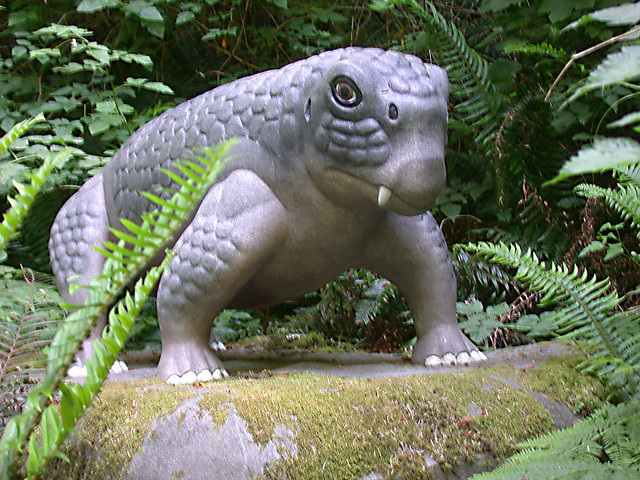
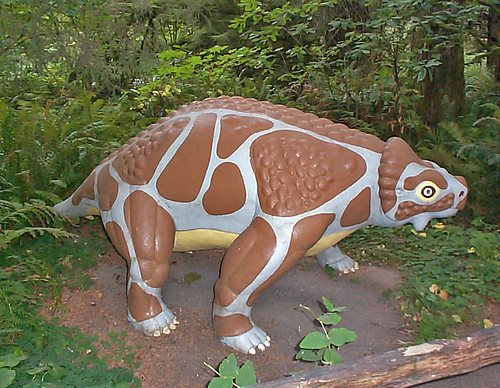
 In honor of this year's World Cup host, July's fossil vertebrate is South African. Bradysaurus (literally "Slow Lizard," represented here by a skeleton from Berlin's Museum für Naturkunde) was a pareiasaur, a group of large, armored herbivores that may be distantly related to turtles. Though pareiasaurs have been found in late Permian sites throughout the Old World, Bradysaurus is unique to the Karoo Basin north and east of Cape Town. While pareiasaurs were among the largest members of the South African ecosystem, the fauna was dominated by therapsids, or "mammal-like reptiles," including the now-iconic, predatory gorgonopsians and burrowing dicynodonts. The Karoo has been the focus of many research projects in recent years because it is one of the few regions with a terrestrial fossil record of the Permian Extinction, the largest mass extinction in the history of life. Pareiasaurs were among the groups that would not survive the end of the Permian; if you want to see one today, I recommend Oregon's very own Prehistoric Gardens.
Subscribe to:
Posts (Atom)