17 December 2015

17. Hominid Sites of Lake Turkana

Nariokotome Boy
National Museum of Kenya
Location: Marsabit & Turkana, Kenya
Formation: Several, most notably the Koobi Fora Formation
Age: Pliocene-Pleistocene (4-2 Ma)

If the story of climate change through the Cenozoic is one of cooling and drying, the principle drama that has been played out in terms of environment is the interplay between forests and grasslands.  Both because of the number of lagerstätten there and the amount of research that has been focused them, the stage on which this drama is often set is North America.  However, places like the steppes of Central Asia and the pampas of South America tell much the same story.  So too do the savannahs of Africa, and these have been the subject of a great deal of study because they factor prominently in our own evolutionary story.  Like much of the world, Africa saw its forests give way to open environments during the Miocene, while at the same the continent began to fracture along the Great Rift Valley as the Horn of Africa began to move eastward.  The wide array of scattered environments, it has been argued, were the impetus for our earliest ancestors to leave the trees and begin walking upright (though, like almost every hypothesis in the subdiscipline of paleoenthropology, this is by no means universally accepted).  Regardless of what originally drove a particular group of apes to evolve an erect posture, by the latest Miocene and into the following epochs, the Pliocene and Pleistocene, hominins - the subfamily of Primates to which we belong - had begun to diversify into a variety of forms.  Sites along the Kenyan shorelines of Lake Turkana preserve an especially high concentration of hominin fossils, from the enigmatic Kenyanthropus, to Australopithecus (best known as the genus to which Lucy belonged, and also well known from sites in Ethiopia and South Africa), to Paranthropus (easily the most bizarre branch of the hominin tree, with enormous and robust skulls that isotopic analyses have suggested were adapted to a diet of bamboo), to members of our own genus, Homo.  The most spectacular Turkana fossil from this last category is the so-called Nariokotome Boy, a specimen assigned variously to H. erectus and H. ergaster.  The nearly complete skeleton, found on the western shore of the lake, is not only spectacular in and of itself, but is one of the best sources of information available about our own branch of the hominin tree.  The oldest rocks along Lake Turkana date to a time when the entirety of human evolution had taken place in Africa.  By the time Nariokotome Boy was alive, though, members of our genus had begun to spread across the rest of the world, where they would encounter Pleistocene ecosystems that would form the basis of some of the Cenozoic's most stunning lagerstätten and in which they would, in many cases, figure prominently.

Visit: A series of national parks surround Lake Turkana, many designated as World Heritage Sites.
Fossils: Fossil material from throughout the country is reposited in Nairobi's National Museum, but having never been, I can't vouch for how much Turkana material is on display.
Is there a relevant book full of gorgeous fossil photos that I can gift to a paleontologically-minded friend?: No, though several books focusing on human evolution are available.

This post is part of my 2015 Paleontology Advent Calendar, a series of vignettes on lagerstätten - sites of exceptional fossil preservation - that document changes in climate and environments through the Cenozoic.  You can see the other posts here.

16 December 2015

16. Gray Fossil Site

Rhinos, alligators, and tapirs from the Gray Site
Phil Fraley Productions
Location: Tennessee, USA
Formation: Sediment fill in the Knox Group
Age: Miocene (7-5 Ma)

By the end of the Miocene, grasslands had expanded across the interiors of most continents, but that is not to say that forests went extinct.  In places where temperature and precipitation remained favorable, forests of various kinds continued to flourish even as global climate cooled and dried.  The Appalachians were one such area, and at the end of the Miocene they were blanketed in woods of oak, hickory, and pine similar in many ways to those of the southern end of the mountain range today.  East Tennessee sits atop carbonate rocks that can be dissolved by water, leading in places to the collapse of overlying sediments to form sinkholes.  One such sinkhole in eastern Tennessee that existed in the closing days of the Miocene accumulated the remains of plants and animals from the area that would eventually become one of the richest vertebrate fossil-bearing sites in eastern North America.  Because it represents a forest from an interval with a fossil record dominated by grasslands, the Gray Fossil Site has yielded many animals not commonly seen elsewhere.  Perhaps the most interesting of these are animals that migrated to North America from elsewhere as cooling temperatures, lowering sea levels, and the movement of tectonic plates facilitated the movement of species across the globe.  North America and Asia were connected many times over the course of the Cenozoic, and some Asian immigrants found at the Gray Site, such as elephant-like gomphotheres and cats (including some of the saber-toothed variety), had arrived on the continent in the mid-Miocene.  Others, such as bears and, bizarrely, red pandas, were much more recent arrivals.  Perhaps most significant of all, though, were giant ground sloths, the earliest and among the most successful of migrants from South America, which until the end of the Miocene had been comparable to Australia in its isolation from the rest of the world.  There are also plenty of North American natives at the Gray Site, the most common of which were tapirs (which, though they are extinct on the continent today, have a fossil record here dating back to the Eocene).  The dwarf species Tapirus polkensis has been found in such numbers, and in such good states of preservation, that it's been the focus of population ecology analyses, an area of study that usually cannot be applied to fossil vertebrates.

Visit: East Tennessee State University in Johnson City owns the Gray Site and operates a museum there.
Fossils: As opposed to many of the lagerstätten featured this month, fossils of which are often scattered through several collections, pretty much everything from the Gray Site has wound up in the ETSU collections.
Is there a relevant book full of gorgeous fossil photos that I can gift to a paleontologically-minded friend?: There is!

This post is part of my 2015 Paleontology Advent Calendar, a series of vignettes on lagerstätten - sites of exceptional fossil preservation - that document changes in climate and environments through the Cenozoic.  You can see the other posts here.

15 December 2015

15. Ashfall

The Ashfall Bone Bed
Location: Nebraska, USA
Formation: Ash Hollow Formation
Age: Miocene (12 Ma)

We've seen several lagerstätten that preserve gorgeous fossils over the course of the month, but most of these are from sites in which remains of organisms accumulated over the course of long periods of time.  Moments of time are only rarely preserved in the fossil record, and Ashfall is among the very few sites to do so.  Twelve million years ago, the Great Plains had begun to take on their modern appearance, while to the west, what would become the Boise area sat atop the volcano that today fuels the geysers and hot springs of Yellowstone.  Eruptions of this titanic volcano produced immense clouds of ash, one of which settled onto a watering hole in northeast Nebraska, starving and suffocating the local wildlife and creating Ashfall.  Small animals died first, probably within hours, as shown by their abundance at the bottom of the ash layer.  Larger animals took up to a few weeks to die, and are consequently more common at the top of the bone bed.  The resulting deposit is not only full of complete skeletons, even of such fragile animals as birds and amphibians, but provides a snapshot of life on the nascent Great Plains that provides endless opportunities for research.  Interested in evolution and anatomy?  Nowhere will you find as many complete and articulated skeletons of everything from camels to snakes as at Ashfall.  Interested in the behavior of extinct mammals?  A whole herd of rhinos is entombed, providing even better evidence than the Agate bone beds of the evolution of herding behavior in plains animals.  Development?  Some taxa, particularly the horse Pseudhipparion, are represented by everything from newborns to full-grown adults.  Paleoecology?  An entire ecosystem preserved in the blink of a geological eye is present here.  Paleopathology?  Larger animals show signs of abnormal bone growth associated with high rates of volcanic particulate in the atmosphere.  Taphonomy?  Not only was the speed of burial unusually fast, but preservation in a layer of volcanic ash is also rare in the fossil record.  In short, Ashfall is more than simply a treasure trove of fossils: more than any other lagerstätte featured this month, it is a frozen moment in time and a font of information about the evolution of life on the Great Plains.

Visit: The "Rhino Barn" at Ashfall Fossil Beds State Historical Park should be at or near the top of everyone's paleontology life list.  It's a bit out of the way from pretty much anywhere, but well worth the detour.
Fossils: Most of the really spectacular fossils from Ashfall remain in situ, but the University of Nebraska State Museum in Lincoln houses and displays specimens excavated from the site.
Is there a relevant book full of gorgeous fossil photos that I can gift to a paleontologically-minded friend?: There is, and it's hot off the presses!  Information about it is available in the link to the State Historical Park above.

This post is part of my 2015 Paleontology Advent Calendar, a series of vignettes on lagerstätten - sites of exceptional fossil preservation - that document changes in climate and environments through the Cenozoic.  You can see the other posts here.

14 December 2015

14. The Barstow Arthropods

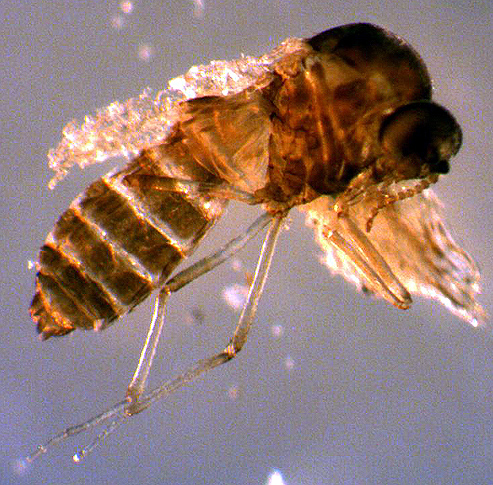
The fly Dasyhelea, preserved in three dimension in the Barstow Formation
Farrall Smith
Location: California, USA
Formation: Barstow Formation
Age: Miocene (16-13 Ma)

The Mid-Miocene Climatic Optimum falls in the midst of a subdivision of the Miocene known in North America as the Barstovian Land Mammal Age, named for Barstow, California.  While the city is famous today as the midpoint between Los Angeles and Las Vegas and for being the very worst the Golden State has to offer, it has considerable fame among paleontologists.  This is primarily due to its mammal fauna, represented both by skeletal material and, more unusually, by trackways.  As productive as the  mammal-bearing units of the Barstow Formation are, though, it is the remains of insects that qualify certain units as lagerstätten.  We've seen a few localities with well-preserved insects, but in most cases (Riverlseigh being the one big exception), these are preserved as flattened remains or as trace fossils (chewed leaves, social insect nests, and the like).  At Barstow, the exoskeletons of insects and other arthropods were replaced by silica-rich minerals, strengthening them and allowing animals to be preserved in three dimensions.  The most abundant of these fossils are adults and larvae of salt-tolerant insects (especially beetles and flies) and fairy shrimp, which are neither insects nor shrimp, but crustaceans that specialize in living in ephemeral desert ponds.  The species preserved in the Barstow insect beds show that, while Nebraska may have been covered in grasslands and Idaho was home to deciduous forests in the mid-Miocene, southern California was a much drier place (not a huge surprise, given Barstow's modern location in the midst of the Mojave Desert).  More than that, the composition of the arthropod fauna changes between beds, showing that the landscape got ever more arid as time passed.  This likely was driven local climatic changes related to the uplift of the land and the shallowing of the lake in which the fossils were preserved, but also reflects a global trend.  While we tend to think of climate change solely in terms of temperature, other variables fluctuate through time as well.  As the MMCO ended and temperatures began their slow, steady decline, most areas of the world also saw less precipitation.  This increase in aridity is very nicely illustrated by the Barstow arthropods and would, among other things, play a major role in the increased global spread of grasslands and animals adapted to a life on the open range.

Visit: The Barstow insect localities are located on BLM land, but there are no visitor facilities associated with them that I'm aware of.
Fossils: Barstow mammal fossils stars of the show at many Southern California museums, such as the LA County Museum, the Raymond Alf Museum, and the San Bernardino County Museum.  To the best of my knowledge, the insect fossils are not exhibited anywhere.
Is there a relevant book full of gorgeous fossil photos that I can gift to a paleontologically-minded friend?: Nope.

This post is part of my 2015 Paleontology Advent Calendar, a series of vignettes on lagerstätten - sites of exceptional fossil preservation - that document changes in climate and environments through the Cenozoic.  You can see the other posts here.

13 December 2015

13. Clarkia

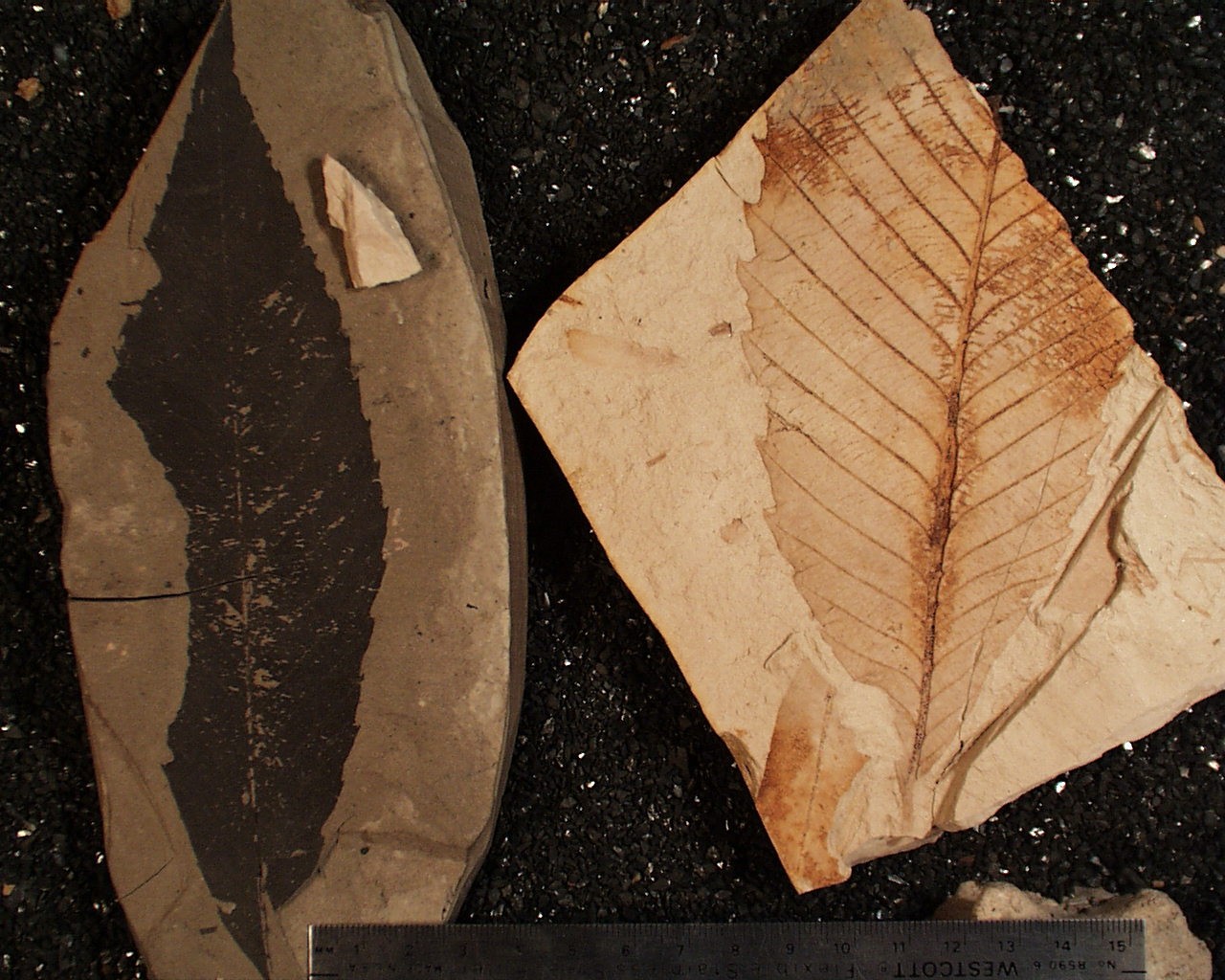
Chestnuts from Clarkia
William C. Rember, University of Idaho
Location: Idaho, USA
Formation: Clarkia Formation
Age: Miocene (15 Ma)

While the Great Plains began to take on a modern appearance at least as early as the beginning of the Miocene, the response of vegetation to changing climate was somewhat more complex elsewhere.  Around 16 million years ago, global climate warmed once more in an event known as the Mid-Miocene Climatic Optimum (or MMCO), after which it would steadily cool, culminating millions of years later in the Pleistocene Ice Ages.  During this final burst of warmth before the protracted cool of the Late Miocene and beyond, parts of the world saw forests reclaim land that had previously been dominated by open woodlands, savannahs, and grasslands.  This was certainly the case in the Northwest, where several floras show a flourishing of trees, with none doing so more spectacularly than the Clarkia Flora of northern Idaho.  The fossils uncovered from the site - including Metasequoia, beeches, maples, and walnuts - indicate a climate comparable to that of the older Bridge Creek Flora and to the modern Southeast US and temperate Asia.  While the plants of Clarkia may tell a familiar taxonomic and environmental story, their quality of preservation is unique.  Fossils in the lower units of the site were entombed in an anoxic environment, and this lack of oxygen has preserved not just details of their anatomy, but actual organic tissue.  This means that, before being exposed to oxygen, many of the leaves retain their original colors.  More importantly, molecular biology and paleontology generally exist in two very separate worlds, but Clarkia fossils allow biochemical and genetic studies that would be impossible at other localities.  Being able to study paleobiology on both a micro- and macroscopic scale is rare in general, and almost unheard of for fossils as old as 15 million years, making Clarkia stand out even in a region known for its fossil floras.

Visit: The site used to be open to private collecting for a fee, but all recent searches for it lead back to the Fossil Bowl dirt bike trackway in Clarkia.  I confess to a sense of deep foreboding about the condition of this internationally important locality today.
Fossils: Information about the location of Clarkia fossils is as ephemeral as information about the site itself.  The original collections were stored in the UI College of Mines Museum.  The College of Mines no longer exists, and the department it was subsumed into provides no hint as to where the fossils are currently stored.
Is there a relevant book full of gorgeous fossil photos that I can gift to a paleontologically-minded friend?: Given the inexplicable obscurity into which the site seems to have sunk, it probably shouldn't surprise you that there isn't.

This post is part of my 2015 Paleontology Advent Calendar, a series of vignettes on lagerstätten - sites of exceptional fossil preservation - that document changes in climate and environments through the Cenozoic.  You can see the other posts here.

12 December 2015

12. The Bone Beds of Agate

The entelodont Daeodon scavenging the corpse of the chalicothere Moropus
Agate Fossil Beds National Monument
Location: Nebraska, USA
Formation: Harrison & Anderson Ranch Formations
Age: Miocene (23-19 Ma)

While global temperature rebounded somewhat at the end of the Oligocene and at the beginning of the following Miocene Epoch, the global jungles and forests of the Eocene were gone.  In place of the trees that had blanketed landscapes from Scandinavia to the Australia, grass was beginning to take over.  Grasslands were a novelty at the beginning of the Eocene, increasingly common by the end of the Miocene, and are among the most widespread biomes on Earth today.  They are affected by climate, tending to grow in cooler, drier environments than forests, but they also play a major role in shaping climate as well as the organisms that occupy them.  One of the best places to observe these effects is in a place still known for its plains today: the panhandle of Nebraska.  Erosion by the Niobrara River has exposed a number of mammal fossil-bearing localities in the area, including some konzentrat-lagerstätten in the form of spectacularly productive bone beds.  Animals found here include relatives of familiar plains-dwellers such as horses, camels, and rhinos, as well as extinct taxa such as pig-like (but probably predatory) entelodonts, bear-dogs, and, strangest of all, chalicotheres (which I can only describe as horse-rhino-panda hybrids).  Many of these animals show what clearly seem to be adaptations to living in grasslands: long legs reflecting greater running ability, larger size, and defensive structures, all necessitated by the absence of trees in which to hide or from which to ambush prey.  Even among small mammals, adaptations to this new ecosystem are apparent, most notably in the beaver Paleocastor which, millions of years before its relatives became aquatic, was tunneling beneath the Nebraska plains, leaving behind the burrows known to early fossil hunters as "Devil's Corkscrews."  Other characteristics of Agate mammals may or may not reflect the pressures of grassland life.  The higher crowned teeth that were beginning to evolve in taxa such as camels and horses were long explained as adaptations to a diet of abrasive grass, but many recent studies have suggested that the connection between tooth height and grass abundance is not as close as once thought.  The bone beds themselves were long interpreted as evidence of herd behavior and living in large groups would certainly be useful in an open landscape, as it provides safety in numbers for herbivores and allows pack hunting in carnivores.  In some cases, the bone beds may indeed represent the death of several members of a herd around a watering hole during a drought, but it's also possible that the bones accumulated over a long period of time or were concentrated in particular locations by rivers.

Visit: Agate Fossil Beds National Monument, south of Harrison, preserves the most important historic bone beds as well as several Paleocastor burrows.
Fossils: The national monument visitor center has some nice fossil displays, but much of the best Agate material can be seen at the American Museum of Natural History, the Carnegie Museum, and the University of Nebraska State Museum, though there's hardly a major museum in the country without a specimen or two from the area.
Is there a relevant book full of gorgeous fossil photos that I can gift to a paleontologically-minded friend?: The Park Service publishes a nice, if somewhat dated, overview of the science and history of Agate.

This post is part of my 2015 Paleontology Advent Calendar, a series of vignettes on lagerstätten - sites of exceptional fossil preservation - that document changes in climate and environments through the Cenozoic.  You can see the other posts here.

11 December 2015

11. Caribbean Amber

Ichneumonid wasp in Dominican amber
George Poinar, Jr., Wikimedia
Location: Dominican Republic &Haiti
Formation: Numerous
Age: Oligocene (25 Ma)

Many of the fossils presented here this month are figurative gems, but a few sites literally preserve fossils within gemstones.  As any fan of trivia will tell you, there are two gems created by organisms: pearls and amber.  As hardened tree resin, amber is itself a fossil, but the fossils most often associated with amber are the remains of organisms entombed within.  These can range in size and taxonomy from pollen grains to vertebrates, but most famously includes insects, which are preserved in resin relatively frequently.  Two region of the world are especially well-known for their amber lagerstätten: the Baltic Sea (representing the European jungles of the Eocene discussed at the beginning of this series) and the island of Hispaniola (which dates to the Oligocene).  Then as now, the Greater Antilles were in the tropics, meaning that the region has not been subjected to the same degree of cooling as much of the rest of the world.  This is confirmed by the fossils themselves; most of the amber on the island is formed from the resin of a relative of the modern algarrobo tree, a tropical legume.  Preserved organisms include organisms such as palms, ants, and lizards, all of which indicate a tropical climate.  Like the Oligocene-Early Miocene sites from Riversleigh, then, the environmental story told by Caribbean amber is not one of organisms and ecosystems adapting to colder climatic conditions.  Rather, amber provides a window on the evolution of one particular ecosystem through time: tropical rain forests.  Rainforests are cradles of biodiversity today and, presumably, through much of Earth's history, but despite their huge importance, they are among the worst-represented biomes in the fossil record.  Decomposition occurs at high rates in jungles and soil conditions are generally unfavorable for preserving many types of fossil (most of the rainforest ecosystems discussed so far this month are actually preserved in lake or marine sediments, which are much better preservational environments).  The rare in situ snapshot of an Oligocene rainforest provided by Caribbean amber allows the study of a forest ecosystem that persists in the area to this day.  To the north, though, formerly forested land was beginning to give way to an entirely new biome dominated by a particularly hearty group of plants and populated by animals forced to play by an entirely new set of rules.

Visit: Caribbean amber is mined commercially, and based on what I can glean from the Dominican Republic's tourism site, none of these mines are open to the public.
Fossils: Two Dominican museums focus on local amber: the Museo Mundo del Ambar in Santo Domingo and the Museo del Ambar in Puerto Plata.  Also in Santo Domingo, the Museo Nacional de Historia Natural has an amber exhibit.
Is there a relevant book full of gorgeous fossil photos that I can gift to a paleontologically-minded friend?: Not as such, but there is a well-written survey of Dominican amber available.

This post is part of my 2015 Paleontology Advent Calendar, a series of vignettes on lagerstätten - sites of exceptional fossil preservation - that document changes in climate and environments through the Cenozoic.  You can see the other posts here.

10 December 2015

10. Riversleigh

Nimbacinus dicksoni, a dasyuromorph from the Oligo-Miocene of Riversleigh
Queensland Museum/University of New South Wales
Location: Queensland, Australia
Formation: Numerous
Age: Oligocene-Holocene (25-0 Ma)

Most of the sites included in the Lagerstättenadventskalendar thus far have been from the Northern Hemisphere, in large part because sites in Europe and North America are numerous and have been extensively studied for long periods of time.  However, global climate change, by definition, affects the entire globe and there are sites on the southern continents that document how organisms and ecosystems there were influenced by changing climate.  Perhaps the most significant of these, Australia's Riversleigh is not one site but a series of several in the northwest corner of Queensland.  Riversleigh is remarkable not only because of its location but because it records a history of environmental change encompassing everything from the Oligocene to the present day.  From a preservational standpoint, the most impressive of Riversleigh's fossils are the three-dimensionally preserved arthropods from the Miocene Upper Site, but the most abundant and best-studied of Riversleigh's fossils are its vertebrates.  These include such stars of the Australian fauna as giant dromornithid birds, crocodiles, egg-laying monotreme mammals, and, of course, marsupials.  Everything from (relatively) familiar animals such as koalas and rhino-sized diprotodonts to obscure creatures such as "thingodonts" and tapir- (or possibly sloth-) like palorchestids has been found at Riversleigh.  Of particular interest to me, Riversleigh fossils account for much of what we know about the evolution of the three major groups of Australian carnivorous marsupials: dasyuromorphs (the group that includes Tasmanian devils and most other modern Australian predators), thylacoleonids (the marsupial lions), and propleopines (carnivorous kangaroos!).  Taken as a whole, these fossils and the rocks in which they are preserved tell a long-term story of environmental change from dense rainforest in the Oligocene and Early Miocene to cooler forests in the later Miocene to drier, more open woodland in the Pliocene to the shrubland that characterizes the region today.  No series of sites has provided as much insight into the evolution of Australia's unique fauna and ecosystems as has Riversleigh, and there are few localities anywhere that so clearly tell the story of climatic cooling and drying that characterizes the post-Eocene world.

Visit: The Riversleigh sites have been inscribed as a World Heritage Site and are preserved in Boodjamulla National Park in Queensland.
Fossils: The Queensland Museum in Brisbane is the official repository for Riversleigh fossils, but relatively few are on display there.  This is in large part due to much of the material still being the subject of active research at several institutions across Australia.
Is there a relevant book full of gorgeous fossil photos that I can gift to a paleontologically-minded friend?: There is!  It's written by Mike Archer, the leading authority on Riversleigh, and his colleagues at the University of New South Wales and, besides being full of gorgeous reconstructions and photos, is an excellent read.

This post is part of my 2015 Paleontology Advent Calendar, a series of vignettes on lagerstätten - sites of exceptional fossil preservation - that document changes in climate and environments through the Cenozoic.  You can see the other posts here.

09 December 2015

9. Bridge Creek Flora

The dawn redwood Metsequoia
Photo by staff of John Day Fossil Beds NM
Location: Oregon, USA
Formation: Big Basin Member of the John Day Formation
Age: Oligocene (33 Ma)

The fossil plants of the Big Basin Member in the John Day Basin are only about a million years younger than the fossils of Florissant, but that brief interval of time encompasses one of the most important periods of change in the Cenozoic.  The clock ticked over from the Eocene to the Oligocene 33.7 million years ago, midway between the deposition of the two lagerstätten, and this boundary marks a significant climatological and ecological shift worldwide.  Global temperature had been slowly decreasing through the Late Eocene, but at the boundary it drops precipitously (though exactly how precipitously is still a matter of some debate).  For the first time in the Cenozoic, ice sheets began to grow in Antarctica and ecological turnover occurred across the face of Earth in an event known in Europe as the Grande Coupure.  The plants of Oregon's Bridge Creek Flora very clearly illustrate this new world order.  Though they grew in the same spot where the forests of the Clarno Formation had existed 11 million years earlier, the Bridge Creek plants draw comparisons not to jungles but to temperate deciduous woodlands. The most abundant fossils from these sites are leaves and needles of trees, some - oak, elm, beech, and several others - compare to species from the Southeast US, while others - including ginkgoes and katsuras - have living relatives native to China and Japan.  The most notable of these plants with Asian affinities is the dawn redwood Metasequoia, a deciduous conifer related, as the name suggests, to redwoods and sequoias.  Metasequoia has the distinction of being one of the very few taxa first described as a fossil and to later be discovered alive and well, in this case in the central Chinese province of Hubei.  Its fossils have been found worldwide, but they are especially common in the Bridge Creek Flora and other John Day Basin sites of similar age, leading to its designation as Oregon's State Fossil in 2005.

Visit: Many of the sites from which the Bridge Creek Flora have been uncovered are protected by John Day Fossil Beds National Monument.  One site, behind the football field at Fossil High School, is administered by the Oregon Paleo Lands Institute and allows public collecting for a fee.
Fossils: As with the Clarno Nut Beds, the best place to see Bridge Creek fossils is at the national monument's Condon Fossil Center, which I will reiterate should be near the top of anyone's list of excellent regional fossil museums.
Is there a relevant book full of gorgeous fossil photos that I can gift to a paleontologically-minded friend?: No, but there should be.

This post is part of my 2015 Paleontology Advent Calendar, a series of vignettes on lagerstätten - sites of exceptional fossil preservation - that document changes in climate and environments through the Cenozoic.  You can see the other posts here.

08 December 2015

8. Florissant

Paleovespa, the Florissant wasp
National Park Service
Location: Colorado, USA
Formation: Florissant Formation
Age: Eocene (34 Ma)

The lagerstätten featured so far this month all date to the early or middle parts of the Eocene and, with the rare exception, indicate a global hothouse.  The warm conditions of this interval were not to last, however.  Dating to the very end of the epoch, Colorado's Florissant Fossil Beds are the Eocene's last bow, and suggest that temperate conditions had already become more widespread.  Unlike most other sites in the advent calendar, Florissant preserves some truly massive specimens that document this climatic shift.  The largest fossils from this lagerstätten are redwood trunks that are impressive in and of themselves but that, to anyone who has spent time in the modern forests of coastal California, clearly show that Florissant was no tropical paradise.  Smaller plant fossils, of leaves and flowers, support this conclusion, as they represent trees such as beeches, willows, and pines.  These leaves are preserved in exquisite detail, as are the arthropod fossils for which the site is known.  Perhaps the most familiar of all Florissant fossils is the wasp Paleovespa, but insects from ants to dragonflies (both nypmhs and adults) to katydids have been found there, as have non-insect arthropods (most notably spiders).  Was the cool, lakeside forest occupied by these animals representative of the world as a whole in the Eocene's closing years?  It's worth noting that, like the Okanogan lakes of millions of years earlier, Florissant was a high-elevation site and this likely influenced its climate (its mountainous location certainly had an effect on the site's fossil record, as burial by volcanic ash was a major factor in Florissant's high quality of preservation).  However, the advent of the Oligocene was nigh, and another, slightly younger, lakeside forest shows that temperate conditions were becoming ever more common even at lower elevations in this new epoch.

Visit: The fossil beds are preserved within Florissant Fossil Beds National Monument near Colorado Springs and make a long but doable and worthwhile day trip from Denver.
Fossils: The national monument visitor center has the largest display of Florissant fossils I've seen, but other local museums house specimens as well; I'm given to understand that the University of Colorado Museum of Natural History has an especially large collection.
Is there a relevant book full of gorgeous fossil photos that I can gift to a paleontologically-minded friend?: There is, and it's another one that my personal collection is sorely lacking.

This post is part of my 2015 Paleontology Advent Calendar, a series of vignettes on lagerstätten - sites of exceptional fossil preservation - that document changes in climate and environments through the Cenozoic.  You can see the other posts here.

07 December 2015

7. The Quercy Phosphorites

"Mummy" of the frog Thaumastosaurus gezei
Denis Serrette, Muséum National d'Histoire Naturelle
Location: Quercy, France
Formation: Quercy Phosphorites Formation
Age: Eocene-Oligocene (39-27 Ma)

Phosphorites that outcrop throughout the historic region of Quercy in southern France document life in Europe from the middle Eocene through the later part of the succeeding epoch, the Oligocene.  The earliest of the fossils from Quercy tell a story similar to that told by Messel, though one based largely on remains of vertebrates rather than plants and invertebrates.  Indeed, many of the Quercy specimens are close relatives of Messel taxa and the presence of animals such as parrots and primates shows that even later in the Eocene, Europe remained a much warmer, wetter place than it is today.  Also in common with Messel, the closest living relatives of several Quercy organisms are found today in far-flung locales (such as todies, found today only in the Caribbean and seriemas, now native to the pampas of South America), suggesting that migration between continents was more widespread in the Eocene.  I'm not able to give the Quercy Phosphorites the nuanced coverage they deserve, in large part because most of the published papers on them are in French.  However, I would be remiss if I didn't point out the most remarkable feature of the Quercy fossils, and the aspect of the formation that places it firmly in lagerstätte territory.  The phosphorites have, in several cases, preserved reptiles and amphibians as "mummies" (such as the frog seen in the picture here).  This is unusual and remarkable enough in and of itself, but recent studies that have scanned these "mummies" have shown that besides just skin, the specimens contain skeletons and organs, all preserved in three dimensions, providing insight on soft tissue and internal anatomy usually unavailable from the fossil record.

Visit: The language barrier makes it a bit difficult to confirm this, but as far as I know none of the Quercy localities are open to the public.
Fossils: The main repository for Quercy fossils (including the "mummies") is the Muséum National d'Histoire Naturelle in Paris.
Is there a relevant book full of gorgeous fossil photos that I can gift to a paleontologically-minded friend?: Oddly no, neither in French nor in English.

This post is part of my 2015 Paleontology Advent Calendar, a series of vignettes on lagerstätten - sites of exceptional fossil preservation - that document changes in climate and environments through the Cenozoic.  You can see the other posts here.

06 December 2015

6. Clarno Nut Beds

Plants from the Clarno Nut Beds
Smithsonian Institution
Location: Oregon, USA
Formation: Clarno Formation
Age: Eocene (44 Ma)

One state south of the southernmost Okanogan locality, are the slightly younger Clarno Nut Beds.  As the name suggests, the site is known for its preservation of nuts and seeds, though wood and leaves from plants and a few bits and pieces of animals are preserved as well.  While some of the plants found in the Nut Beds - such as sycamores and conifers - are comparable to those of the Okanogan sites, many indicate a much warmer environment in keeping with other Eocene localities.  Most notable among these taxa are palms, cycads, bananas, and, among animals, the crocodile Pristichampsus.  Why do these nearby lagerstätte represent such different climates?  It likely comes down to elevation: the fossils of the Okanogan were from much higher-altitude, and therefore cooler, ecosystems than their Oregonian counterparts.  There is almost certainly more to the story than this, but these two floras do demonstrate that the overall trend of cooling climate during the Cenozoic is in fact much more complex and that climate can vary considerably across even fairly small regions.  The other noteworthy aspect of the Clarno Nut Beds is their method of preservation.  While most fossils are preserved in sedimentary rocks, the origin of the rocks in which these fossils are preserved is more explosive.  Lahars - mudflows kicked off by nearby volcanic eruptions - raced downhill uprooting and, eventually, burying everything in their path.  Fortunately for posterity, among the things engulfed was a forest, meaning we have a massively destructive event to thank for some of Oregon's most spectacular plant fossils.

Visit: The Nut Beds are preserved in the Clarno Unit of John Day Fossil Beds National Monument, one of the few places in the monument where visitors can view in situ fossils.
Fossils: The monument is also home to the Condon Fossil Center near Dayville, one of the best locally-focused fossil museums you'll see anywhere in the world.  Many Nut Beds fossils are on display here, along with a gorgeous mural depicting the landscape of Eocene Oregon.
Is there a relevant book full of gorgeous fossil photos that I can gift to a paleontologically-minded friend?:  No, though the Clarno, along with the rest of the John Day Fossil Beds, is well-deserving of a first-class photologue (if that's even a word).

This post is part of my 2015 Paleontology Advent Calendar, a series of vignettes on lagerstätten - sites of exceptional fossil preservation - that document changes in climate and environments through the Cenozoic.  You can see the other posts here.

05 December 2015

5. Lakes of the Eocene Okanogan

Leaf and flower fossils from Stonerose Fossil Site, Republic, WA
Location: Washington, USA & British Columbia, Canada
Formation: Klondike Mountain & Allenby Formations (including Princeton Chert)
Age: Eocene (53-49 Ma)

You all must have known it was only a matter of time before I came to sites from the Northwest (spoiler: this is just the first of many this month).  Messel and the other localities I've highlighted so far may have given you the impression that the Eocene world was entirely blanketed by rainforests.  A series of localities from Washington and British Columbia, though, show that the environmental picture was somewhat more complicated.  The Okanogan Highlands of Washington and British Columbia were even higher in the Eocene, and lakes that formed in the region's valleys have reserved a wide range of organisms.  My favorite Okanogan fossil is the fish Eosalmo driftwoodensis.  Its name translates as 'Dawn Salmon' which is appropriate as it is the oldest and most basal salmon, meaning that the fish synonymous with the Northwest today have been residents of the region since the beginning of their evolutionary history.  In terms of both numbers and quality of preservation, though, the most notable Okanogan organisms are plants (including large specimens of leaves and flowers - most famously from the kola relative Florissantia - as well as microscopic pollen and algae) and insects.  These fossils were first thought to date from the cooler Oligocene Epoch, as they resembled temperate species, but multiple lines of evidence have shown that they date back to the global greenhouse of the Eocene.  How is it that a cool-climate flora lived at the same latitude and time as Messel's crocodiles and primates?  A site a couple of hundred miles to the south helps illustrate the answer to this question.

Visit: Important Okanogan localities are preserved by the BC government within Driftwood Canyon Provincial Park and McAbee Fossil Beds Heritage Site.  These sites are (wisely) off-limits to collectors, but you can collect fossils at the Stonerose site in Republic, WA (though any significant specimens will be retained for study)
Fossils: The Stonerose Center has a display of local fossils.  Elsewhere, the only museum I know of to permanently display several Okanogan fossils is Seattle's Burke Museum.
Is there a relevant book full of gorgeous fossil photos that I can gift to a paleontologically-minded friend?:  Not as such, but Spokane author Jack Nisbet has a nice chapter on the Okanogan lagerstätte in his book 'Ancient Places' and paleontologist Bruce Archibald has written a publicly available overview of relevant sites.

This post is part of my 2015 Paleontology Advent Calendar, a series of vignettes on lagerstätten - sites of exceptional fossil preservation - that document changes in climate and environments through the Cenozoic.  You can see the other posts here.

04 December 2015

4. Grube Messel

The creodont Lesmesodon behnkeae
Hessisches Landesmuseum Darmstadt
Location: Hesse, Germany
Formation: Messel Oil Shale
Age: Eocene (47 Ma)

A few million years and a hemisphere removed from Fossil Lake, another lakeside rainforest is preserved in a pit mine south of Frankfurt.  Messel is the fossil record's 9th Symphony: immediately recognizable, intensively studied, and sublimely beautiful.  All of the fossils uncovered here - be they plants, invertebrates, amphibians, reptiles,  or birds - are amazingly well preserved, often including soft tissue and detail down to the cellular level.  It is the mammals, though, that really steal the show.  These range from perissodactyls (including pregnant horses preserved with fetuses intact), to carnivores (and their creodont relatives, such as the Lesmesodon pictured here), to primates (such as the much-publicized Darwinius).  Small mammals that are often rare in the fossil record, including rodents, bats, and hedgehogs, are relatively common at Messel, and even some completely unexpected taxa, such as marsupials and pangolins, make an appearance.

Visit: The pit itself, a World Heritage Site, has an excellent visitor's center that can be easily visited as a day trip from Frankfurt, Darmstadt, or Heidelberg.
Fossils: Many museums around the world, especially in Europe, have a handful of Messel specimens.  The largest collections and most impressive exhibits are at the Senckenberg Museum in Frankfurt and the Hessisches Landesmuseum Darmstadt.
Is there a book full of gorgeous fossil photos that I can gift to a paleontologically-minded friend?:  There is!  In fact, there are a couple, but one was published as part of a limited run in Germany, so it's a bit hard to find a copy (I can vouch for its being excellent, though).

This post is part of my 2015 Paleontology Advent Calendar, a series of vignettes on lagerstätten - sites of exceptional fossil preservation - that document changes in climate and environments through the Cenozoic.  You can see the other posts here.

03 December 2015

3. Fossil Lake

The herring Knightia and palm frond
Field Museum
Location: Wyoming, USA
Formation: Green River Formation
Age: Eocene (50 Ma)

If England and Scandinavia had tropical climates in the Eocene, it should come as no surprise that North America was quite a bit hotter as well.  Perhaps the best evidence for this comes from localities in Wyoming, and no Equality State fossils are more spectacular than those of the Green River Formation.  Palms and crocodiles, many of them spectacularly large and all of them impeccably preserved in the sediments of a series of ancient lakes, attest to the warm, wet climate of what is now an arid landscape.  Fossil Lake has also yielded impressive bird and mammal specimens, including the earliest bat, but the stars of the show are fish.  Literally millions have been uncovered from the shales of southwest Wyoming, ranging from herring and perch to gar and paddlefish and including taxa as exotic as stingrays.  The overwhelming numbers of fish fossils from the Green River Formation mean that they have become common sights in museums, rock shops, and personal collections across the world and making Fossil Lake perhaps the most familiar of all lagerstätte.

Visit: Fossil Butte National Monument near Kemmerer preserves some of the most important Green River localities and has an excellent visitor center.  Several privately-owned sites in the area allow fossil collection (usually for a fee, and remember that poaching fossils from private or public land is a sure ticket to paleo hell).
Fossils: I doubt there is a natural history museum on North America without a Green River collection. The best, and largest, display I've seen is at the Field Museum.
Is there a book full of gorgeous fossil photos that I can gift to a paleontologically-minded friend?:  There is!  And, as a subtle hint to my family and friends, this is one of the few books on Cenozoic lagerstätten that I don't own.

This post is part of my 2015 Paleontology Advent Calendar, a series of vignettes on lagerstätten - sites of exceptional fossil preservation - that document changes in climate and environments through the Cenozoic.  You can see the other posts here.

02 December 2015

2. The London Clay

Fruit of the palm Nypa burtini
Sheppey Fossils
Location: England, UK
Formation: London Clay
Age: Eocene (54-48 Ma)

Scandinavia isn't the only place with a famously cool modern climate that was home to heat-loving organisms during the Eocene.  Conjure up an image of Victorian London and, especially at this time of year, you probably find yourself thinking of dark, fog-shrouded streets illuminated by the occasional shop window, tavern, or gas lamp.  However, at the same time that authors such as Dickens and Conan Doyle were immortalizing the clammy weather of the great metropolis, paleontologists were beginning to realize that the ground beneath their feet showed that the England of the past was a very different place indeed.  Like the Limfjord moler, the London Clay preserves an Eocene shoreline, and like its Danish counterpart it has yielded several bird specimens, along with fish, invertebrates, reptiles, and even the occasional mammal.  However, it is the plants that have been found in the clay that provide the most unmistakable evidence that southeast England was once much sunnier.  Whereas most of the plant-bearing lagerstätten that I'll be highlighting this month produce primarily leaf and flower fossils, the London Clay tends to preserve harder parts of plants, such as wood, seeds, and nuts.  These fossils reveal a flora in which palms were common, as were relatives of cinnamon, monkey puzzle trees, magnolias, cypress, and other trees associated with warm, wet climates.  This image of a tropical English coast is reinforced by the remains of terrestrial animals such as crocodiles and primates.

Visit: Exposures of the London Clay outcrop throughout southeast England, though to the best of my knowledge there is no museum or interpretive center devoted exclusively to it.
Fossils: Most museums in England have at least a few London Clay fossils.  The largest exhibit I recall seeing is at the Sedgwick Museum in Cambridge.
Is there a relevant book full of gorgeous fossil photos that I can gift to a paleontologically-minded friend?: No, but there are several monographs on fossils from the clay, some dating back to the 19th Century.

This post is part of my 2015 Paleontology Advent Calendar, a series of vignettes on lagerstätten - sites of exceptional fossil preservation - that document changes in climate and environments through the Cenozoic.  You can see the other posts here.

01 December 2015

1. The Moler of Limfjord

Head of a bird from the Fur Formation
Rene Sylvestersen, Wikimedia
Location: Jutland, Denmark
Formation: Fur Formation
Age: Eocene (55-53 Ma)

Sixty-six million years ago, the End-Cretaceous Extinction irrevocably altered the course of life on Earth.  Among its most prominent victims were the vast majority of dinosaurs.  Not all dinosaurs, however, disappeared at the close of the Cretaceous, and one of the oldest Cenozoic lagerstätte shows just how well their descendants were doing 10 million years after the extinction.  Along the Limfjord in northern Denmark, cliff outcrops known in Danish as moler have yielded some of the most spectacular bird fossils ever found.  These fossils are nothing short of stunning, many retaining evidence of feathers preserved in exquisite detail.  Though descended from dinosaurs, the birds of the Limfjord moler were a far cry from their Mesozoic ancestors, instead representing groups that are still extant and familiar today.  While the birds might have looked somewhat familiar to us, the world as a whole would not have.  Some of the fossils found in the Fur Formation represent tropical birds such as parrots and trogons, and fossils of other organisms - particularly plants - support the suggestion that, at the beginning of the Eocene, Denmark would have been much warmer than it is today, boasting a climate that would have been comparable to that of parts of Central America today.

Visit: The Limsfjord moler are a major natural attraction in northern Denmark that have been short-listed for World Heritage Site status.  If Google is any judge, the main local source of information is a museum on the island of Mors.
Fossils: The main collection of Fur Formation fossils in Copenhagen's Geological Museum.  I've been to the museum, but to my eternal shame, I cannot recall if any specimens from this lagerstätte are on display.
Is there a relevant book full of gorgeous fossil photos that I can gift to a paleontologically-minded friend?:  Sadly, no.

This post is part of my 2015 Paleontology Advent Calendar, a series of vignettes on lagerstätten - sites of exceptional fossil preservation - that document changes in climate and environments through the Cenozoic.  You can see the other posts here.

30 November 2015

Paleontology Advent Calendar 2015: Lagerstätten, Climate, and Paleoecology

Cenozoic Climate
Modified from Zachos
et al. 2001
One of the things we take for granted in today's climate, particularly those of us from areas far distant from the equator, is that winter is cold and dark.  This is, of course, generally true, and the reason that so many cultures have developed holidays that celebrate togetherness, warmth, and light and that fall on or near the Winter Solstice - Christmas, Hanukkah, Diwali, Yule...the list goes on and on.  Thanks to axial tilt, winters will always be colder than summers, but Earth was not always the icehouse it is today.  Earth's climate is warming, but it's worth remembering that our starting point was the Pleistocene Ice Age, the coldest interval in Earth's history since at least the Permian (this is a big part of the reason that climate change has the potential to be so disruptive).  Go back in time to any other point in the Cenozoic and things would have been considerably warmer.  In fact, at the risk of oversimplifying, the story of climate since the extinction of the dinosaurs has been one of a decrease in temperature, though as you can see on the climate curve at left, there have been several spurts of both warming and cooling along the way.  As climate has changed over the last 66 million years, organisms and ecosystems have changed along with it, and a big part of my work is examining precisely what changes have been wrought and what might be brought about by future climate change.  Fossils from sites across the globe have helped illuminate this story, but some localities shine brighter than others, either by preserving huge numbers of fossils or by preserving fossils in exquisite detail.  The sites are known as lagerstätten, a German term loosely translatable as "Storage Place."  A site that preserves fossils in impeccable detail is known as a konservat-lagerstätte, a site that preserves a large concentration of fossils is a konzentrat-lagerstätte, and together these localities comprise the most spectacular record of past life and ecosystems.  Using lagerstätten as a foundation, my holiday gift to my readers (a gift that, like so many that you'll be encountering over the next few weeks, was unrequested but that you're getting anyway) is to tell the story of how life on land has been shaped by climate as it has cooled since the end of the Cretaceous.  The story has played out as the grandest of pageants, but I'm going to be telling it in another seasonably appropriate format, and one that lends itself both to blogging and to my own personal tastes: an advent calendar.  As a kid, I loved the countdown to Christmas almost as much as the holiday itself.  There's something very satisfying to an organizational mind about peeling back a window each day to reveal some colorful scene within and I suspect that I'd have enjoyed the experience even more if, instead of wreaths and candy canes, each window had revealed a spectacularly preserved fossil.  So, each day starting tomorrow and ending on the 24th, I'll be featuring a photo of specimens from a particular lagerstätte (taken by me unless otherwise noted) and doing my best to fit it into the bigger picture of Cenozoic ecology and evolution.  Note that the definition of precisely what constitutes a lagerstätte is a bit fuzzy; my criteria are that either someone must have referred to a particular locality as such in print or made direct comparisons between a locality and a widely recognized lagerstätte (I should mention that I've leaned heavily on this book, the Bristol lagerstätte site, and Wikipedia while selecting sites to include).  Besides the photo and a brief blurb about each site, I'll also be including basic geological data, information about how to visit the site or specimens it has yielded, and lists of publications for those of you who have people on your shopping list that really like gorgeous photos of beautiful fossils.  Enjoy, and Happy Holidays!

06 November 2015

Fossil Vertebrate(s) of the Month: Pelycosaur Extravaganza!

Pelycosaurs (Edaphosaurus, Dimetrodon, Sphenacodon, & Ophiacodon)
From The Age of Reptiles by Rudolph Zallinger
I've been negligent about posting fossil vertebrates of the month since the beginning of the school year, so I've made November's installment an especially hearty three-course Thanksgiving feast of paleontological delicacies on which to gorge yourself.  Bon appetit!

Soup & Salad: Rudolph Zallinger & The Age of Reptiles
As long as paleontologists have been finding and describing fossils, they have relied on paleoartists to bring these organisms to life.  There have been several such artists through time, but none have had more of an impact than Rudolph Zallinger.  Born in Russia, raised in Seattle (where you can still see some of his work), and educated at Yale, Zallinger led a fascinating life.  He created several works of scientific illustration and paleoart, but two have played an especially important role in public understanding of science.  His 1965 depiction of human evolution, widely known as the March of Progress, became one of the greatest (and most endlessly parodied) icons of evolutionary biology, despite the fact that it does not do justice to the true branching complexity of human evolution (as Zallinger himself well knew).  Before this, though, Zallinger had painted the most impressive single work of paleoart ever created.  In 1941, the director of the Peabody Museum decided to liven up the museum's Great Hall (home to, among other things, the original specimen of the recently resurrected genus Brontosaurus) and selected Zallinger, still a student at the time, to carry out his vision.  The result, completed in 1947, was the 1,760 square-foot mural The Age of Reptiles (later to be joined by the smaller Age of Mammals).  As a fresco, the animals, plants, and scenery depicted in the painting remain as stunning today as they were in the '40s.  So impressive is the mural that, until the release of Jurassic Park, it probably had more impact on the public image of prehistoric life than any other work (it is, for example, widely believed that Zallinger's lumbering Tyrannosaurus had a direct influence on the design of Godzilla).  While much of what has been written about the mural has focused on dinosaurs (the subjects of the mural, incidentally, that are now the most outdated), Zallinger gets high paleoecological marks for including a wide range of organisms (especially plants) in his work and for placing them in a landscape that reflected the conditions that were thought to have existed on Earth during a given period.  For the Permian section of the mural, shown in the picture above, filling in the foreground in front of a series of soaring red cliffs (seriously, check out an uncropped image of the mural: no reconstructions of extinct organisms ever got a more dramatic backdrop), Zallinger chose for his main subjects reptiles that had been emerging from the Red Beds of Texas since the 1870s.  They are, from left to right, Edaphosaurus, Dimetrodon, Sphenacodon, and Ophiacodon.  As an artist, Zallinger no doubt chose to depict them because they were visually striking.  One of his strengths as a paleoartist, though, was his understanding of the organisms he was painting, so he was no doubt aware that these animals have an evolutionary history every bit as impressive as their appearance.

Main Course: Pelycosaurs
The four large animals depicted in the Permian section of The Age of Reptiles are known collectively as pelycosaurs, often misunderstood as a lineage of dinosaurs.  In fact, pelycosaurs are neither a lineage (the group is paraphyletic) nor are they dinosaurs (the nearest - though still quite distant - relative of dinosaurs in this picture is the small Araeoscelis scuttling along the rocks below the feet of Dimetrodon) .  Look at the skull of any of the pelycosaurs depicted in the mural and you'd see a single opening behind the eye.  This is known as the synapsid opening and it has lent its name to the large group of whose evolutionary tree pelycosaurs form the base: the Synapsida, the taxon that includes all mammals and our extinct relatives (as I frequently point out to students, this means that pelycosaurs are more closely related to us than to dinosaurs).  While often misidentified, two of the animals depicted by Zallinger, Edaphosaurus and Dimetrodon, are among the most widely recognized organisms in paleontology due to the characteristic sails on their backs.  Despite their superficial similarity, the two genera are actually not particularly close relatives.  Edaphosaurus was an edaphosaurid, a family remarkable for its stubby teeth indicating one of the earliest occurrences of herbivory among land-living vertebrates.  Teeth are also one of the remarkable features of the larger Dimetrodon, which belonged to the family Spenacodontidae (named after Spenacodon, the third of the four large pelycosaurs in Zallinger's mural).  Unlike Edaphosaurus, the teeth of Dimetrodon were serrated and clearly adapted for a carnivorous diet.  The name Dimetrodon ('two sizes of teeth') reflects the most important aspect of sphenacodontid dentition: teeth vary in size and shape along the jaw, with large teeth at the front and smaller teeth towards the rear.  While this may seem a minor point, differentiated and specialized teeth are one of the defining characteristics of mammalian evolution, and as our distant relatives, sphenacodontids represent the earliest expression of this hugely important trait.  Edaphosaurus and Dimetrodon, then, represent significant innovations in synapsid evolution - herbivory and heterodont dentition, respectively - but it should come as little surprise that much of the attention that has been lavished on them by paleontologists and the general public has focused on the elongated vertebrae and the sails they supported, which may (or may not) have implications for another defining characteristic of mammals.

Dessert: Warm-Bloodedness
It's easy to take warm-bloodedness (both endothermy - the ability internally regulate our own body temperature - and homeothermy - the ability to maintain a constant internal temperature) for granted, as it's the basis of our metabolism, as it is for other mammals and for birds.  However, warm-bloodedness is only really widespread in those two groups and, just as much recent work has focused on the evolution of endothermy in the dinosaurian ancestors of birds, there has long been in interest in identifying its origins in our own lineage as well.  Such research has often centered on the sails of edaphosaurids and sphenacodontids, as one of the leading hypotheses for their function is that they acted as a means of absorbing solar heat to power metabolism (the main alternative hypothesis is that the sails were used as display structures of some sort).  If this were the case, it would imply that, while not fully capable of endothermy, being able to maintain an active lifestyle would have been advantageous to pelycosaurs.  Thus, just as the teeth of Edaphosaurus and Dimetrodon are harbingers of the later diversity of mammalian diets, perhaps their sails were likewise precursors to the warm-bloodedness of modern mammals.  Early tests of this hypothesis focused primarily on the ability of the sails to absorb solar heat or, in the case of the unusual knobs on the spines of Edaphosaurus, to create a turbulent airflow around the sail that would allow a more efficient uptake of energy.  More recently, several analyses of bone structure have shed new light on the question.  One working group in particular (that includes former UW paleontologist Adam Huttenlocker) has looked into the histology of Sphenacodon, Edaphosaurus, and Dimetrodon vertebrae.  This group has shown that not only is there no compelling support for pelycosaur sails acting as solar collectors, but that in many cases the morphology of pelycosaur spines does not mesh with what one would expect if the sails were primarily adapted to absorbing energy.  Very recently, an analysis of the fourth pelycosaur depicted by Zallinger - Ophiacodon, seen in the mural lounging on the riverbank below Sphenacodon - has added another histological datum to the debate.  This study suggests that Ophiacodon produced fibrolamellar bone, fast-growing tissue that is often associated with warm-blooded metabolisms.  It's worth noting that the study is still in peer-review and that the correlation between fibrolamellar bone and endothermy may not always hold true for extinct taxa, but if these findings hold up, they could push the evolution of warm-bloodedness further down the synapsid tree than had been previously suggested.

19 October 2015

The Wide World of Vertebrate Paleontology (Local Edition): Summer 2015

The desmostylian Behemotops (illustration by Carl Buell)
Beatty & Cockburn 2015
Fall has fallen and I'm enjoying the sensation of being able to enjoy autumn without the prospect of months of soul-sappingly cold weather on the horizon.  To mark the turning of the seasons and to continue my ongoing celebration of being back in the Northwest, let's take a look back at some of the paleontological headlines from this part of the world back when days were longer and temperatures were higher.
  • "Suciasaurus": The story that made the most headlines this summer was the description of a new dinosaur from Sucia Island, the first ever found in Washington.  The specimen consists of part of a femur, which is sufficient to identify it as a theropod, the group that includes all carnivorous dinosaurs and birds.  Beyond this, it's hard to say for certain precisely which type of dinosaur it represents, but the size and age of the specimen make a tyrannosaurid the most likely candidate.  While the specimen was found in the San Juan Islands and described by UW paleontologists, the animal itself probably lived and died much further south, ferried north by tectonic activity.  Exactly how far south?  That depends on your interpretation of the complex tectonic history of the West Coast - likely somewhere equivalent to either Alta or Baja California.
  • Zoneait: A much more impressive specimen of a Mesozoic archosaur was described by Iowa paleontologist Eric Wilberg.  The specimen in question is from central Oregon and is the remains of a thalattosuchian - a seagoing crocodile from the Jurassic.  It's an especially early member of the group, and its age and combination of traits suggest that the evolution of this group of crocodilians was mosaic in nature: adaptations to a marine lifestyle evolved piecemeal rather than all at once.
  • New fossils of Carnivores, Primates, and Desmostylians: Archosaurs are great and all, but the strength of the Northwest vertebrate fossil record is mammal remains, and this summer saw the description of new material for several species.  Some are close relatives of living taxa, such as the ringtail Bassariscus, described for the first time from the Pliocene Ringold Formation by Eric Gustafson.  Others are long-time favorites of mine.  Ekgmowechashala is unusual for so many reasons.  It has a tongue-twisting Lakota name (meaning "Little Cat Man," as the Sioux had no word for monkey). It was the last primate in North America until the arrival of humans around 15 thousand years ago.  Its nearest relatives - and indeed all other primates - disappear from the North American fossil record a good six million years before it appears in the Oligocene of South Dakota and Oregon, begging the question of whether it survived in patches of forest or migrated from Asia.  New material from the John Day Formation, described by a team led by Josh Samuels, muddies the water even further, suggesting that Ekgmowechashala belonged to a primate group known as adapiforms, not to the omomyids, the group to which it had previously been assigned.  Probably the weirdest of the taxa for which new material was described this summer was the desmostylian Behemotops.  Desmostylians were (probably) afrotheres, relatives of elephants and sea cows, that were marine and evolved the thickest tooth enamel of any mammal.  While Behemotops is not a new genus, the new material from Vancouver Island described by Brian Beatty and Thomas Cockburn sheds light on that genus' morphology and on the evolution of desmostylians as a whole.  It also allows the reidentification of existing material from Seal Rock, Oregon as a new genus.  As with many of the taxa discussed in this post (and in keeping with one of my favorite trends in modern paleontology), the new taxon was given a Native American name, in this case Seuku, the name of a trickster from Alsea mythology.
  • Horse Diet Through Time in the John Day: My personal favorite study to be published on regional paleontology this summer was by Kaitlin Maguire, who examined stable isotopes from horse teeth through time in the John Day Basin of Oregon.  These isotopes are valuable tools for reconstructing the diet of herbivorous animals, as they indicate the type of vegetation consumed by an individual.  When analyzed through time, they can show whether or not diet changed within a particular group of organisms.  This is especially interesting when looking at intervals of significant climate change, such as the global warming that characterized the middle of the Miocene Epoch, roughly 16 million years ago.  One might reasonably expect that shifting climate would lead to corresponding shifts in vegetation and in herbivore diet, but the John Day horses examined here do not seem to change their diet across the Middle Miocene.  This may suggest that factors other than climate - such as the delayed arrival in Oregon of particular taxa of grass - have played a large role in driving the evolution of ungulates.