13 September 2007
The Blue Bucket
Tomorrow is my last day working out here at John Day, after which I will be heading back to the greener, rainier side of the Cascades. It's been a whirlwind six weeks here, and very worthwhile. I accomplished what I came for, nailing down a PhD topic, on top of which I also got to get acquainted with the excellent fossil collection of the park, to spend several (reasonably productive) days in the field, to see all sorts of desert wildlife (scorpions and rattlesnakes and coyotes, oh my!), and in general to soak up the lifestyle of John Day Country. I do, however, have one regret: I never did find the Blue Bucket Mine. In all fairness, this may be because a) it never existed as a mine per se, and b) I only just learned about it yesterday. At any rate, the Blue Bucket is a legend in these parts and has driven many a local to distraction. In 1842, an emigrant party passed through the region in hopes of finding a southern alternative to the Oregon Trail. Unfortunately, they were led by an inept guide who they followed right into one of the most desolate deserts anywhere in North America. Eventually they decided to rejoin the main trail, and as they made their way north they passed through the John Day Country. Somewhere near here a group of children found several colorful rocks in a stream, which were passed off as copper at the time. Though the children claimed there were at least enough of them to fill a blue bucket they had with them, all but one rock was left behind. After finally reaching the Willamette Valley and later learning of the discovery of gold in California in 1849, the settlers went back and looked at the colorful rock once more, which turned out to be a good deal more valuable than just a lump of copper. Ever since, people have been trying to find the stream from which the nugget was taken, to no success. Given that I'll be leaving soon, it doesn't look as though I will be, either. I'm not giving up just yet, though, because I think my discovering the Blue Bucket might still be in the cards: while in California, I got two fortune cookies, the first telling me that I would "discover unexpected treasure" and the second that "the start of riches" was shining on me. As far as I'm concerned, that's money in the bank...
11 September 2007
The Big Picture
I like the big picture. After all, being able to piece together scattered bits of information to discern some sort of higher-order pattern (whether that pattern is actually there or not) is what makes us human. I especially like looking at the big picture in science. In paleontology, one could make a distinguished career of describing new species of dinosaur or of debating exactly how many species comprise a certain genus of plant. While I don't want to imply that such research is unimportant (far from it, in fact), it's not for me. To my mind, the most interesting issues to address are ones that are almost impossible to resolve. The classic "big picture" questions in paleontology are those relating to the nature and rate of evolutionary change and to mass extinctions, though several other topics have received a good deal of attention as well (the effects of climate change have been an area of increasing interest lately, for obvious reasons). Because of both the staggering complexity of the systems being studied and the extremely fragmentary nature of the fossil record, many of these questions will never be fully answered. A certain degree of speculation will always be inherent in such research, and as such many paleontologists avoid it like the plague (and understandably so). However, even if the conclusions drawn from such studies must be taken with a grain of salt, their implications are potentially very important (again, the utility of climate change research should be readily apparent). On top of that, at least to my mind, studying great, overarching problems is just more fun than focusing on the minutiae.
This is all a long, rambling preamble to me saying that, to that end, I've decided to radically increase the scope of my PhD project. If there's anyone out there that reads this regularly, you may recall that I'd decided to focus on the effects of the Columbia River Basalts on Oregon mammal communities. However, there were several other events going on at the same time that were just too significant to ignore. In the Middle Miocene, from about 20-13 million years ago, there was a significant shift in climate (to almost exactly the conditions predicted by most models of modern day global warming, interestingly enough), a major migration of mammals from Asia to North America, large-scale volcanism in the form of the Columbia River Basalts, regional volcanism in Oregon and Washington, and a major shift from forest to grassland habitats. Because I like setting myself impossible goals, I want to tease apart the effects these factors had on mammal ecology. Rather than trying to do so across the globe (I like impossible goals, but not that impossible), my plan is to focus on the far west of North America, effectively Washington, Oregon, California, Mexico. I'm still piecing together the methods I'll use (and I wouldn't want to bore you all any more than I already have even if I had a clearer plan); suffice it to say it'll require trips to museums in Berkeley, Los Angeles, and Mexico City (as well as - time and funding allowing - further afield to compare sites in the Great Plains, Europe, Africa, and South America). I may very well have bitten off a great deal more than I can chew, especially as projects tend to balloon in complexity the further they progress. Still, I'm thrilled with the prospect, and I know that, as hectic as it may get, I'll be having a blast each step of the way.
This is all a long, rambling preamble to me saying that, to that end, I've decided to radically increase the scope of my PhD project. If there's anyone out there that reads this regularly, you may recall that I'd decided to focus on the effects of the Columbia River Basalts on Oregon mammal communities. However, there were several other events going on at the same time that were just too significant to ignore. In the Middle Miocene, from about 20-13 million years ago, there was a significant shift in climate (to almost exactly the conditions predicted by most models of modern day global warming, interestingly enough), a major migration of mammals from Asia to North America, large-scale volcanism in the form of the Columbia River Basalts, regional volcanism in Oregon and Washington, and a major shift from forest to grassland habitats. Because I like setting myself impossible goals, I want to tease apart the effects these factors had on mammal ecology. Rather than trying to do so across the globe (I like impossible goals, but not that impossible), my plan is to focus on the far west of North America, effectively Washington, Oregon, California, Mexico. I'm still piecing together the methods I'll use (and I wouldn't want to bore you all any more than I already have even if I had a clearer plan); suffice it to say it'll require trips to museums in Berkeley, Los Angeles, and Mexico City (as well as - time and funding allowing - further afield to compare sites in the Great Plains, Europe, Africa, and South America). I may very well have bitten off a great deal more than I can chew, especially as projects tend to balloon in complexity the further they progress. Still, I'm thrilled with the prospect, and I know that, as hectic as it may get, I'll be having a blast each step of the way.
08 September 2007
The Time Machine
 I've done my share of complaining about my time spent here in Dayville, and it's true that I've had to come to terms with being something of an urban snob who doesn't deal well with rural life. Still, for all my whining, this region is really not as remote as all that, nor is it a cultural wasteland. In fact, I spent this afternoon perusing one of the more unique and fascinating museums I've ever seen: the Kam Wah Chung store in John Day, which one served the region's Chinese community as a general store/apothecary/doctor's office/letter-writing service/post office/temple/restaurant/social club/bunkhouse/opium den. It's run by the state park service now, and to step through its door (made of reinforced metal to protect the patrons and inhabitants from the bullets - stray or otherwise - of drunken cowboys) is to take a trip to a different era. The time machine effect is a happy accident of fate: the family that ran the store deeded the building to the town, which literally did not bother to look inside. Because of this, the original contents of the store were preserved intact for the better part of three decades. These contents run the gamut from the personal possessions and furniture of the owners to boxes of products from China (as well as from closer to home, such as "extra standard" canned steelhead from Portland) to medicinal herbs and animal parts. My favorite item was the dried body of a flying gecko; not sure it's something I'd want to take as medicine, but it looked really cool. The walls are covered in sheets of Chinese characters, both ads and devotional texts. Years of smoke from candles, the kitchen, and opium pipes have left their mark as well, coloring all the permanent fixtures in the building black. All of this really does make it feel like you've stepped into an exotic corner of the Wild West. Perhaps because I plan to make a career of studying things that have been dead for millions of years, I have a predilection for any experience that makes you feel as though you've travelled to the past. All too often, though, such experiences are over-marketed and artificial. It's always refreshing to come across a more authentic "time machine" such as Kam Wah Chung. If nothing else, it proves that I underestimated the cultural bounty of the John Day Country...
27 August 2007
Rawhide!
I got a hefty dose of Americana this weekend at the Grant County Fair in John Day. The fair itself was not much to write home about: a few food stands, a motley assortment of displays, a barn full of livestock, a few (expensive) rides, and an inexplicable but kind of cool reptile zoo. The real highlight was in the evening, when the fair gave way to the rodeo. As a born-and-raised urbanite, I was all set to appreciate the rodeo as a spectacle and to enjoy a few condescending laughs. To be sure, there were aspects of it that reinforced all the stereotypes: the announcer with the affected Texas accent, the borderline jingoistic patriotism (never mind that the man singing the anthem didn't know all the words...), and the clown making jokes about killing off endangered fish to protect farmers. On the whole, though, I really, genuinely enjoyed myself. Above all, I was amazed by the skill shown by all the competitors. It's no easy task to rope and hogtie a calf in under ten seconds or to stay on the back of a bronco or a bull that really does not want you to be there. Frankly, I could never hope to do any of the things that the men - and women - in the rodeo were doing, which of course made watching them that much more entertaining and impressive. Almost as fun was taking in the atmosphere out in the grandstand, which was packed full of honest-to-god ranchers and cowboys; regardless of what you think of Western cattle culture, it's nothing if not colorful. 'Til next time, move 'em on, head 'em up, head 'em up, move 'em on...
19 August 2007
What am I doing here?
 Last week I rambled on for a while about the countryside in which I've found myself living for the latter half of the summer. I never really did explain what exactly it is I'm doing here, though. As I think I mentioned once way back when, the John Day Country has more than just desert scenery. What it's best known for is its fossils, which represent one of the world's best records of life on land over the last 30 or so million years. Not only is the fossil record outstanding, it has a remarkable climate record and several accurate dates attached to it, making it an ideal place to study paleoecology and evolution. That's why I'm out here wiling away my days in a town with a population much smaller than that of my high school: to figure out what aspect of this exceptional record I want to focus on for my PhD dissertation project. To that end, I've been puttering around the collections and library of the Thomas Condon Paleontology Center, as well as making occasional forays into the field with some of the researchers here in order to figure out what has been done and what remains that I might want to spend the next few years of my life studying. At the moment, the answer to that question seems - somewhat surprisingly - to be volcanoes. No, I haven't gone soft in the head and given up paleontology for volcanology. Far from it. In fact, the question in which I'm interested is very much a biological one. A long-standing debate in paleontology has centered on whether or not flood basalt eruptions (a type of eruption similar to that you might see in Hawaii, but orders of magnitude larger) are at least partially responsible for mass extinction events. It so happens that just such an event took place 16 million years ago right in the backyard of the John Day Fossil Beds. Any of you that have been to eastern Oregon or Washington have seen the remnants of this event, whether you realized it or not. A series of eruptions flowed from what is now the Columbia Plateau all the way to the Pacific Ocean, leaving behind the layers of dark, columnar rock known today as the Columbia River Basalts. The CRBs, as they're affectionately known, are at least partially responsible for, among other things, the lack of topography around Moses Lake, the stunning waterfalls of the Columbia River Gorge, and the top-rate wines of the Willamette Valley. They also might reasonably be expected to have a major effect on any animals living in the path of the lava. Just how major that effect was will, if all goes to plan, be the focus of my PhD. It'll be a complex project, requiring field work on the Warm Springs Indian Reservation and possibly in the middle of nowhere in Southeast Oregon, as well as lots of time nosing through collections both here and in several museums down in California. It will necessitate lots of library time to factor in the effects of a major migration from Asia that occurred at the same time, as well as to compare patterns in diversity here to those in other regions where flood basalts have erupted. It'll be lots of work, of course, but I can't wait to get started.
10 August 2007
John's Days in John Day
 Those of you who read this regularly (There must be some of you? Right?) but don't know Oregon all that well may have gotten the impression that the entire state is a rain-drenched, evergreen landscape of craggy coasts and soaring volcanoes. That would be a fairly good description of the rainy side of the state, but once you head east of the Cascades, it's a different world entirely. The rain turns to sun, the green turns to brown, and the volcanoes are replaced by the weathered peaks of much more ancient mountains. It is in fact because of the older age of the rocks in Eastern Oregon that I am spending the second half of my summer here. The John Day region in the center of the state harbors one of the best records of Cenozoic (the so-called "Age of Mammals" for those of you who aren't paleontologists) in the world, and I am out here working with the National Park Service to figure out exactly what aspect of the region's paleoecology I want to study for my PhD project. More on the specifics of my job in a later post, but for now I want to do my best to describe the countryside in which I've landed.
 If one were to choose one word to describe the John Day Country, it would probably be 'frontier.' That's in fact the official phrase that the government applies to the region due to its population density of less than 2 people per square mile. The area does certainly retain a "Wild West" feel: the economy is dominated by cattle and sheep ranching, the main social events are county fairs and rodeos, and towns are very small, few, and far between (the town in which I'm staying is the 9th smallest in Oregon, a state not known for its massive cities). Unsurprisingly, the region is predominately conservative, but it's typified by the breed of conservatism that has long been prevalent in the rural West: essentially libertarian and generally happy to let you and your beliefs alone so long as you don't impinge on them and theirs (while the consequences of such impingements can be dire, I much prefer this to the holier-than-thou, "Big Brother" religious conservatives in other parts of the country). While it's hardly an untouched wilderness (ranching and, at higher elevations, logging have taken their toll), nature is still a much more visible presence than civilization. Wildlife is certainly present, though as is so often the case in deserts it is not usually readily obvious (I have yet to see anything larger or more spectacular than a deer, but while doing some recon work today I came across some fresh tracks of what I'm fairly certain was a cougar, though coyotes or bobcats are possibilities as well). More impressive is the landscape, which is absolutely littered with sheer cliffs, jagged badlands, looming spires of rock, river valleys, and seemingly endless mountains (watching the sin set over the Ochocos is nothing short of stunning). It's a complete 180 from the Southern California half of my summer, of course, but there are much worse places to be stuck for six weeks. Hopefully this has convinced you all to come visit me between now and mid-September; the region's economy and I would both be happy to see you...
04 August 2007
Waking up from California Dreaming
 It's sad but true: all good things must come to an end, and my California foray is no exception. The last week or two since my last post have been nothing if not eventful. There was the end of the course and the farewell to Santa Barbara. There was the drive with Graeme and Phil up the Big Sur and through Monterey (We saw a condor!!!). There were a few days with new friends in San Francisco and a few more with old friends in Sacramento. Now I'm back in the Bay Area for this trip's final hurrah: my best friend's wedding. It's been a wild month or so, and perhaps I will try and sum it all up later on once I'm safely ensconced back in the Pacific Northwest (though don't expect anything too soon: my next tour of duty is Eastern Oregon, where I will not have any Internet access for at least the first few days). Whatever I get out of it in the long run, it's certainly been one of the busiest and most fun summers I've ever had. As always, you can check out my pictures on my Picasa site. Enjoy, and stay tuned for my dispatches from the middle of nowhere!
22 July 2007
Thar she blows!
 All my life I've wanted to see a blue whale. They are one of the ultimate superlatives of the natural world, the largest animal - and one of the largest organisms of any kind - that has ever existed. Every school child has heard all the relevant stats. They weigh as much as 200 tons and grow to over 100 feet in length, larger than any dinosaur currently known. Their tongue weighs as much as an elephant, the heaviest animal on land. Even newborn calves are larger than most animals (and are in fact larger than the adults of many other whale species). Simply put, there is not now, nor has there ever been, anything quite like a blue whale on this planet, and with my taste for the sublime, it should come as no surprise that I've always wanted to see one. Today, I got my wish. Blue whales are, of course, quite rare, but for whatever reason they congregate in Santa Barbara Channel each summer. I took advantage of our first two-day break of the course to go on a whale-watching trip this morning, and while the price was steep, it turned out to be well worth it. We saw at least two blue whales, and it's true: they really are massive (and they really are blue, too). The picture above does not, I'm afraid, do them any justice at all, but I can now say with authority that watching a blue whale dive is one of nature's greatest spectacles. The trip would have been worthwhile if we had only seen the whales, but there was even more. We also saw a pod of Risso's dolphins feeding around our boat, a school of ocean sunfish (the largest bony fish, though these were just juveniles), lots of sea lions, and Painted Cave (a massive sea cave beneath Santa Cruz Island, one of the Channel Islands). I like to flatter myself that I've seen several examples of nature at its most spectacular (the Victorian coast in Australia, the redwoods of Northern California, and of course the volcanoes of the Northwest, to name a few), and I can confidently say that today's trip ranked among those. The only downside will be returning to class tomorrow: with apologies to Hans, the world of data analysis just isn't quite exhilarating as that of giant whales and cloud-shrouded island wildernesses...
15 July 2007
Los Angeles
 Growing up anywhere on the West Coast, you are raised to hate everything about Los Angeles. It's portrayed as an ugly, sprawling, polluted, hedonistic cultural wasteland, a stereotype to which I have always wholeheartedly subscribed. However, since I've been enjoying life in Santa Barbara so much, my outlook on Southern California has improved remarkably, and I was even beginning to worry that I might find myself feeling kindly disposed towards LA. I put that to the test yesterday when we made a trip into town, and I'm proud to say that those fears were unjustified: I still hate Los Angeles. It's still ugly (with a few admittedly nice areas like 3rd Street in Santa Monica and Beverley Hills), it's sprawling more than ever, its skies are still gray with smog, and it's still rife with self-indulgence (though some of this hedonism takes an almost pathetically banal form, most glaringly evident in Hollywood, which is shockingly seedy and seems to have more strip clubs and porn stores than movie theaters).
 This all may sound very negative, but I do have a few good things to say about LA. First off, it's the only city that I know of that has a fossil site of international importance within its borders (the La Brea Tar Pits). Being paleontologists as we are, the entire purpose of our trip was to see the tar pits, and it was time well-spent (I especially like the wall of dire wolf skulls pictured at right, one of the cooler fossil displays I've ever seen). The park in which the tar pits are located is an experience in and of itself, especially when you come across a spot where an asphalt seep is bubbling up in the middle of a lawn; it's not the best place for a nap. You can also get good food at almost any hour in LA, which was very nice after our previous night's experience of trying to find somewhere to get food after 9:00 in Goleta.
 Those last couple of items might sound like platitudes, but LA does have one thing that no other city in the world can match: the Getty Center. The center is an art museum and institute sitting on a crag of the Santa Monica Mountains above Beverley Hills, and I can honestly say it is one of the most amazing places I've ever been. The art is very nice, of course, but the structure is the real reason to visit. It's an acropolis of white travertine accessible only by train and surrounded by fantastic gardens. Needless to say, the views are outstanding as well. I'm fairly certain that my words can't do it justice, and my photos fall well short of capturing the full effect too. Suffice it to say, it's worth going out of your way to see if you ever get the chance. If nothing else, it proves that even if LA is still ugly, sprawling, polluted, and hedonistic, it at least can't be considered a complete cultural wasteland anymore. So there you go, something positive about LA. Maybe I am getting soft after all...
01 July 2007
Analytical Paleobiology
 Hans' comment on my last post made me realize not only that I probably sounded like I was complaining about my coursework this summer, but that I never did a very thorough job of explaining exactly why I'm spending my summer in Southern California to begin with. My (almost) all-expenses-paid trip to Santa Barbara is courtesy of the National Center for Ecological Analysis and Synthesis, a think-tank affiliated with UC Santa Barbara that each summer offers what I believe is the only course in analytical paleobiology in the world. The subject matter may sound less than thrilling, but it is extremely relevant. For decades, paleontology - and in particular vertebrate paleontology - has languished in the realm of observational science: people would go out to the field, collect some fossils, describe them, and leave it at that. Even the so-called "Dinosaur Renaissance" of the late 20th Century consisted mainly of an increase in discovery and description rather than being marked by a shift in analytical techniques (and for all you smart-asses out there, yes, I realize this is an oversimplification and that researchers such as G.G. Simpson were outstanding theoretical paleontologists long before the modern era; still, on the whole, I think my assertion stands). Fortunately, in recent years a greater emphasis has been placed upon interpretation of data in an effort to discern large-scale trends in ecology and evolution. Of course, any such effort requires statistics, and lots of them (though, as always, quality is much more important than quantity). Such methods are anathema to many of the old guard in paleontology (partly, I expect, because they lack the glamor of field work), but they are essential in detecting patterns in the fossil record (which, as I've argued before, really is the point of science). The purpose of this course is to give us all a baptism by fire into the the world of analytical paleobiology. Several paleontologists from across the country are flown in to teach five-day modules, each focusing on a particular field. This week's topic, for example, is morphometrics, the quantitative study of fossil shape. It's a field I came into the course knowing very little about, and even a couple of lectures have made it clear to me that it's far more complex than I had ever realized (the highlight so far has been making silhouettes of rodent jaws for analysis, such as the one above). In later sessions we start delving into the far more convoluted world of ecology and evolution. It will no doubt get very confusing, but don't for a minute get fooled into thinking I hate the experience. Nothing could be further from the truth.
28 June 2007
Santa Barbara
 Here's a fun thought experiment: take the old phrase "heaven on Earth" and imagine for a moment what exactly that would look like. Have you conjured up perfect temperatures, sea breezes, beautiful buildings, abundant wildlife, and a horizon punctuated by mountains? If so, you've just imagined Santa Barbara, my home for the next month. It is very hard for any Northwesterner to admit that anywhere in Southern California could possibly be nice, let alone idyllic, but I have to confess that in this case it's true. It's not perfect, of course, but if you don't mind the occasional threat of earthquakes and have the money to survive in the opulent world of Santa Barbara, you'd be hard-pressed to find much better. Several of us spent today exploring the city, from the old Spanish mission down to the harbor and its massive wharf, and I'm sure that all of us could supply a long list of glowing adjectives to describe the experience. Incidentally, for those of you who think I'm making up that bit above about "abundant wildlife," in the last day I've seen lizards, a skunk, bats, dolphins, a bluebird, hummingbirds, pelicans, scrub jays (the last three birds aren't particularly rare, but they're all among my favorites, so I figured I'd list them anyway), and swallows galore, to say nothing of the floral extravaganza that is Santa Barbara. The only downside to spending a month in paradise? Most of that time will be spent indoors crunching numbers (tomorrow we begin morphometrics, hardly the most inspiring topic in paleontology). On the other hand, if it weren't for this all-expenses-paid course, I wouldn't be here to begin with, so it would be awfully stupid and ungracious of me to complain. Besides, it's hard to get too upset about anything in Santa Barbara...
27 June 2007
California Dreaming
Ah, California. If nothing else, it's a complex place. Even under ideal conditions it would be difficult to do the week or so I've spent here so far justice, and since I've spent that week alternating between mile-a-minute touring and mind-numbing classwork, I really haven't had time to try. Rather than attempting to sum it all up (I'll save that for future posts when my thoughts are more collected), I'll take the old saw that a picture is worth a thousand words at face value. Fortunately, since California is among the most photogenic states, I have several pictures to put into the slideshow above and I can keep my words to a minimum (check out my Picasa site of you want to see the still versions). Stay tuned for updates; there will be many as this long, strange trip continues...
23 June 2007
On the Road Again
I'm writing this entry as I wait for everyone else to wake up on a perfect morning in Oakland, California. Today is the third day of summer, which means my summer as a nomad is well underway. Last week it was Seattle and Lopez, this week I'm en route to Santa Barbara by way of the Bay Area. I'll be in California for the next month and a half before heading back north the eastern Oregon, as close to the middle of nowhere as you'd ever hope to find. Living on the road like this is a new experience for me, but I'm looking forward to it. After all, there's nothing I enjoy more than travel, and for all intents and purposes I'll be traveling nonstop for the next month. Should be fun, especially if the California weather lives up to its reputation (living in a consistently sunny and warm climate will also be a new experience for me after Seattle, Chicago, Bristol, and Oregon)...
19 June 2007
Feathered dinosaurs invade Seattle!
Today I paid a visit to my old stomping grounds, the Pacific Science Center, and after doing so I feel obliged to put in a plug for them. If any of you have an interest in paleontology and are in the Seattle area, I heartily recommend their current exhibit on dinosaurs. There are several skeletons and casts of large Chinese dinosaurs (Mamenchisaurus, Tsintaosaurus, and the like) as well as a nice display on dinosaur eggs, but the real reason to go is for the several specimens from Liaoning. Liaoning, for those of you outside the paleontological loop, is a region in northeastern China that first came to international attention in the early 1990s. It's a lagerstätte (a site of exceptional fossil preservation) that has yielded, among other things, many exquisitely preserved birds and feathered dinosaurs. It was these specimens, in fact, that effectively ended the debate over whether birds evolved from dinosaurs (to say nothing of the fact that they're some of the most beautiful fossils you'll ever see). The exhibit at PSC runs the gamut from the dinosaur Sinosauropteryx to the true birds Sapeornis (one of the most primitive birds known), Confuciusornis, and Yixianornis. Considering their scientific, monetary, and even cultural value (paleontology is very closely tied to nationalism in China), it is rare for the Chinese government to allow Liaoning fossils out of the country, and it may be a long time before they make their appearance in the Great Northwest again. So, for those of you with the time and inclination, a trip would be well worth your while.
12 June 2007
England Revisited
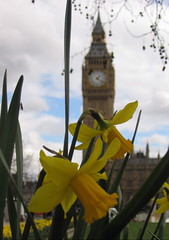 I was doing a little spring cleaning and organization of my iPhoto library today, and I came across several pictures from Britain that I had completely forgotten about, including these gems. If you like them, there's lots more where they came from on my Flickr site. Incidentally, I think it's quite a testament to the English climate that these two pictures were taken on the same day.
02 June 2007
The Godfather of Oregon Paleontology
 Our department had its annual end of the year picnic and awards ceremony yesterday and I was (somewhat unexpectedly) the recipient of the Thomas Condon Fellowship for the work I'll be doing in eastern Oregon the latter half of the summer. The money is nice, of course, but it's also an honor just to have my name associated with Thomas Condon. He's a figure who hasn't ever gotten much press outside of Oregon, but he was an excellent vertebrate paleontologist and a complex individual. He was born in Ireland in 1822, but spent most of his life in the US as a minister and scientist (he purchased an early copy of Darwin's On the Origin of Species and rumor has it that it was the only book other than the Bible that he always carried with him). Condon saw no conflict between faith and science, considering (correctly, in my opinion) that each represented its own distinct sphere. After moving to Oregon in 1852 as a missionary, he began to make a special study of the state's paleontology, eventually becoming the first professor of geology at the University of Oregon and a hugely important figure in this state's scientific history. He collaborated in his research with several of the biggest names in 19th Century paleontology (most notably March and Cope of "Bone Wars" fame). Condon's name is most often associated with the John Day region in central Oregon, where he collected huge numbers of fossils that still form the core of the university's collection. Appropriately enough, the fellowship I just received will go towards funding the preliminary work I'll be doing on my dissertation project in those very same John Day Fossil Beds. Besides just proving that there are very few degrees of separation between any two figures in paleontology, receiving this fellowship is certainly a bit of good news, and as clichéd as it may sound, I do look forward to following in Thomas Condon's footsteps.
25 May 2007
When Worlds Collide
Ever since widespread consensus was reached last decade that a meteorite was at least partially responsible for the extinction of the dinosaurs (among other organisms) at the end of the Cretaceous, it's been en vogue to try to show that meteorite or comet collisions can be linked to all the major mass extinctions. I'm usually very skeptical of such studies, which are often highly speculative and smack more of self-promotion than of good science. That said, it's never worth shooting such hypotheses down without having first heard the evidence used to formulate them. With that in mind, I went to a talk last Friday given by two professors from the anthropology department here at Oregon. It was, in effect, a practice talk in advance of the official presentation of their findings this week at the Geological Society of America's meeting in Acapulco. The research group - which consists of 26 (!) members from representing many different fields - had come across several lines of evidence that seem to suggest that a small meteorite, or more likely a comet, smashed into Michigan 13,000 years ago. These lines of evidence included such things as an iridium spike and nannodiamonds, both of which are generally associated with some type of extraterrestrial impact. I was ready to be a skeptic, but I have to admit, their argument was very compelling. While the impact itself would have been relatively minor, the authors suggest that such an event in an area that was then covered by glaciers would shatter ice dams holding back massive glacial lakes, wreaking havoc on ocean circulation and, by extension, climate.
As anthropologists, the presenters I saw were most interested in how the impact might have affected North American paleoindian society. I was more interested in a topic they touched upon only briefly. For several years, one of the most contentious debates in paleontology has been the argument over whether humans are responsible for the extinction of large "Ice Age" mammals (megafauna). It's been a particularly vitriolic debate, with each side having its share of convincing arguments, bad science, and flat-out name-calling. This comet hypothesis will no doubt light an entirely new fire under a cauldron that's already been boiling for some time. As such, I have no doubt that the findings of this will be debated and subjected to several rigorous geological, anthropological, and paleontological test, and I for one look forward with great interest to seeing how well they hold up under scrutiny.
As anthropologists, the presenters I saw were most interested in how the impact might have affected North American paleoindian society. I was more interested in a topic they touched upon only briefly. For several years, one of the most contentious debates in paleontology has been the argument over whether humans are responsible for the extinction of large "Ice Age" mammals (megafauna). It's been a particularly vitriolic debate, with each side having its share of convincing arguments, bad science, and flat-out name-calling. This comet hypothesis will no doubt light an entirely new fire under a cauldron that's already been boiling for some time. As such, I have no doubt that the findings of this will be debated and subjected to several rigorous geological, anthropological, and paleontological test, and I for one look forward with great interest to seeing how well they hold up under scrutiny.
24 May 2007
My Own Private Deer Park
 Eugene is Oregon's Second City, and it likes to bill itself as the "World's Greatest City of the Arts and Outdoors" (whatever that means). It has an acclaimed symphony orchestra, beautiful parks, a major university, and in general is far more urban and cosmopolitan than a city its size should be. That said, it's still very much part of Oregon, and no matter where you go in this state, nature is never very far away. Case in point: when I came home from the university today, I looked out my kitchen window and saw the scene at left. Deer are hardly anything remarkable, but the seeing wild animals - fairly large ones, at that - in your backyard is always a novelty when you live in a city. Even more memorable was watching the many neighborhood cats try to stalk the deer (without much success, as you might imagine, though one did manage to get close enough to bat at a tail).
22 May 2007
Happy ACD-Day!
 A few weeks back, I posted to commemorate T.H. Huxley's birthday. This week, I want to acknowledge the birthday of another great Victorian, Sir Arthur Conan Doyle. Besides Charles Dickens, no author has ever been so adept at conjuring up images of Industrial Era Britain, from the foggy streets of London in its glory days, to the eerie tors of Dartmoor, to the fading elegance of a ducal mansion. Conan Doyle's gift for evocative description was most frequently put to use to enliven the adventures of his most famous creations, Dr. John H. Watson and Sherlock Holmes (The Sign of Four and The Hound of the Baskervilles, for example, each have settings that are every bit as compelling as the characters themselves). Conan Doyle was also a well-educated man with a keen understanding of science (though he lapsed into mysticism and quackery towards the end of his life - the Sherlock Holmes story The Creeping Man is a particularly embarrassing product of this stage). He wrote The Lost World, the first and still the best dinosaur novel out there; it's significantly more exciting, engaging, and creepy than any of Michael Crichton's efforts. Its plot is simple: a group of explorers find an isolated plateau in South America that preserves a primeval world of dinosaurs and ape-men. Tenuous as this segue may seem, Conan Doyle's writing has always appealed to me because it itself paints a picture of the lost world: the Victorian Era, a world which was unexplored enough and still rife enough with possibility to engender The Lost World but which was also coming to terms with its increasingly prevalent dark side so familiar to the world's greatest detective. I may never really understand why I have such a fascination with Industrial Britain, but I know that Conan Doyle's vivid depiction of it is largely responsible. And for that, I am eternally grateful.
20 May 2007
How to Make a Good Nature Documentary
Today, the Discovery Channel has been airing the BBC series Planet Earth. I had heard about the series before, but I'd been skeptical: it couldn't really be as good as everyone claimed it was, could it? Turns out that yes, it is. Here's why:
- As the narrator is never tired of reminding you, the cinematography in the series is nothing short of stunning. There are gorgeous landscape shots (like a top-down view of Angel Falls and a flyby of a fog-shrouded coastal forest right here in the Northwest), close-ups catching animal behavior "in the act" (like macaques diving for food in Indonesia or the mating display of a bird of paradise), or - best of all - combinations of the two (the most spectacular example being a snow leopard hunt on a sheer cliff face in the Himalayas). The producers also do a great job of using slow-motion footage (of a great white shark leaping to catch a seal, for example) and stop-motion (to show a sunflower sea star chasing brittle stars across the California seafloor).
- Many nature documentaries focus on one individual or group. While this might make for a good story-line, it also opens the door for anthropomorphism and presents logistical problems (one documentary on baboons is notorious for having used five or six other individuals stand-ins for the "main character," of which they just didn't have enough footage). Planet Earth takes a much more holistic approach, with each episode focusing on an entire biome. While much of the documentary is still devoted to animals, other organisms get plenty if air time as well, as does the physical environment itself.
- The producers aren't afraid to show "nature, red in tooth an claw." It's always annoyed me that most documentaries will show only the appealing bits of the natural world, cutting away from footage hunts just before the kill, for example. Planet Earth, on the other hand, doesn't skimp on the carnage, whether it's a chimp cannibalizing an infant from another troop or a parasitic fungus erupting out of the head of an ant (in stop-motion, no less). It may be gruesome to some people's eyes, but a documentary that shows only those aspects of the natural world that they think viewers will want to see are, at best, telling only half the story.
- Many nature documentaries also like to drive home their conservation message with a sledgehammer. I'm as pro-conservation as the next guy, but finger-pointing and guilt-mongering are annoying at best, and more commonly are entirely counterproductive. Planet Earth most certainly has the same goal, but it is much more nuanced and subtle about it. One of the producers stated that the aim of the program was to show people that there are still places out there worth saving, and there can be no doubt that Planet Earth does so masterfully. It would take a truly hard-hearted person to watch this and not be moved on some level, and to paraphrase the old adage, there is no better way to inspire conservation efforts than to first inspire appreciation.


04 May 2007
Happy Darwin's Bulldog Day!
 Today is the 182nd birthday Thomas Henry Huxley, the man known as "Darwin's Bulldog" and one of my personal heroes. I've been taken to task a few times for my hero-worship, because it's certainly true that not everyone out there is a big T.H. Huxley fan. He was very much a product of his time and his culture (Victorian England), and almost any historical figure starts showing flaws when viewed from a modern perspective. So yes, he did have a running feud with the Salvation Army because he didn't like the idea of handouts to people who didn't work for them, but I would argue that any such non-PC idiosyncrasies are more than counterbalanced by the good he did. There are two things for which I particularly admire Huxley. First, every one of us out there who considers ourself to be a scientist owes the man an enormous debt of gratitude, because in many ways he was the first professional scientist. Pre-Victorian scientists were largely independently wealthy aristocrats and clergymen that indulged in "natural philosophy" as a hobby, while Huxley was a "common" Londoner who relied on science as a career. More importantly, he was famous as a teacher, educating a generation of students in the newly-emerging fields of biology and geology (and in the intersection of those two fields, paleontology). The second thing I admire about Huxley is his eloquence. There have been many great scientists, but many of them have been terrible at communicating their research to the rest of the world. To be able to explain one's ideas in a way that both instructs and engages is a very rare gift, and it was a skill that Huxley had in spades. He was able to take a commonplace object, such as a crayfish or a piece of chalk, and use use these as means of introducing much larger-scale topics; he was so good at this that his lectures were regularly packed to the gills not just by fellow scientists, but by the general public as well. I have read the transcripts of some of his lectures, as well as some of his essays, and even now, almost two centuries after the fact, they remain works of stunning rhetorical beauty. Of course, his golden tongue is best remembered for its defense of Darwin's then-new theory of evolution by natural selection. Huxley was far and away the most successful promoter, defender, and teacher of evolution of his time, and it is doubtful that natural selection would not have become recognized as the fundamental theory of biology as quickly as it did if not for his efforts. So, Happy Birthday, T.H. Huxley; here's hoping that there are a few more out there like you...
27 April 2007
John Orcutt, Oregonian
 After seven months of living in Eugene, it's finally official: I'm a certified Oregonian now. Yesterday, I finally had the requisite documents and the necessary funds to license my car here and, more importantly, to get an Oregon driver's license (for those of you out there who don't happen to live stateside, driver's licenses effectively double as national IDs here; the fact that it's a license rather than a voter registration card that identifies you in the US probably tells you a lot about American priorities). Up until now, I'd always officially remained a Washington citizen, a residency that I proudly - if impractically - maintained even when I was living eight out of twelve months of the year in Illinois. While the thought of officially being from a place as cold and flat as Chicago gives me the chills, I was raised by an Oregonian to believe that this is the best state out there, and as such had no qualms about settling in here. So far, life as a resident of Oregon has been uneventful but good, all in all. If nothing else, I get one very tangible benefit: not only is there no sales tax in the state, but I'm not taxed for anything I buy online either. It may not be quite as cushy a deal as Alaskans - who get paid just for living in the state - have, but as a starving student, I certainly am not going to complain.
15 April 2007
Paleo futures are up!
Maybe this makes me crazy (or, more likely, marks me as a Chicago alumnus), but I sometimes find myself thinking of my paleontological career as a Wall Street-style stock and wondering how the market for that would look. The years between Chicago and Bristol would have been a good time for a canny investor to buy low, and there were a couple of times when PhD rejections nearly drove me to bankruptcy. While I'm still not claiming that my stock is the most valuable out there (I'm no Microsoft), I do think it's fair to say that's it's steadily risen in value this last year and a half or so. While you never know how long these things are going to last, I am happy to report that my paleo futures market took a noticeable jump this last week. First, I've finally narrowed down the topic for my dissertation project to a reasonable scale: I'm going to be correlating ecological changes in the John Day Fossil Beds with the that site's extremely well-documented paleoenvironmental data. There are all sorts of advantages to this project (not the least of which is that it's the one I really wanted to do). I'll be heading out that way early next month to nail down the specifics with the park's resident paleontologist. Not only am I happy with this turn of events, but the department here has just announced the hiring of two new paleontologists rather than the one we were expecting (I'd say who, but the hiring is still unofficial and I don't want to break any departmental taboos). This is outstanding news for all of us in the program, but I am doubly lucky because both study Cenozoic paleoecology, which I now know is exactly what I'll be doing as well.
Perhaps the biggest news of all, though, is that I was just accepted to attend an Analytical Paleobiology class this summer in Santa Barbara. As far as I'm aware, it's the only class of its kind in the world, and given that they only take 12 people, I feel extremely lucky and privileged to have gotten in. I'm excited about the class, of course, but I'll confess I'm also looking forward to living (albeit briefly) in a warm climate for the first time in my life. Now, if only I could get all this imaginary stock to translate into real money...
Perhaps the biggest news of all, though, is that I was just accepted to attend an Analytical Paleobiology class this summer in Santa Barbara. As far as I'm aware, it's the only class of its kind in the world, and given that they only take 12 people, I feel extremely lucky and privileged to have gotten in. I'm excited about the class, of course, but I'll confess I'm also looking forward to living (albeit briefly) in a warm climate for the first time in my life. Now, if only I could get all this imaginary stock to translate into real money...
09 April 2007
Drawing Out Leviathan With a Hook
 I spent last weekend celebrating Easter the traditional way: by fighting and then killing and eating a giant fish. Really. On Saturday, my dad and I went fishing on the Olympic Peninsula (fishermen are a secretive bunch, so I won't give away which river) and I caught a Steelhead that I'm told was of the world-class, once-in-a-lifetime variety. This is hilarious, since I hadn't been fishing in years and anyone who saw me reel this one in could tell you that it shows. It's also funny because it was one of only two fish we caught that day, the other one being all of six inches long. Not that I would ever brag, but my fish was significantly bigger, weighing in at a hefty 17 pounds, which I'm sure we can all agree is awfully large for a trout. I was so excited about this that for pretty much the first time ever, I willingly ate fish that evening, which will no doubt come as a shock to anyone who knows my finicky eating habits. I have to admit, it was pretty tasty...
02 April 2007
Play Ball!
Do you know why today was a great day? Because it's one of the happiest days of the year on my calendar. See if you can guess which one (this is a real toughie...):
- Christmas Eve
- Baseball Opening Day
- Christmas Day
30 March 2007
How Science Works: Hypotheses, Theories, and Laws
As you all may or may not recall, I argued last week that observation alone does not constitute science, and that discerning patterns in the natural world is essential to both formulating and testing a hypothesis. It's a point that I would hope be obvious to anyone with any kind of education in science, but I was shocked to learn how vehemently some of the students in my ecology class disagreed with it. Today I want to touch on another controversy that arose from that class: the difference (if any) between theories and laws.
First, I ought to define my terms. When I use the word 'theory,' I am using it in the true sense of the word; that is to say, I am not using it synonymously with 'hypothesis.' A hypothesis is effectively a guess (ideally an educated guess, as per Part One of this post) that has yet to be proved. A theory is a scientific fact; in a sense, it is a hypothesis that has been tested enough times and with sufficient rigor to have been proved beyond a reasonable doubt. Again, I would hope that this would be common knowledge, but the two words have become increasingly conflated (thanks in part to the active efforts of the Discovery Institute and other supporters of "intelligent" design) to the point where most scientists I know use the phrases "in theory" and "hypothetically" interchangeably. However, this point has been made several times by people far more eloquent than me, so I won't belabor it any further here.
The real purpose of this post is to address what I consider to be a particularly irritating conceit of the physical sciences. It often seems to be assumed that the fundamental theories of physics and chemistry are somehow more valid than those of natural sciences, such as evolution or plate tectonics, and as such are often considered to be laws rather than "just" theories. However, this gulf between "hard" and "soft" sciences is merely one of degree, and does not reflect any fundamental differences. I won't for a moment deny that physical theories have much more predictive power than biological or geological ones, but this is in part because biologists and geologists deal with staggeringly complex systems, whereas physicists and chemists often consider the processes they study to be occurring in a vacuum. Of course, this is not generally the case, and as such even predictions made based on physical "laws" are often inaccurate (Think, for example, about when you took classes in chemistry: were you ever able to exactly predict the relative proportions of the products of a reaction?). My point here is more philosophical and semantic than scientific: the word 'law' implies an immutability that does not exist in science. If you were able to say beyond a shadow of a doubt that a formula could predict the outcome of a process 100% of the time, then it would be perfectly appropriate to consider that formula a law. However, how can you prove such unerringly accuracy? Even if every experiment you perform confirms the precise predictive power of your formula (which in itself would be unlikely), to assert that this predictive power was universal would, by definition, require a knowledge of the entire universe. What's more, it would require knowledge of the universe not just as it is now, but as it has been and will be. Clearly, no human has ever possessed such knowledge. As such, claiming that any scientific "law" is universally applicable is a leap of faith, and blind faith is the antithesis of science. Rather, a "law" is nothing more than a theory: a hypothesis proved beyond a reasonable doubt, but that cannot be applied universally within the framework of science. This fundamental indecisiveness may seem to cheapen science, but it in fact reflects its greatest strength: accepting nothing as dogma and always leaving room for skepticism.
Once again, I've probably well overstepped the bounds of my own knowledge in writing this post; after all, I'm only a simple paleontologist. As with my last post of this nature, I'd be very curious to know what you all think; I realize I might just be ranting here, and I'd be really curious to know where other people stand.
First, I ought to define my terms. When I use the word 'theory,' I am using it in the true sense of the word; that is to say, I am not using it synonymously with 'hypothesis.' A hypothesis is effectively a guess (ideally an educated guess, as per Part One of this post) that has yet to be proved. A theory is a scientific fact; in a sense, it is a hypothesis that has been tested enough times and with sufficient rigor to have been proved beyond a reasonable doubt. Again, I would hope that this would be common knowledge, but the two words have become increasingly conflated (thanks in part to the active efforts of the Discovery Institute and other supporters of "intelligent" design) to the point where most scientists I know use the phrases "in theory" and "hypothetically" interchangeably. However, this point has been made several times by people far more eloquent than me, so I won't belabor it any further here.
The real purpose of this post is to address what I consider to be a particularly irritating conceit of the physical sciences. It often seems to be assumed that the fundamental theories of physics and chemistry are somehow more valid than those of natural sciences, such as evolution or plate tectonics, and as such are often considered to be laws rather than "just" theories. However, this gulf between "hard" and "soft" sciences is merely one of degree, and does not reflect any fundamental differences. I won't for a moment deny that physical theories have much more predictive power than biological or geological ones, but this is in part because biologists and geologists deal with staggeringly complex systems, whereas physicists and chemists often consider the processes they study to be occurring in a vacuum. Of course, this is not generally the case, and as such even predictions made based on physical "laws" are often inaccurate (Think, for example, about when you took classes in chemistry: were you ever able to exactly predict the relative proportions of the products of a reaction?). My point here is more philosophical and semantic than scientific: the word 'law' implies an immutability that does not exist in science. If you were able to say beyond a shadow of a doubt that a formula could predict the outcome of a process 100% of the time, then it would be perfectly appropriate to consider that formula a law. However, how can you prove such unerringly accuracy? Even if every experiment you perform confirms the precise predictive power of your formula (which in itself would be unlikely), to assert that this predictive power was universal would, by definition, require a knowledge of the entire universe. What's more, it would require knowledge of the universe not just as it is now, but as it has been and will be. Clearly, no human has ever possessed such knowledge. As such, claiming that any scientific "law" is universally applicable is a leap of faith, and blind faith is the antithesis of science. Rather, a "law" is nothing more than a theory: a hypothesis proved beyond a reasonable doubt, but that cannot be applied universally within the framework of science. This fundamental indecisiveness may seem to cheapen science, but it in fact reflects its greatest strength: accepting nothing as dogma and always leaving room for skepticism.
Once again, I've probably well overstepped the bounds of my own knowledge in writing this post; after all, I'm only a simple paleontologist. As with my last post of this nature, I'd be very curious to know what you all think; I realize I might just be ranting here, and I'd be really curious to know where other people stand.
28 March 2007
South by Southwest
As any of you out there that know me can attest, I am pretty well convinced that the Pacific Northwest is the best part of the world (those of you that don't know me all that well could probably figure that out from the title of this blog). The last few days, I've been on a brief road trip that's given me cause to say that many of the best parts of the best part of the world are in Southern Oregon. Here's what we saw that led me to that conclusion:
 Ashland - Besides being a lovely town in a gorgeous setting, Ashland has always been one of my favorite places because it's where I saw my first Shakespeare play, performed by one of the world's preeminent presenters of The Bard's works, the Oregon Shakespeare Festival. That was years ago, but I've returned several times since to see many excellent plays; this time, though, we saw one that tops them all. It was a production of As You Like It set in 1930s America. I was skeptical at first, but I was convinced before the first scene had ended: setting the the play in the Depression both complemented its fast-pace humor and underscored its more serious moments (particularly the "All the world's a stage" soliloquy). If you find yourself anywhere near Ashland this year, by all means go out of your way to catch this one. I can't sing its praises highly enough.
 Wineries - Not only does Oregon produce excellent Shakespeare, it produces excellent wine as well (Why even bother traveling to Europe?). We stopped at several wineries on the road between Ashland and the coast, and we tasted wine ranging from good to outstanding (and that's not just me being positive; we really didn't taste anything that was bad). The biggest surprise of all was a dry Riesling we found in a winery just outside of Eugene, something that I didn't know existed outside of Germany.
 Redwoods - Technically speaking, Redwood National Park isn't in Oregon, but we did pass through the northern corner of it en route to the coast. I mention it here because it's one of those places that everyone should see once in their lives. I'm willing to go out on a limb to say there's nothing quite like it anywhere: it's the Forest to End All Forests. There's something otherworldly about the groves of staggeringly enormous trees shrouded in fog and blanketed in a thick green carpet of ferns. I'm not the only one who thinks so: the redwoods served as a backdrop for both Endor in Star Wars and the Jurassic in Walking With Dinosaurs, and if both George Lucas and the BBC give the forest their seal of approval, then it must be a great place...
 The Coast - I've sung the praises of the Oregon Coast so many times on this blog that there really is no sense in me belaboring the point here. Suffice it to say that the southern coast is, if you can imagine, even better than its northern counterpart, and is certainly far less built-up. It also turns out you can get a great bowl of clam chowder at no less than three restaurants in Florence (we went with Mo's, which also has the best view in town).


23 March 2007
How Science Works: Patterns & Predictions
Good news, everyone! Now that my ridiculous Finals Week is over, I can start posting random ramblings again! I know that's what you're all here for, after all. At any rate, as I mentioned a couple of posts ago, I recently took part in an impromptu debate on the philosophy of science. It was in my Community Ecology class, and began as a discussion of whether or not ecology had any general laws (more on that in the second installment of this post). I'm not usually a big participant in class discussions, but one of the other students said something that I just couldn't let go unchallenged. He said something to the effect of "Who cares about general laws, anyway? I mean, it's science, who cares if you're finding patterns or not?" Effectively, his argument was that science is all about exploring the unknown, and that simply going out and describing things (in this case, ecological structures) was sufficient. With all due respect to this student, I would consider this view to be not just mistaken, but dangerously so. Science is, at its core, all about finding patterns. Reduced to it's barest essentials, science is a two-step process: first you make a prediction, then you see if it holds true in the real world or laboratory (that's the Scientific Method, after all: formulating and testing hypotheses). Observation of patterns is essential to both these components. First, how can any prediction be made without some pattern to base it on? To cite an example near and dear to my own heart, a cladogram is a hypothesis of how organisms are related. While it is based on observational data, it is the patterns formed by these data that are of real importance: they allow an evolutionary biologist (by way of PAUP) to predict which organisms are most similar ("Species A and B share features 1 and 2, while Species C does not; therefore, A and B are more closely related."). Second, once your prediction is made, it is tested by observing whether the patterns it predicts are in fact manifested. In keeping with the example cited above, a cladogram might be tested in several ways, most often bootstrapping or jackknifing, which reshape or prune the tree to see of the patterns predicted by the original cladogram still hold. Of course, the student in my class was right that description and data collection are essential to both processes, but they alone are not sufficient. Finding patterns in these data and to use those patterns to construct or test a hypothesis is also necessary.
I probably ruffled a few feathers by saying the student who made the claim that patterns were unnecessary for science was "dangerously" wrong. I'll explain what I mean now, and maybe that will also explain why I take this sort of thing so seriously (it's not just that I'm old before my time and hate people disagreeing with me). I may sound like a conspiracy theorist now, but to me it comes down to that menace that's constantly looming in the shadows, "intelligent" design. The powers that be at the Discovery Institute and throughout the ID world are very, very good at making people think that what they do is science (it's clearly not, but I'll save my lengthy explanations of why for another time). A key component of their campaign is confusing people about what actually constitutes science. At the risk of sounding jaded, I'm never too surprised when they're able to pull wool over the eyes of much of the American public, but
to hear a student at a major university - supposedly one of our educated elite - profess such a profound misunderstanding of the scientific method is extremely worrying. Of course, this has more to do with the generally abysmal state of education in this country than with the agenda of the Discovery Institute per se, but it was still enough to shake me to the point where this has been on my mind literally every day for the last week and a half.
Having said all this and knowing that my audience is, of course, a highly scientifically literate bunch, I'm curious to know what you all think. I realize it's possible that my opinions on the nature of science are divergent from those that you have, and I'd be curious to know if you're with me 100%, agree with some things, or think I'm just a nut job with too much free time on my hands. After all, skepticism, even regarding your own thoughts, is another important facet of science.
I probably ruffled a few feathers by saying the student who made the claim that patterns were unnecessary for science was "dangerously" wrong. I'll explain what I mean now, and maybe that will also explain why I take this sort of thing so seriously (it's not just that I'm old before my time and hate people disagreeing with me). I may sound like a conspiracy theorist now, but to me it comes down to that menace that's constantly looming in the shadows, "intelligent" design. The powers that be at the Discovery Institute and throughout the ID world are very, very good at making people think that what they do is science (it's clearly not, but I'll save my lengthy explanations of why for another time). A key component of their campaign is confusing people about what actually constitutes science. At the risk of sounding jaded, I'm never too surprised when they're able to pull wool over the eyes of much of the American public, but
to hear a student at a major university - supposedly one of our educated elite - profess such a profound misunderstanding of the scientific method is extremely worrying. Of course, this has more to do with the generally abysmal state of education in this country than with the agenda of the Discovery Institute per se, but it was still enough to shake me to the point where this has been on my mind literally every day for the last week and a half.
Having said all this and knowing that my audience is, of course, a highly scientifically literate bunch, I'm curious to know what you all think. I realize it's possible that my opinions on the nature of science are divergent from those that you have, and I'd be curious to know if you're with me 100%, agree with some things, or think I'm just a nut job with too much free time on my hands. After all, skepticism, even regarding your own thoughts, is another important facet of science.
17 March 2007
Happy St. Patrick's Day!
Given my curmudgeonly nature, I'm sure you're all expecting some rant about how turning St. Patrick's Day into purely a drinking holiday is a trivialization of Irish culture. It's true that I do have opinions along those lines; reducing the nation that brought us James Joyce, Oscar Wilde, and Jonathan Swift to an excuse to wear green and drink Guiness could be construed as offensive. On the other hand, I know that any one of the people I just mentioned would much prefer having a pint or two (or several...) to getting wrapped up in self-pity and victimhood. No, the reason I felt the need to post today was because I wanted to share one of my favorite Irish toasts:
May those who love us, love us.
And for those who don't love us,
May God turn their hearts.
And if he cannot turn their hearts,
May he turn their ankles,
So we may know them by their limping.
At the end of the day, I really can't claim to know more about Ireland than any other Irish-American (which is to say about 90% of the country), but I do know that I've always liked that toast, hokey as it may be. I could drone on about how things like that remind me not to take myself too seriously, but doing so would be taking myself too seriously, so in the spirit of the day I'll avoid that catch-22. Happy St. Patrick's Day!
16 March 2007
What a Week it's Been
It's the last week of the quarter, which always makes for a busy time. On top of that, the whole city of Eugene has had a buzz about it this week, because Oregon just won the Pac-10 and is poised to go deep into the NCAA tourney. Even for someone such as yours truly who doesn't really care for basketball it's an exciting time to be a Duck. Combine that with the idyllic weather we've been having, and it's been a week that's been anything but conducive to working. Of course, I've not had any time for idling. Here's a few of the things that have been keeping me busy:
-Continuing my jihad against the ants. The talcum powder trick worked to break up the trail that kept forming across my kitchen, but to actually reduce numbers I've had to resort to chemical weapons in the form of ant traps full of arsenic. They're pretty insidious devices that fool the ants into bringing back the poison to feed the rest of the colony. They seem to be working spectacularly well, and I feel almost bad for the poor things, but I'm not about to cut and run.
-Getting things in order for the summer. In the past week I've applied for a summer grant from the university (though I'm not holding out much hope for it) and for a class in analytical paleobiology down in Santa Barbara this summer. I should hear about both sometime next month.
-Vetting candidates for the department's next professor of paleontology. I seem to have timed my arrival here well, since in the next few months we'll have hired a new paleontologist (probably of the vertebrate variety). Given that we're still in the interview process, it's probably best that I don't elaborate on things too much, but the powers that be in the department actually seem to be interested in my opinions on the candidates, which is nice.
-Having an argument on the philosophy of science with some of the students in my Community Ecology class. More on this later, since I think this particular topic deserves a little more detail than I'm willing to go into now.
-Setting up my brand new replacement cell phone. It's got a camera in it and everything (not that I care that much about whether my phone has a camera or not, but I enjoy the novelty of it all). Give me a call so you can see how nice and clear the reception is!
-Reading up on the future of paleontology. Apparently it's robots.
-Finishing up class work. Nothing particularly exciting about this, but it's what I've devoted the bulk of this previous week to, so this list really wouldn't be complete without it. Next week being Finals Week, it's not going to be getting any less hectic, either...
-Continuing my jihad against the ants. The talcum powder trick worked to break up the trail that kept forming across my kitchen, but to actually reduce numbers I've had to resort to chemical weapons in the form of ant traps full of arsenic. They're pretty insidious devices that fool the ants into bringing back the poison to feed the rest of the colony. They seem to be working spectacularly well, and I feel almost bad for the poor things, but I'm not about to cut and run.
-Getting things in order for the summer. In the past week I've applied for a summer grant from the university (though I'm not holding out much hope for it) and for a class in analytical paleobiology down in Santa Barbara this summer. I should hear about both sometime next month.
-Vetting candidates for the department's next professor of paleontology. I seem to have timed my arrival here well, since in the next few months we'll have hired a new paleontologist (probably of the vertebrate variety). Given that we're still in the interview process, it's probably best that I don't elaborate on things too much, but the powers that be in the department actually seem to be interested in my opinions on the candidates, which is nice.
-Having an argument on the philosophy of science with some of the students in my Community Ecology class. More on this later, since I think this particular topic deserves a little more detail than I'm willing to go into now.
-Setting up my brand new replacement cell phone. It's got a camera in it and everything (not that I care that much about whether my phone has a camera or not, but I enjoy the novelty of it all). Give me a call so you can see how nice and clear the reception is!
-Reading up on the future of paleontology. Apparently it's robots.
-Finishing up class work. Nothing particularly exciting about this, but it's what I've devoted the bulk of this previous week to, so this list really wouldn't be complete without it. Next week being Finals Week, it's not going to be getting any less hectic, either...
06 March 2007
Ants Aren't Gentlemen
Spring has sprung! The weather has been warm, flowers have been blooming, trees have been leafing, and baseball is back on the radio. All in all, it's a great time of year to be alive. Unfortunately, I'm not the only one who thinks so. The local any colony has responded to the change of season as animals always do: by reproducing like crazy and stuffing themselves full of food. Of course, my 1940s-vintage house is chock-a-block full of holes that make perfect entrances for ants, so I probably shouldn't have been surprised when I wandered into my kitchen the other day to find a long line of the little buggers stretching from the exterior wall to my pantry. As you all know, I love animals, even some that many people would find unsavory (case in point, I would never willingly kill a spider). Here's my dirty little secret, though: I really don't like ants. There are some pretty large ants in the world, some of which can deliver a correspondingly nasty bite, but even harmless little ones like those that have invaded my house give me the creeps. Maybe it's the whole hive mentality thing that bugs me (though bees don't bother me to speak of), maybe it's because they're so damn tenacious (you just can't keep them away from food once they've found it), or maybe it's just that they're very nearly impossible to get rid of. The good news is that they do have their weaknesses, some of which really make no sense at all. It turns out, for instance, that they won't cross a line of talcum powder (no idea why this should be, but it does seem to work), but of course it's only a matter of time before the persistent little gluttons find a new route to the pantry. So, if any of you out there have had this problem before, any advice on getting ants out of one's house would be greatly appreciated.
On an unrelated subject, I've posted my photos from my trip to England on my Picasa page if anyone's interested in seeing them.
On an unrelated subject, I've posted my photos from my trip to England on my Picasa page if anyone's interested in seeing them.
27 February 2007
25 February 2007
Britain, Britain, Britain
 Last night I returned home from my farewell (for the moment) tour of England. As you already know from the last post, I spent the first few days in Bristol. We spent the second half of the week in Aldworth, a tiny village (small enough to fit the entire population into one photograph) in rural Berkshire. It served as a base from which to check off two of the major items on my "Things to See in England" list. The first was Avebury, which we visited on the way out of Bristol. Avebury is the stone circle to end all stone circles, and is leaps and bounds beyond Stonehenge because of its size (most of a village fits comfortably inside it), because of its extensive earthworks, and because of the relative lack of tourists. The other big item I can now cross off my list is Oxford, where we spent Thursday. My general impression was that it ranked slightly behind Cambridge on the charm scale but had excellent museums that make you feel as though you've been transported back a century or so. Both places are well worth the trip if you ever get the chance. We managed to see more than Avebury and Cambridge, of course: we also went to Castle Combe (often considered to be the ideal English village), the Uffington white horse (possibly the oldest chalk figure in England, and right next to the hill where St. George is supposed to have killed the dragon), Blenheim Palace (one of the most spectacularly ornate palaces I've seen in Europe and the site of Churchill's birth to boot), antique stores aplenty (if you sense my dad's hand in that one, you're right), top-notch gastro-pubs in Chinnor and Goring, and a "normal" pub in Aldworth that might well be the best in which I've ever had a drink. It was a hectic week, but a good one, and it certainly reminded me just how much I'll miss England. With that in mind, remember when I closed out my old blog with a series of "Top 7" lists about my favorite things in Britain? I promised I'd make one more, and whether you want me to or not, I'm now going to keep that promise with my list of the top 7 things I'll miss about England (and yes, I do mean England; sorry Wales and Scotland, I just didn't spend enough time in either place to get too sentimental).
 7) Transportation
This may sound odd, but one of the great joys of my time in Bristol was that I could leave it so easily. This is not because I dislike Bristol (see below) but because I love to travel, be it by train to London or Cambridge or by plane to Madrid or Hamburg.
6) Place Names
Seriously, how can you not love a country that comes up with names like Chipping Sodbury or Wootton Bassett?
5) Pubs
No, they're not just bars, at least not in principle. You don't just go to a pub to drink (though I won't deny that plenty of that takes place, sometimes to excess), you go to sit down and have nice, long conversations with your friends over some beers.
4) Bristol
I'd just as soon not go back to many English cities (I'm talking about you, Gloucester), but Bristol never got old. It's got it all: an historic harbor, beautiful parks, a medieval core (albeit a very small one), a magnificent Georgian neighborhood, and enough pubs and restaurants to keep going out from getting stale.
3) The Landscape
Being quite a Pacific Northwest chauvinist, it's rare for me to rave about any countryside other than my own, but I've found myself oddly nostalgic for England's rolling hills and grassy pastures. The most striking things about it is its perpetual green-ness, a color that is striking even in the middle of winter and is almost overwhelming in spring.
2) Old Buildings
Even in Bristol, which was gutted during the war, it's not uncommon to run across a centuries-old building. Head ten minutes away by train to Bath and you'll see one of the most gorgeous collections of 18th Century buildings in the world. Coming from a country where a 19th Century building is considered ancient, that's nothing short of remarkable.
1) The English
Mind you, I won't miss everything about the English. Like any group of people, they have their faults. However, there are a great many qualities of the English personality that can be chalked up in the plus column. They can carry on a conversation masterfully, but they don't waste words. They will be unwaveringly polite to you, even if they hate you. Most of all, they have the best sense of humor in the world. This is an underappreciated side of English culture, I feel, but it is also true. I know several people who would disagree but, well, they're wrong. Sarcasm is funny. Deal with it.
20 February 2007
The Avon Stream, Redux
 This very possibly marks the last opportunity I will have to post a blog entry from Bristol, and I figured I had to take advantage of that opportunity for old time's sake. I'm back in Britain to celebrate an era that came to an end yesterday at a pompous (but exceedingly well-organized) graduation ceremony at which, to the strains of thunderous organ music, my classmates and I were officially awarded our master's degrees. Actually, you might more accurately say that the era came to an end after our subsequent gathering at the pub, which I imagine is the last time such a high percentage of the 2005-2006 MSc cohort will be in the same place at the same time. It is, of course, great to be back in Bristol (which, oddly enough, it feels like I never left), gratifying to receive the degree, and wonderful to see my classmates again. Still, this sort of thing is always bittersweet, since it finally hit home just how much I will miss this city, this country, and the people with whom I worked. Those of you who have been reading my blogs since Day One will remember that my first reaction to my classmates was that they appeared to me to be "one of the most outstanding groups of people I’ve had the pleasure of being associated with" and that I "will really like it here" in Bristol. A year and a half after making those predictions, my mind has not changed in the least. Have there been low points? Of course. Still, there is not the slightest doubt in my mind that I am a better person for having spent time at the University of Bristol, and I will be forever grateful to the university, the city, and above all else the people who I have had the pleasure of working with. Thanks, all. Now, off to Oxfordshire!
13 February 2007
Canoe Conundrum
On Sunday, I drove out to Veneta to go to a canoe steaming ceremony. It was a dugout canoe that my uncle had been building for the Kalapuya tribe, and it turns out that in order for the boat to bow out into the right shape, it needs to be exposed to very hot water for several hours. This is done by filling the hull of the boat with water and periodically adding rocks that have been heated in a fire. It's a very tense time, since there's always a chance that the canoe will not expand correctly or, even worse, split, so needless to say the ceremonies surrounding it have traditionally been very important. The affair this weekend was much more toned-down, but it was still really interesting. I had a great time, but I'll admit I always feel a bit voyeuristic at such things. After all, my family history consists of white, white, and more white, and it's no secret that those of Northern European descent have had, at best, a rocky history with the Indians. Don't get me wrong, I have great - and genuine - respect for the Kalapuya and for pretty much all the tribes along the Northwest Coast, both because of their boat-oriented society (seriously, I have great admiration for any seafaring people, from Northwestern Indians to the Vikings to - I'll admit it - imperial Britain) and because their art, culture, and language are the foundation upon which modern Northwestern culture is built (I'm perfectly willing to support this claim of mine, just not now, since this post is long enough already). I've been to a smattering of ceremonies and events like this canoe steaming and for the first summer out of college I practically lived on the Makah reservation, and I've never once sensed any resentment or any objection to my being there. In fact, I've experienced exactly the opposite. Still, I can never shake the thought that maybe I shouldn't be so welcome. After all, just imagine how my Swedish forebears would have reacted if a group of Kalapuya had started showing up at their church services not because they shared the parishioners' faith but because (for some strange reason) they found Lutheran pageantry interesting. I'd like to be able to tie this all up with a nice, clear concluding statement, but frankly I can't. As a matter of fact, I've wound up with far more questions about the relationship between white Americans and Indians than I began with. I suppose you could argue that provoking thought is the highest goal of any human endeavor, so by that measure, this may be my first meaningful post ever! Hooray!
02 February 2007
Happy Groundhog Day!
February has its share of worthless holidays (I'll spare you all my Valentine's Day rant for now), but I'll admit I've always had a soft spot for Groundhog Day, largely because it celebrates something totally meaningless and makes not one shred of sense. Of course there are the obvious questions of what a burrow-dwelling rodent has to do with weather prediction and why we arbitrarily rely on a groundhog from Pennsylvania, of all places, to forecast the turning of the seasons. I've also always thought that we've been reading the whole thing backwards all these years: if the groundhog sees its shadow, it must be sunny out, which seems to me to be more indicative of the onset of warmer weather than a grey sky would be. I'm probably overthinking this, but the good news is that Punxsutawney Phil didn't see his shadow this morning, so Spring should be right around the corner! Of course, any Oregonian groundhogs would disagree: our freakishly sunny stretch continued today, and any animal emerging from its burrow this morning would have been face-to-face with a particularly bold shadow. Fortunately, there are no groundhogs in Oregon (the closest we've got is another member of the genus Marmota, the Yellow-bellied Marmot), so that means Spring starts tomorrow, right?
Subscribe to:
Posts (Atom)